Rychkov G Y, Pusch M, Roberts M L, Jentsch T J, Bretag A H
Centre for Advanced Biomedical Studies, University of South Australia, Adelaide, SA 5000, Australia.
J Gen Physiol. 1998 May;111(5):653-65. doi: 10.1085/jgp.111.5.653.
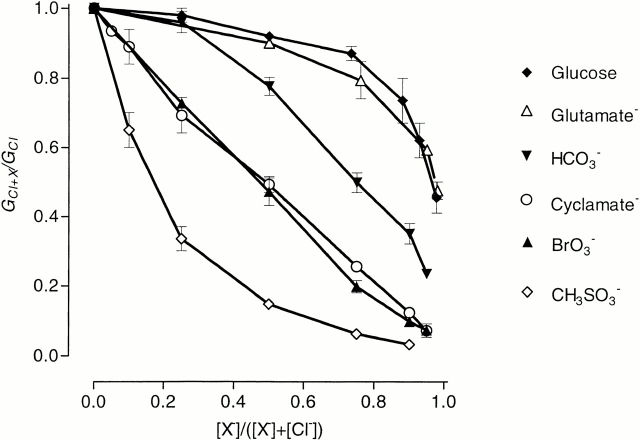
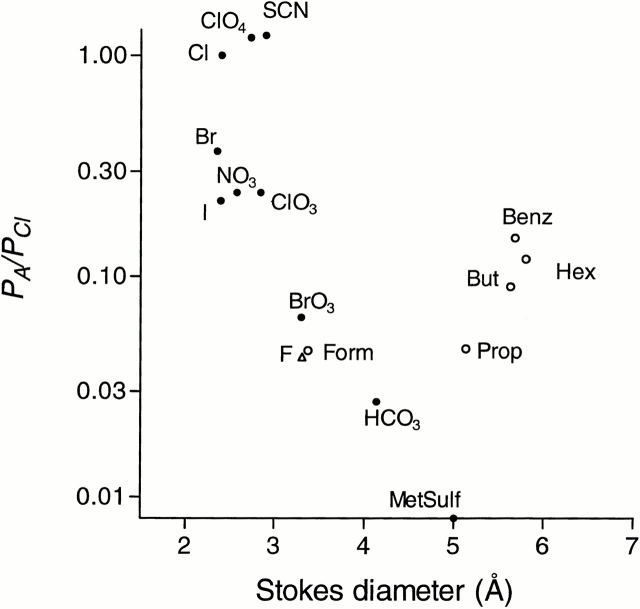
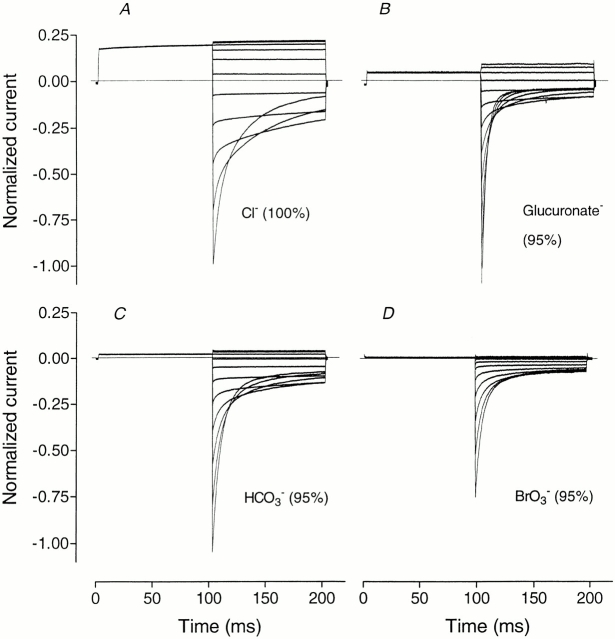
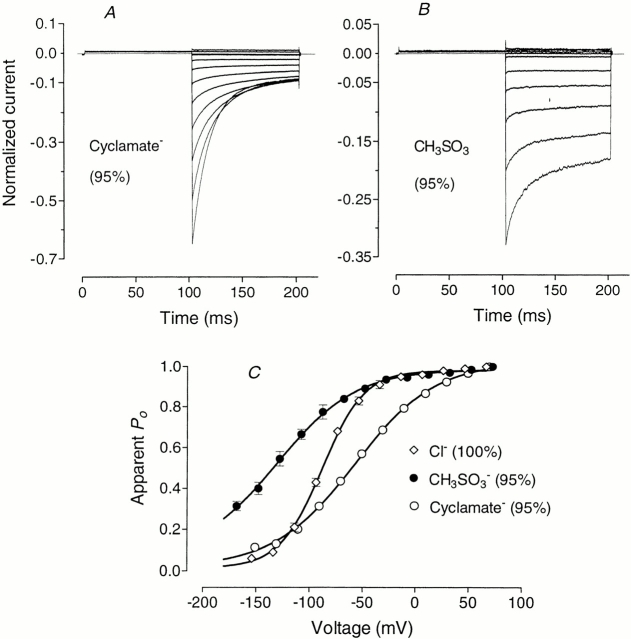
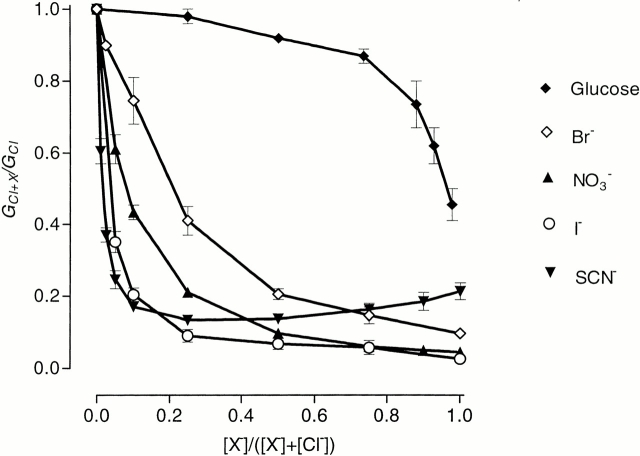
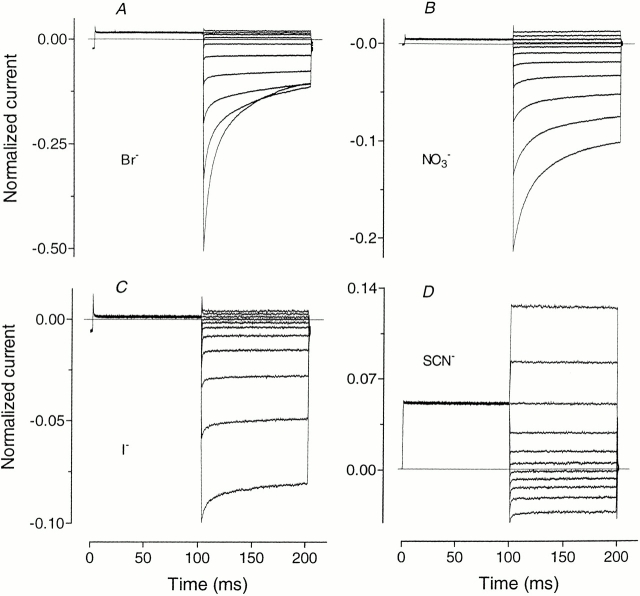
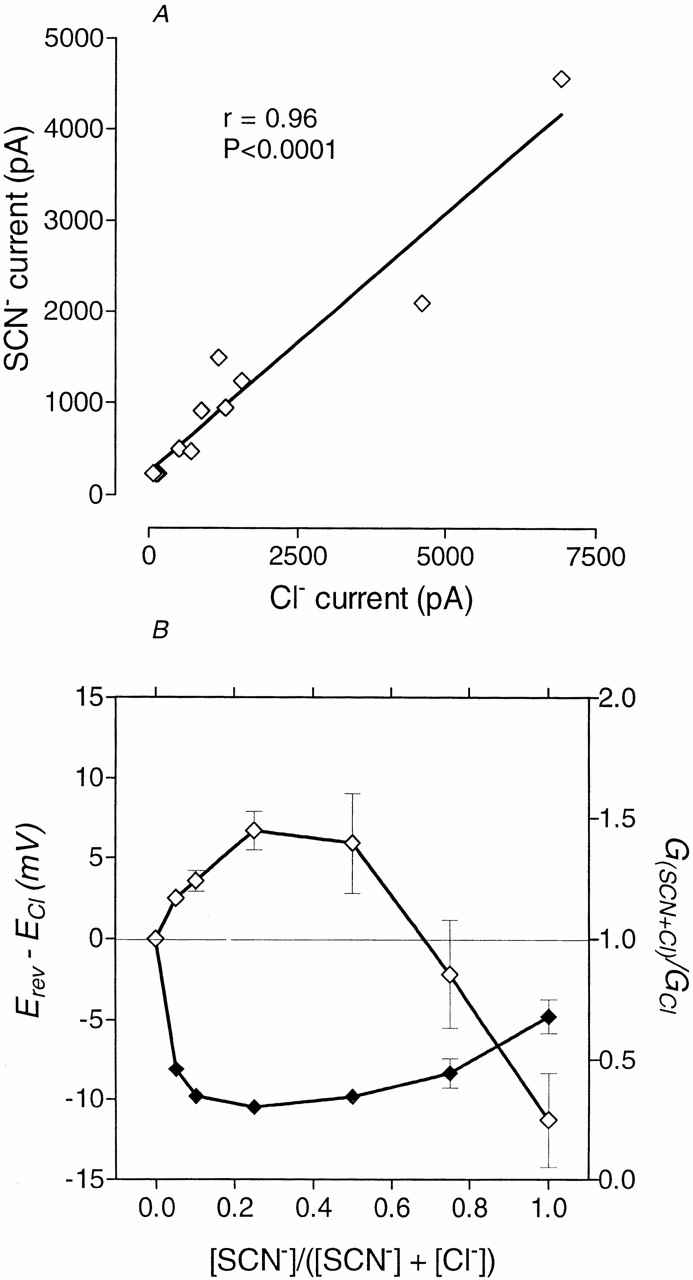
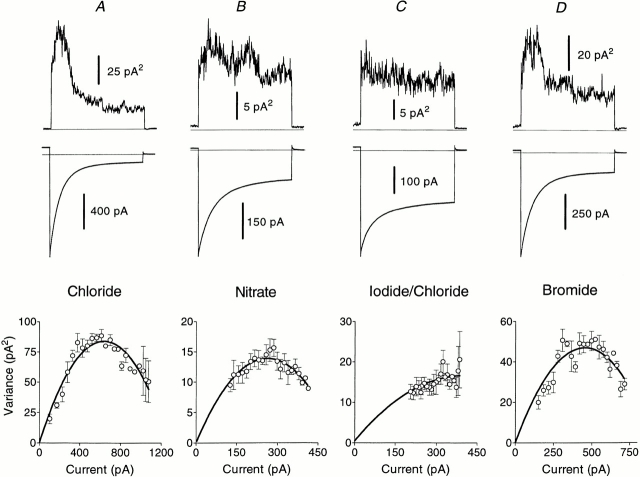
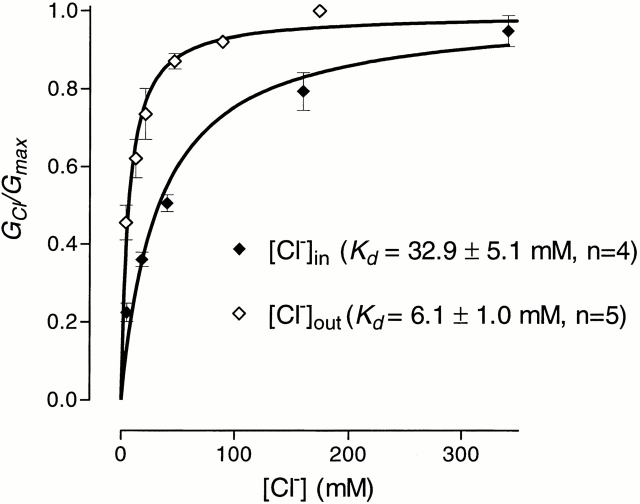
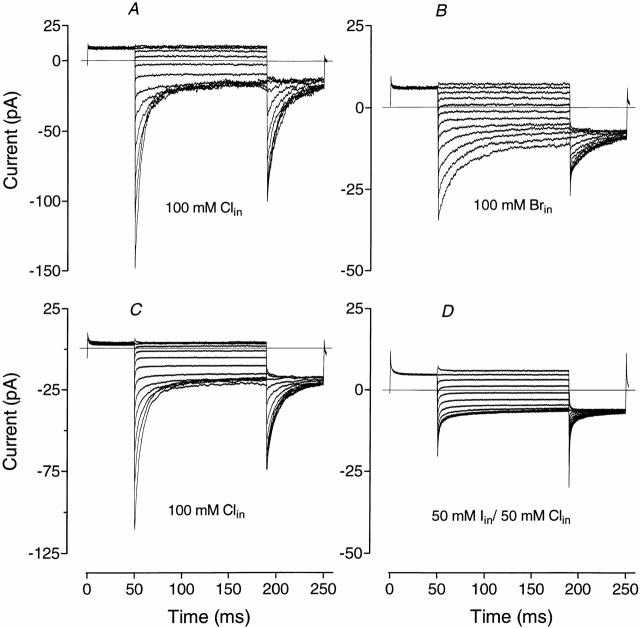
A distinctive feature of the voltage-dependent chloride channels ClC-0 (the Torpedo electroplaque chloride channel) and ClC-1 (the major skeletal muscle chloride channel) is that chloride acts as a ligand to its own channel, regulating channel opening and so controlling the permeation of its own species. We have now studied the permeation of a number of foreign anions through ClC-1 using voltage-clamp techniques on Xenopus oocytes and Sf9 cells expressing human (hClC-1) or rat (rClC-1) isoforms, respectively. From their effect on channel gating, the anions presented in this paper can be divided into three groups: impermeant or poorly permeant anions that can not replace Cl- as a channel opener and do not block the channel appreciably (glutamate, gluconate, HCO3-, BrO3-); impermeant anions that can open the channel and show significant block (methanesulfonate, cyclamate); and permeant anions that replace Cl- at the regulatory binding site but impair Cl- passage through the channel pore (Br-, NO3-, ClO3-, I-, ClO4-, SCN-). The permeability sequence for rClC-1, SCN- approximately ClO4- > Cl- > Br- > NO3- approximately ClO3- > I- >> BrO3- > HCO3- >> methanesulfonate approximately cyclamate approximately glutamate, was different from the sequence determined for blocking potency and ability to shift the Popen curve, SCN- approximately ClO4- > I- > NO3- approximately ClO3- approximately methanesulfonate > Br- > cyclamate > BrO3- > HCO3- > glutamate, implying that the regulatory binding site that opens the channel is different from the selectivity center and situated closer to the external side. Channel block by foreign anions is voltage dependent and can be entirely accounted for by reduction in single channel conductance. Minimum pore diameter was estimated to be approximately 4.5 A. Anomalous mole-fraction effects found for permeability ratios and conductance in mixtures of Cl- and SCN- or ClO4- suggest a multi-ion pore. Hydrophobic interactions with the wall of the channel pore may explain discrepancies between the measured permeabilities of some anions and their size.
电压依赖性氯离子通道ClC-0(电鳐电器官氯离子通道)和ClC-1(主要的骨骼肌氯离子通道)的一个显著特征是,氯离子作为自身通道的配体,调节通道开放,从而控制自身离子的通透。我们现在分别利用电压钳技术,在表达人源(hClC-1)或大鼠源(rClC-1)同工型的非洲爪蟾卵母细胞和Sf9细胞上,研究了多种外来阴离子通过ClC-1的通透情况。根据它们对通道门控的影响,本文所呈现的阴离子可分为三组:非通透或低通透阴离子,它们不能替代氯离子作为通道开放剂,也不会明显阻断通道(谷氨酸、葡萄糖酸盐、HCO3-、BrO3-);非通透阴离子,它们能打开通道并表现出显著阻断作用(甲磺酸盐、甜蜜素);以及通透阴离子,它们在调节性结合位点取代氯离子,但会损害氯离子通过通道孔的通透(Br-、NO3-、ClO3-、I-、ClO4-、SCN-)。rClC-1的通透顺序为SCN-≈ClO4->Cl->Br->NO3-≈ClO3->I->>BrO3->HCO3->>甲磺酸盐≈甜蜜素≈谷氨酸,这与阻断效力和改变开放概率曲线能力所确定的顺序不同,即SCN-≈ClO4->I->NO3-≈ClO3-≈甲磺酸盐>Br->甜蜜素>BrO3->HCO3->谷氨酸,这意味着打开通道的调节性结合位点与选择性中心不同,且更靠近外侧。外来阴离子对通道的阻断具有电压依赖性,并且完全可以通过单通道电导的降低来解释。估计最小孔径约为4.5埃。在氯离子与SCN-或ClO4-混合物中,渗透率比值和电导发现的异常摩尔分数效应表明存在多离子孔。与通道孔壁的疏水相互作用可能解释了一些阴离子测量渗透率与其大小之间的差异。