Shibata A, Wright M V, David S, McKerracher L, Braun P E, Kater S B
Department of Anatomy and Neurobiology, Colorado State University, Fort Collins, Colorado, USA.
J Cell Biol. 1998 Jul 13;142(1):191-202. doi: 10.1083/jcb.142.1.191.
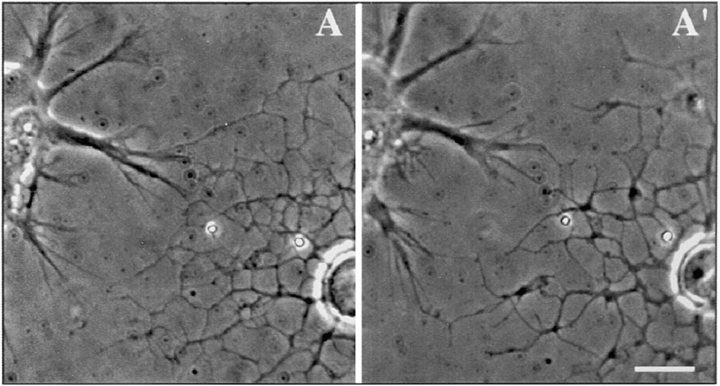
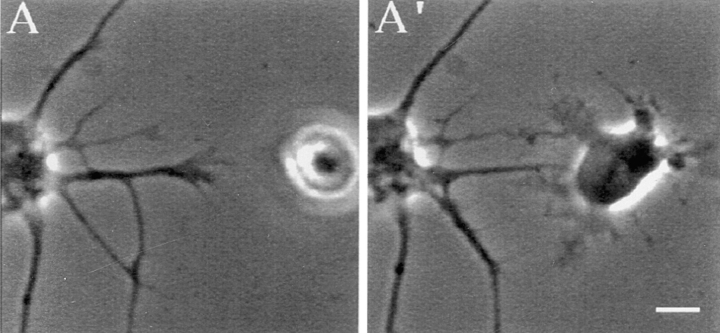
During central nervous system development, neurons differentiate distinct axonal and dendritic processes whose outgrowth is influenced by environmental cues. Given the known intrinsic differences between axons and dendrites and that little is known about the response of dendrites to inhibitory cues, we tested the hypothesis that outgrowth of differentiating axons and dendrites of hippocampal neurons is differentially influenced by inhibitory environmental cues. A sensitive growth cone behavior assay was used to assess responses of differentiating axonal and dendritic growth cones to oligodendrocytes and oligodendrocyte- derived, myelin-associated glycoprotein (MAG). We report that >90% of axonal growth cones collapsed after contact with oligodendrocytes. None of the encounters between differentiating, MAP-2 positive dendritic growth cones and oligodendrocytes resulted in growth cone collapse. The insensitivity of differentiating dendritic growth cones appears to be acquired since they develop from minor processes whose growth cones are inhibited (nearly 70% collapse) by contact with oligodendrocytes. Recombinant MAG(rMAG)-coated beads caused collapse of 72% of axonal growth cones but only 29% of differentiating dendritic growth cones. Unlike their response to contact with oligodendrocytes, few growth cones of minor processes were inhibited by rMAG-coated beads (20% collapsed). These results reveal the capability of differentiating growth cones of the same neuron to partition the complex molecular terrain they navigate by generating unique responses to particular inhibitory environmental cues.
在中枢神经系统发育过程中,神经元分化出不同的轴突和树突,其生长受环境线索影响。鉴于轴突和树突之间已知的内在差异,以及对树突对抑制性线索反应的了解甚少,我们测试了以下假设:海马神经元分化的轴突和树突的生长受抑制性环境线索的影响不同。使用一种敏感的生长锥行为分析方法来评估分化的轴突和树突生长锥对少突胶质细胞和少突胶质细胞衍生的髓鞘相关糖蛋白(MAG)的反应。我们报告,超过90%的轴突生长锥在与少突胶质细胞接触后塌陷。分化的、MAP-2阳性的树突生长锥与少突胶质细胞之间的接触均未导致生长锥塌陷。分化的树突生长锥的不敏感性似乎是后天获得的,因为它们从小的突起发育而来,其生长锥在与少突胶质细胞接触时受到抑制(近70%塌陷)。重组MAG(rMAG)包被的珠子导致72%的轴突生长锥塌陷,但仅29%的分化树突生长锥塌陷。与它们对与少突胶质细胞接触的反应不同,很少有小突起的生长锥被rMAG包被的珠子抑制(20%塌陷)。这些结果揭示了同一神经元分化的生长锥能够通过对特定抑制性环境线索产生独特反应,来划分它们所导航的复杂分子地形。