Polić B, Hengel H, Krmpotić A, Trgovcich J, Pavić I, Luccaronin P, Jonjić S, Koszinowski U H
Department of Histology and Embryology, Faculty of Medicine, University of Rijeka, Croatia.
J Exp Med. 1998 Sep 21;188(6):1047-54. doi: 10.1084/jem.188.6.1047.
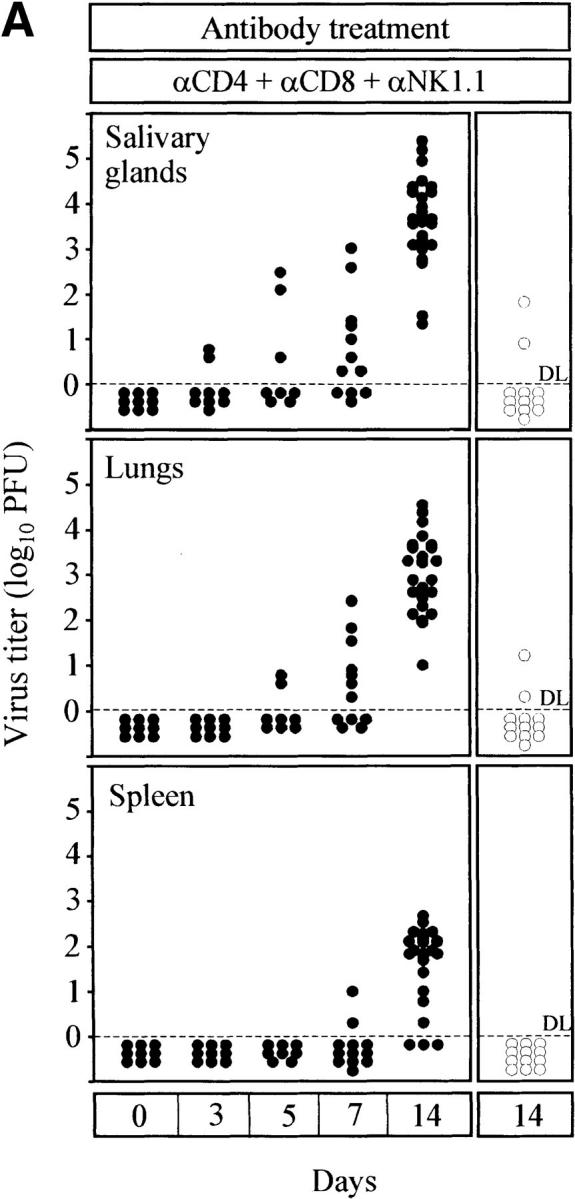
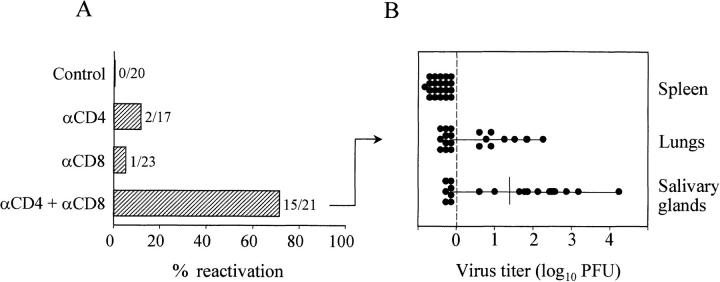
Reactivation from latent cytomegalovirus (CMV) infection is often associated with conditions of immunosuppression and can result in fatal disease. Whether the maintenance of systemic CMV latency is mainly governed by factors of the infected cell or by immune control functions is unknown. Likewise, the putative immune control mechanisms which could prevent the induction and spread of recurrent CMV infection are not clearly identified. We took advantage of latently infected B cell-deficient mice and a sensitive method for virus detection to study CMV reactivation after ablation of lymphocyte subsets. A crucial role of both T lymphocytes and natural killer (NK) cells was demonstrated. Within 5 d after depletion of lymphocytes, productive infection occurred in 50% of mice, and 14 d later 100% of mice exhibited recurrent infection. A hierarchy of immune control functions of CD8(+), NK, and CD4(+) cells was established. Reactivation was rare if only one of the lymphocyte subsets was depleted, but was evident after removal of a further subset, indicating a functional redundancy of control mechanisms. The salivary glands were identified as the site of most rapid virus shedding, followed by the detection of recurrent virus in the lungs, and eventually in the spleen. Our findings document a previously unknown propensity of latent CMV genomes to enter productive infection immediately and with a high frequency after immune cell depletion. The data indicate that only the sustained cellular immune control prevents CMV replication and restricts the viral genome to a systemic state of latency.
潜伏性巨细胞病毒(CMV)感染的重新激活通常与免疫抑制状态相关,并可能导致致命疾病。系统性CMV潜伏的维持主要是受感染细胞的因素还是免疫控制功能的影响尚不清楚。同样,能够阻止复发性CMV感染的诱导和传播的假定免疫控制机制也未明确确定。我们利用潜伏感染的B细胞缺陷小鼠和一种敏感的病毒检测方法来研究淋巴细胞亚群消融后CMV的重新激活。结果表明T淋巴细胞和自然杀伤(NK)细胞都起着关键作用。淋巴细胞耗竭后5天内,50%的小鼠发生了 productive 感染,14天后100%的小鼠出现了复发性感染。建立了CD8(+)、NK和CD4(+)细胞免疫控制功能等级体系。如果仅耗竭一种淋巴细胞亚群,重新激活很少见,但在去除另一种亚群后则很明显,这表明控制机制存在功能冗余。唾液腺被确定为病毒最快速排出的部位,随后在肺部检测到复发性病毒,最终在脾脏中检测到。我们的研究结果证明了潜伏性CMV基因组在免疫细胞耗竭后立即且高频进入 productive 感染的一种前所未知的倾向。数据表明,只有持续的细胞免疫控制才能阻止CMV复制,并将病毒基因组限制在系统性潜伏状态。