Cartoux M, Msellati P, Meda N, Welffens-Ekra C, Mandelbrot L, Leroy V, Van de Perre P, Dabis F
Centre Muraz, Bobo-Dioulasso, Burkina Faso.
AIDS. 1998 Dec 3;12(17):2337-44. doi: 10.1097/00002030-199817000-00016.
To evaluate the attitude of pregnant women towards HIV testing in two cities of West Africa: Abidjan, Côte d'Ivoire and Bobo-Dioulasso, Burkina Faso.
In the context of a clinical trial to prevent HIV vertical transmission, HIV counselling and testing was offered systematically to women attending antenatal clinics. Informed consent was obtained and test results were given anonymously. Multiple logistic regression was performed to identify factors associated with refusal for testing and failure to return for test results.
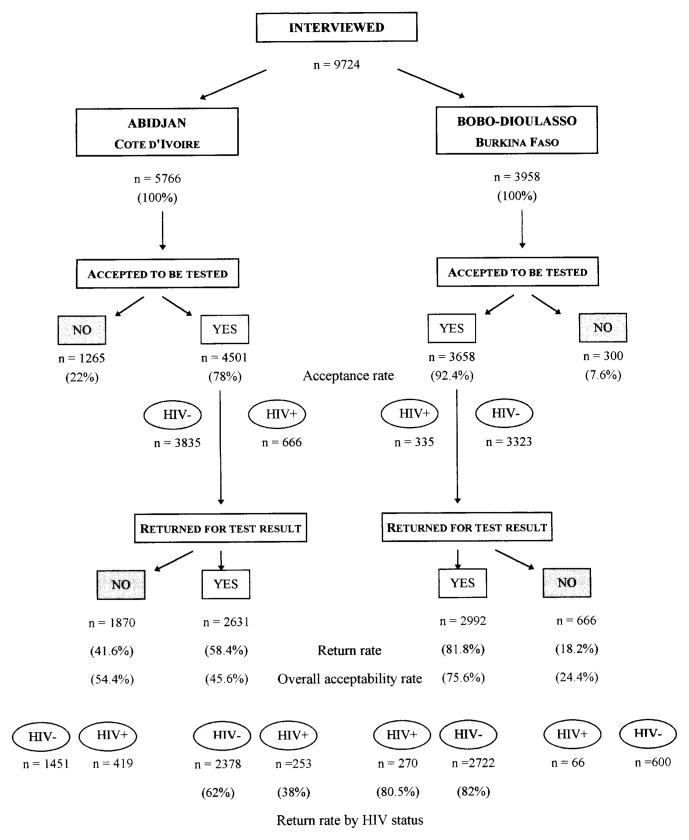
A total of 9724 pregnant women were interviewed from January 1995 to September 1996. In Abidjan (n=5766) and Bobo-Dioulasso (n=3958), 78 and 92.4% of the women consented to HIV testing, respectively, and 58.4 and 81.8% of them returned for the test results disclosure, respectively. In the two sites, the counsellors themselves and high educational level of the women appeared to be related to refusal of the test, whereas last trimester gestation was associated with failure to return for test results. In Abidjan, foreigners and employees were more likely to refuse testing, and HIV-infected women were three times less likely to return for results than uninfected women.
Future implementation of interventions to reduce vertical transmission of HIV that require antenatal HIV testing and counselling will have to solve issue of acceptability of HIV testing by pregnant women.
评估西非两个城市(科特迪瓦的阿比让和布基纳法索的博博迪乌拉索)的孕妇对艾滋病毒检测的态度。
在一项预防艾滋病毒垂直传播的临床试验背景下,系统地为到产前诊所就诊的妇女提供艾滋病毒咨询和检测。获得知情同意并匿名给出检测结果。进行多因素逻辑回归分析以确定与拒绝检测及未返回获取检测结果相关的因素。
1995年1月至1996年9月共访谈了9724名孕妇。在阿比让(n = 5766)和博博迪乌拉索(n = 3958),分别有78%和92.4%的妇女同意进行艾滋病毒检测,其中分别有58.4%和81.8%的妇女返回获取检测结果。在两个地点,咨询师自身以及妇女的高教育水平似乎与拒绝检测有关;而孕晚期与未返回获取检测结果有关。在阿比让,外国人及雇员更有可能拒绝检测,且感染艾滋病毒的妇女返回获取结果的可能性比未感染妇女低三倍。
未来实施旨在减少艾滋病毒垂直传播且需要进行产前艾滋病毒检测和咨询的干预措施时,必须解决孕妇对艾滋病毒检测的接受度问题。