Meyer William R, Muoio Debra, Hackney Anthony C
Department of Obstetrics and Gynecology, School of Medicine, University of North Carolina, Chapel Hill 27599, USA.
Fertil Steril. 1999 Jun;71(6):1085-91. doi: 10.1016/s0015-0282(99)00144-2.
To examine the interaction between circulating beta-endorphin levels and sex steroids during sustained submaximal exercise in runners who are either anovulatory and oligomenorrheic (AO) or ovulatory and eumenorrheic (EO).
Controlled clinical study.
General clinical research center at an academic medical center.
PATIENT(S): Three AO and four EO runners.
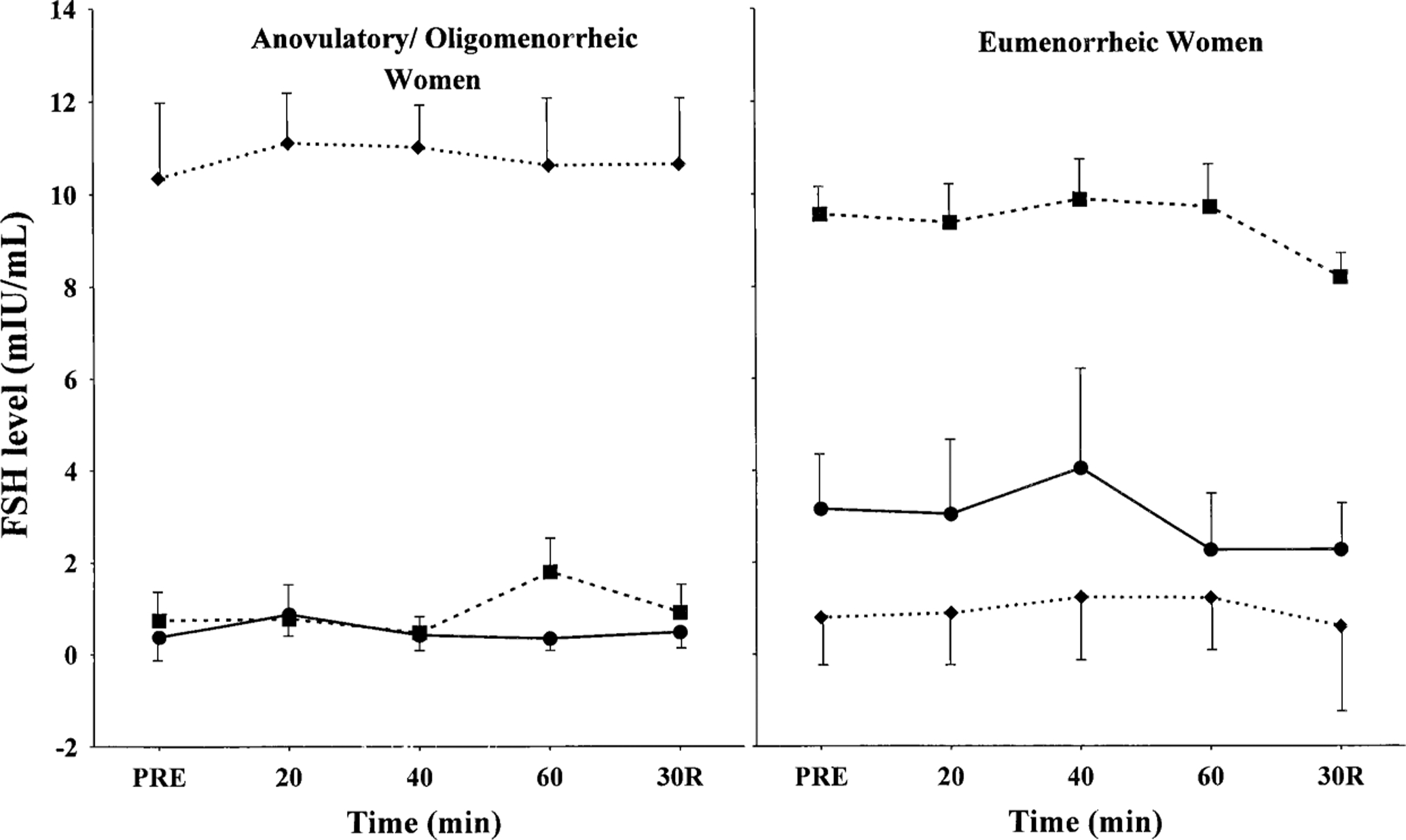
INTERVENTION(S): The athletes underwent 60 minutes of submaximal treadmill exercise on three separate occasions. Anovulatory and oligomenorrheic runners underwent exercise at baseline and after physiologic estrogen and combined estrogen and progesterone replacement. Ovulatory and eumenorrheic runners underwent exercise in the follicular and luteal phases and after GnRH agonist desensitization.
MAIN OUTCOME MEASURE(S): Serum cortisol, beta-endorphin, progesterone, estrogen, and gonadotropin levels at rest and during exercise.
RESULT(S): Serum levels of E2 increased in response to exercise in both EO and AO runners during sex steroid replacement. Baseline peripheral beta-endorphin and cortisol levels were not different between the EO and AO groups. A significant increase in beta-endorphin levels in response to exercise occurred only in the EO group after GnRH agonist desensitization.
CONCLUSION(S): Alterations in menstrual cyclicity and ovulation in conditioned runners probably are not due to an increase in opioid tone. The hypothalamic-gonadotropic axis appears to be intact in AO runners, as measured by the gonadotropic response to exogenous exposure to estrogen and progesterone. Sex steroid administration had no effect on basal beta-endorphin levels, but this probably was not due to preexisting increased opioid tone.
研究无排卵和月经过少(AO)或有排卵且月经正常(EO)的跑步者在持续亚极量运动期间循环β-内啡肽水平与性类固醇之间的相互作用。
对照临床研究。
一所学术医疗中心的综合临床研究中心。
3名AO跑步者和4名EO跑步者。
运动员在三个不同时间进行60分钟的亚极量跑步机运动。无排卵和月经过少的跑步者在基线时以及生理雌激素和雌激素与孕激素联合替代后进行运动。有排卵且月经正常的跑步者在卵泡期和黄体期以及GnRH激动剂脱敏后进行运动。
静息和运动期间的血清皮质醇、β-内啡肽、孕激素、雌激素和促性腺激素水平。
在性类固醇替代期间,EO和AO跑步者运动后血清E2水平均升高。EO组和AO组的基线外周β-内啡肽和皮质醇水平无差异。仅在GnRH激动剂脱敏后的EO组中,运动后β-内啡肽水平显著升高。
训练有素的跑步者月经周期和排卵的改变可能不是由于阿片类物质张力增加所致。通过对外源性雌激素和孕激素暴露的促性腺激素反应测量,AO跑步者的下丘脑-促性腺轴似乎是完整的。性类固醇给药对基础β-内啡肽水平无影响,但这可能不是由于预先存在的阿片类物质张力增加所致。