Nunes V S, Quintão E C, Cazita P M, Harada L M, de Faria E C, Oliveira H C
Lipid Laboratory, University of São Paulo Medical School, São Paulo, Brazil.
BMC Biochem. 2001;2:1. doi: 10.1186/1471-2091-2-1. Epub 2001 Feb 20.
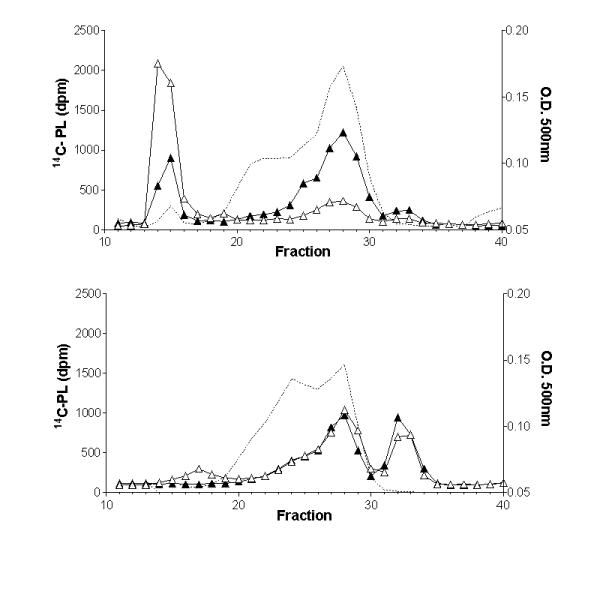
Plasma lipases and lipid transfer proteins are involved in the generation and speciation of high density lipoproteins. In this study we have examined the influence of plasma lipases and lipid transfer protein activities on the transfer of free cholesterol (FC) and phospholipids (PL) from lipid emulsion to human, rat and mouse lipoproteins. The effect of the lipases was verified by incubation of labeled (3H-FC,14C-PL) triglyceride rich emulsion with human plasma (control, post-heparin and post-heparin plus lipase inhibitor), rat plasma (control and post-heparin) and by the injection of the labeled lipid emulsion into control and heparinized functionally hepatectomized rats.
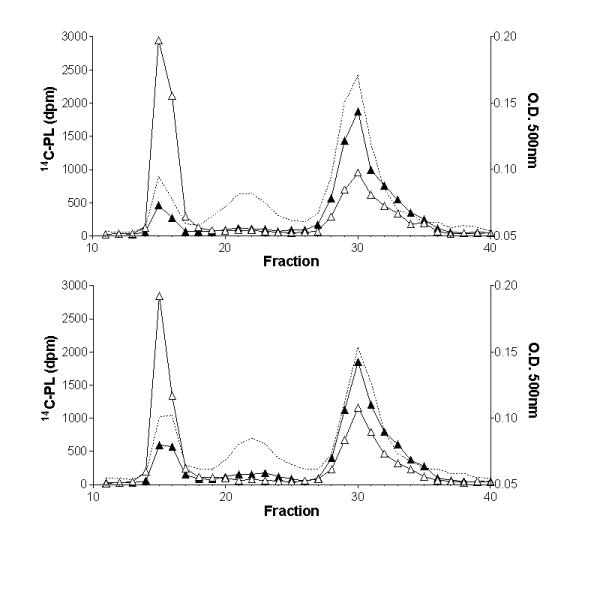
In vitro, the lipase enriched plasma stimulated significantly the transfer of 14C-PL from emulsion to high density lipoprotein (p<0.001) but did not modify the transfer of 3H-FC. In hepatectomized rats, heparin stimulation of intravascular lipolysis increased the plasma removal of 14C-PL and the amount of 14C-PL found in the low density lipoprotein density fraction but not in the high density lipoprotein density fraction. The in vitro and in vivo experiments showed that free cholesterol and phospholipids were transferred from lipid emulsion to plasma lipoproteins independently from each other. The incubation of human plasma, control and control plus monoclonal antibody anti-cholesteryl ester transfer protein (CETP), with 14C-PL emulsion showed that CETP increases 14C-PL transfer to human HDL, since its partial inhibition by the anti-CETP antibody reduced significantly the 14C-PL transfer (p<0.05). However, comparing the nontransgenic (no CETP activity) with the CETP transgenic mouse plasma, no effect of CETP on the 14C-PL distribution in mice lipoproteins was observed.
It is concluded that: 1-intravascular lipases stimulate phospholipid transfer protein mediated phospholipid transfer, but not free cholesterol, from triglyceride rich particles to human high density lipoproteins and rat low density lipoproteins and high density lipoproteins; 2-free cholesterol and phospholipids are transferred from triglyceride rich particles to plasma lipoproteins by distinct mechanisms, and 3 - CETP also contributes to phospholipid transfer activity in human plasma but not in transgenic mice plasma, a species which has high levels of the specific phospholipid transfer protein activity.
血浆脂肪酶和脂质转运蛋白参与高密度脂蛋白的生成和种类形成。在本研究中,我们检测了血浆脂肪酶和脂质转运蛋白活性对游离胆固醇(FC)和磷脂(PL)从脂质乳剂向人、大鼠和小鼠脂蛋白转移的影响。通过将标记的(3H-FC,14C-PL)富含甘油三酯的乳剂与人血浆(对照、肝素后及肝素后加脂肪酶抑制剂)、大鼠血浆(对照和肝素后)孵育,以及将标记的脂质乳剂注射到对照和肝素化的功能性肝切除大鼠体内,验证了脂肪酶的作用。
在体外,富含脂肪酶的血浆显著刺激了14C-PL从乳剂向高密度脂蛋白的转移(p<0.001),但未改变3H-FC的转移。在肝切除大鼠中,肝素刺激血管内脂肪分解增加了14C-PL的血浆清除率以及低密度脂蛋白密度组分中14C-PL的含量,但高密度脂蛋白密度组分中未增加。体外和体内实验表明,游离胆固醇和磷脂从脂质乳剂向血浆脂蛋白的转移是相互独立的。人血浆、对照以及对照加抗胆固醇酯转运蛋白(CETP)单克隆抗体与14C-PL乳剂孵育表明,CETP增加了14C-PL向人高密度脂蛋白的转移,因为抗CETP抗体对其部分抑制显著降低了14C-PL的转移(p<0.05)。然而,比较非转基因(无CETP活性)与CETP转基因小鼠血浆,未观察到CETP对小鼠脂蛋白中14C-PL分布的影响。
得出以下结论:1.血管内脂肪酶刺激磷脂转运蛋白介导的磷脂从富含甘油三酯的颗粒向人高密度脂蛋白以及大鼠低密度脂蛋白和高密度脂蛋白的转移,但不刺激游离胆固醇的转移;2.游离胆固醇和磷脂通过不同机制从富含甘油三酯的颗粒转移到血浆脂蛋白;3.CETP也有助于人血浆中的磷脂转移活性,但在转基因小鼠血浆中无此作用,转基因小鼠血浆中具有高水平的特异性磷脂转移蛋白活性。