Kim J E, Tauber M J, Mathies R A
Department of Chemistry, University of California, Berkeley, California 94720, USA.
Biochemistry. 2001 Nov 20;40(46):13774-8. doi: 10.1021/bi0116137.
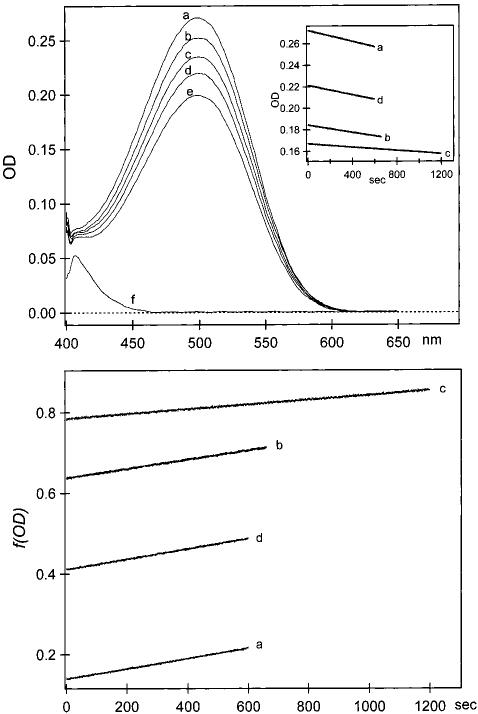
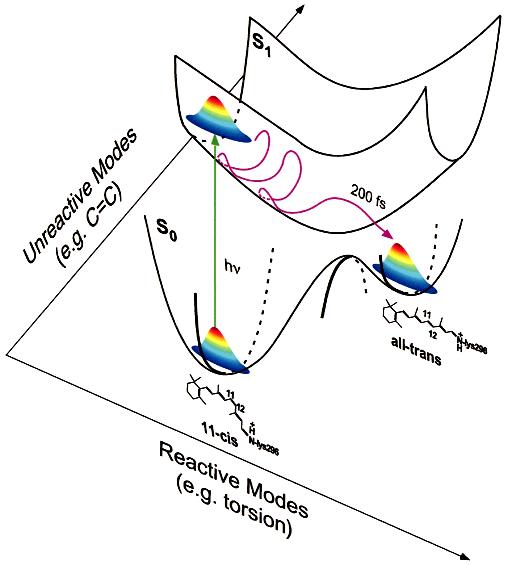
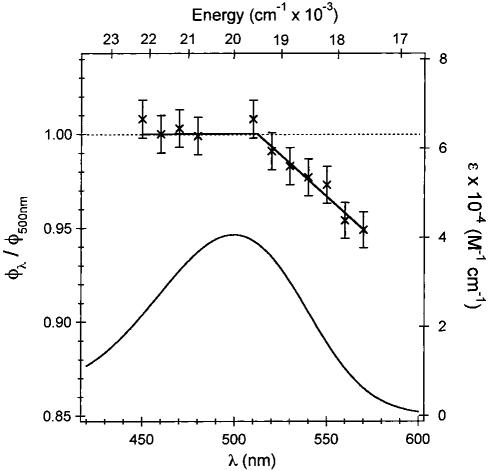
The primary event in vision is the light-driven cis-trans isomerization of the 11-cis-retinal chromophore in the G-protein coupled receptor rhodopsin. Early measurements showed that this photoisomerization has a reaction quantum yield phi of approximately 0.67 [Dartnall (1936) Proc. R. Soc. A 156, 158-170; Dartnall (1968) Vision Res. 8, 339-358] and suggested that the quantum yield was wavelength independent [Schneider (1939) Proc. Natl. Acad. Sci. U.S.A. 170, 102-112]. Here we more accurately determine phi(500) = 0.65 +/- 0.01 and reveal that phi surprisingly depends on the wavelength of the incident light. Although there is no difference in the quantum yield between 450 and 480 nm, the quantum yield falls significantly as the photon energy is reduced below 20 000 cm(-1) (500 nm). At the reddest wavelength measured (570 nm), the quantum yield is reduced by 5 +/- 1% relative to the 500 nm value. These experiments correct the long-held presumption that the quantum yield in vision is wavelength independent, and support the hypothesis that the 200 fs photoisomerization reaction that initiates vision is dictated by nonstationary excited-state vibrational wave packet dynamics.
视觉中的主要事件是G蛋白偶联受体视紫红质中11-顺式视黄醛发色团的光驱动顺反异构化。早期测量表明,这种光异构化的反应量子产率φ约为0.67 [达特纳尔(1936年)《皇家学会学报》A辑156卷,第158 - 170页;达特纳尔(1968年)《视觉研究》8卷,第339 - 358页],并表明量子产率与波长无关[施耐德(1939年)《美国国家科学院院刊》170卷,第102 - 112页]。在此,我们更精确地测定出φ(500)=0.65±0.01,并揭示出φ令人惊讶地依赖于入射光的波长。尽管在450至480纳米之间量子产率没有差异,但当光子能量降低到20000厘米⁻¹(500纳米)以下时,量子产率会显著下降。在测量的最红波长(570纳米)处,相对于500纳米的值,量子产率降低了5±1%。这些实验纠正了长期以来认为视觉中的量子产率与波长无关的假定,并支持了这样一种假说,即引发视觉的200飞秒光异构化反应是由非稳态激发态振动波包动力学所决定的。