White J, Keller P, Stelzer E H
Light Microscopy Group, European Molecular Biology Laboratory, Meyerhofstrabe Heidelberg, Germany.
BMC Cell Biol. 2001;2:19. doi: 10.1186/1471-2121-2-19. Epub 2001 Oct 10.
To maintain organelle integrity, resident proteins must segregate from itinerant cargo during secretory transport. However, Golgi resident enzymes must have intimate access to secretory cargo in order to carry out glycosylation reactions. The amount of cargo and associated membrane may be significant compared to the amount of Golgi membrane and resident protein, but upon Golgi exit, cargo and resident are efficiently sorted. How this occurs in live cells is not known.
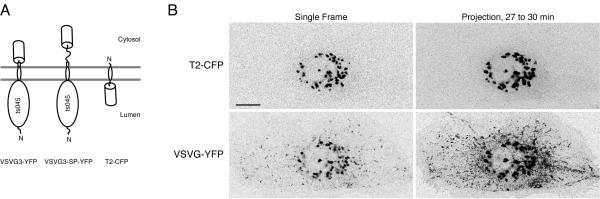
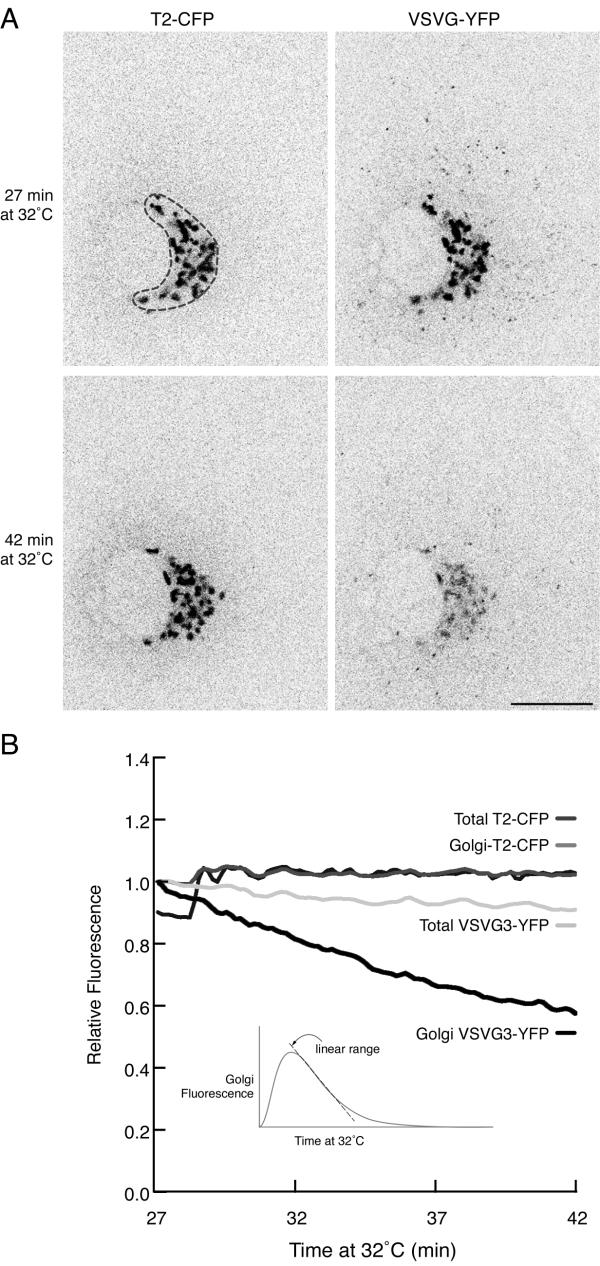
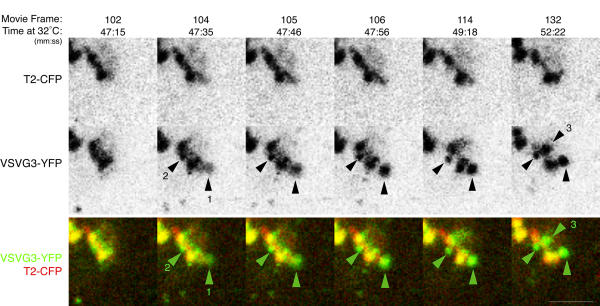
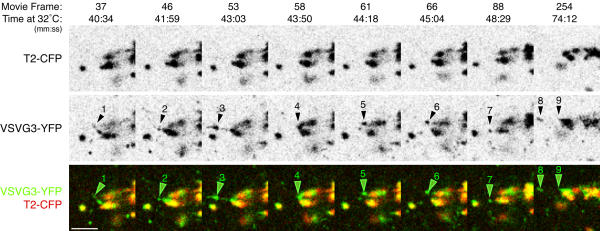
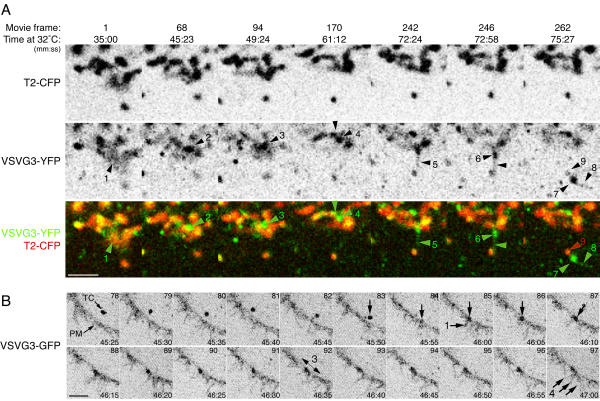
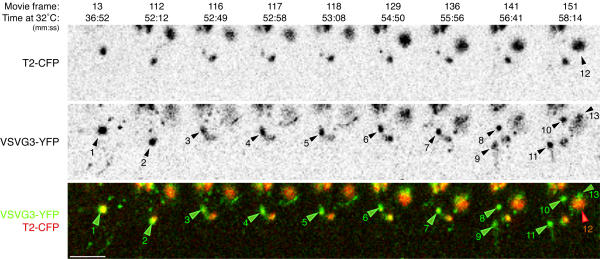
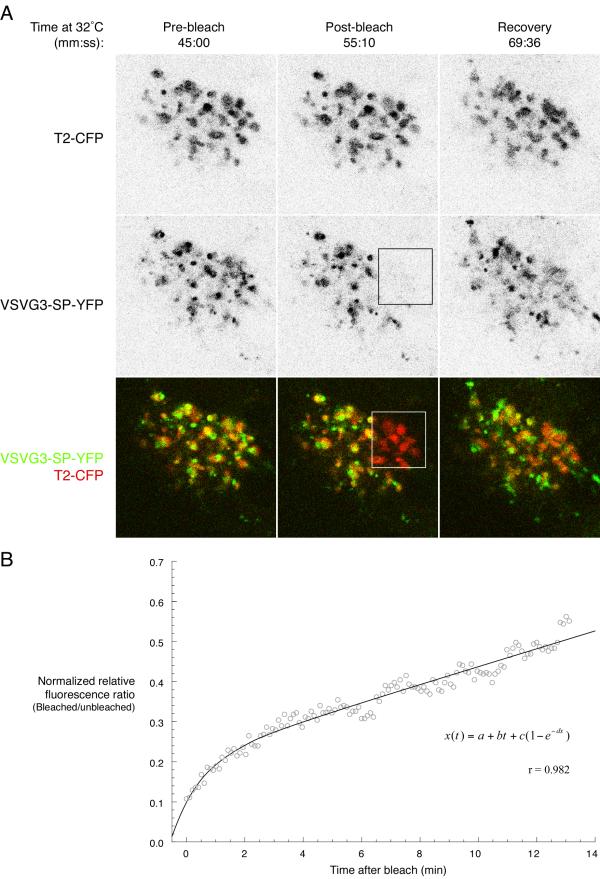
We observed partitioning of the fluorescent Golgi resident T2-CFP and fluorescent cargo proteins VSVG3-YFP or VSVG3-SP-YFP upon Golgi exit after a synchronous pulse of cargo was released from the ER. Golgi elements remained stable in overall size, shape and relative position as cargo emptied. Cargo segregated from resident rapidly by blebbing into micron-sized domains that contained little or no detectable resident protein and that appeared to be continuous with the parent Golgi element. Post-Golgi transport carriers (TCs) exited repeatedly from these domains. Alternatively, entire cargo domains exited Golgi elements, forming large TCs that fused directly with the plasma membrane. However, domain formation did not appear to be an absolute prerequisite for TC exit, since TCs also exited directly from Golgi elements in the absence of large domains. Quantitative cargo-specific photobleaching experiments revealed transfer of cargo between Golgi regions, but no discrete intra-Golgi TCs were observed.
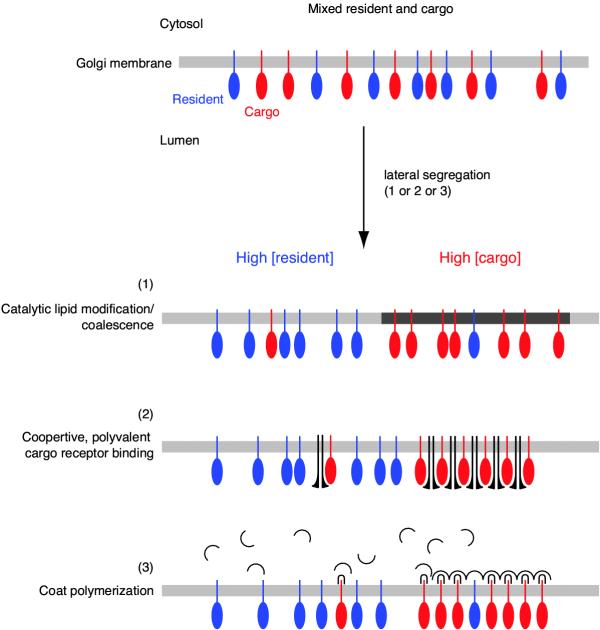
Our results establish domain formation via rapid lateral partitioning as a general cellular strategy for segregating different transmembrane proteins along the secretory pathway and provide a framework for consideration of molecular mechanisms of secretory transport.
为维持细胞器的完整性,驻留蛋白在分泌运输过程中必须与转运货物分离。然而,高尔基体驻留酶必须与分泌货物密切接触才能进行糖基化反应。与高尔基体膜和驻留蛋白的量相比,货物和相关膜的量可能很大,但在高尔基体输出时,货物和驻留蛋白能被有效地分选。这在活细胞中是如何发生的尚不清楚。
我们观察到,在从内质网同步释放货物脉冲后,高尔基体驻留荧光蛋白T2-CFP与荧光货物蛋白VSVG3-YFP或VSVG3-SP-YFP在高尔基体输出时发生了分离。随着货物排空,高尔基体元件在总体大小、形状和相对位置上保持稳定。货物通过形成小泡迅速与驻留蛋白分离,形成微米大小的区域,这些区域几乎不含或检测不到驻留蛋白,并且似乎与母高尔基体元件连续。高尔基体后运输载体(TCs)反复从这些区域排出。或者,整个货物区域从高尔基体元件中排出,形成直接与质膜融合的大TCs。然而,区域形成似乎不是TCs排出的绝对先决条件,因为在没有大区域的情况下,TCs也直接从高尔基体元件中排出。定量的货物特异性光漂白实验揭示了货物在高尔基体区域之间的转移,但未观察到离散的高尔基体内TCs。
我们的结果表明,通过快速侧向分离形成区域是一种普遍的细胞策略,用于沿分泌途径分离不同的跨膜蛋白,并为分泌运输的分子机制研究提供了一个框架。