Cernáková Marta, Kost'álová Daniela, Kettmann Viktor, Plodová Miriam, Tóth Jaroslav, Drímal Ján
Department of Environmental Sciences, Faculty of Chemical Technology, Slovak Technical University, SK-81237 Bratislava, Slovak Republic.
BMC Complement Altern Med. 2002 Feb 19;2:2. doi: 10.1186/1472-6882-2-2.
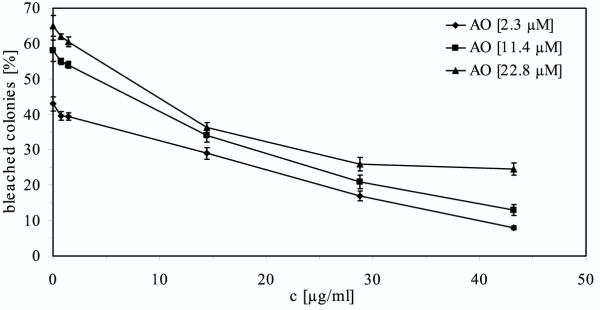
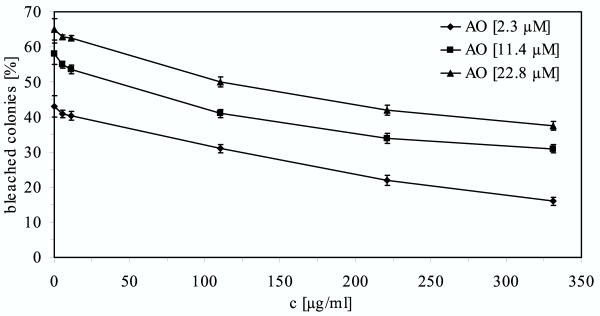
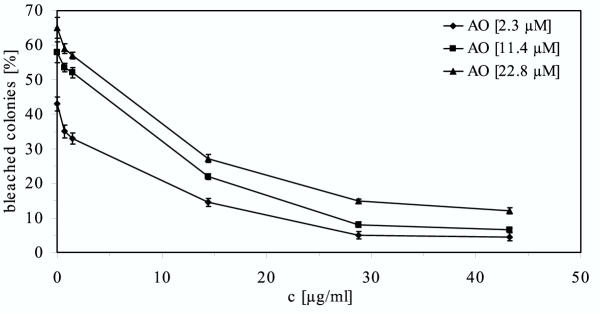
As part of a study aimed at developing new pharmaceutical products from natural resources, the purpose of this research was twofold: (1) to fractionate crude extracts from the bark of Mahonia aquifolium and (2) to evaluate the strength of the antimutagenic activity of the separate components against one of the common direct-acting chemical mutagens.
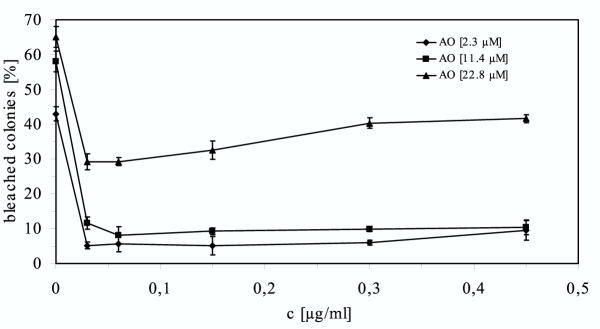
The antimutagenic potency was evaluated against acridine orange (AO) by using Euglena gracilis as an eukaryotic test model, based on the ability of the test compound/fraction to prevent the mutagen-induced damage of chloroplast DNA.
It was found that the antimutagenicity of the crude Mahonia extract resides in both bis-benzylisoquinoline (BBI) and protoberberine alkaloid fractions but only the protoberberine derivatives, jatrorrhizine and berberine, showed significant concentration-dependent inhibitory effect against the AO-induced chloroplast mutagenesis of E. gracilis. Especially berberine elicited, at a very low dose, remarkable suppression of the AO-induced mutagenicity, its antimutagenic potency being almost three orders of magnitude higher when compared to its close analogue, jatrorrhizine. Possible mechanisms of the antimutagenic action are discussed in terms of recent literature data. While the potent antimutagenic activity of the protoberberines most likely results from the inhibition of DNA topoisomerase I, the actual mechanism(s) for the BBI alkaloids is hard to be identified.
Taken together, the results indicate that berberine possesses promising antimutagenic/anticarcinogenic potential that is worth to be investigated further.
作为一项旨在从自然资源开发新药品的研究的一部分,本研究有两个目的:(1)对阔叶十大功劳树皮的粗提物进行分离;(2)评估各分离成分对一种常见直接作用化学诱变剂的抗诱变活性强度。
以纤细裸藻作为真核测试模型,基于测试化合物/组分预防诱变剂诱导的叶绿体DNA损伤的能力,评估对吖啶橙(AO)的抗诱变效力。
发现阔叶十大功劳粗提物的抗诱变活性存在于双苄基异喹啉(BBI)和原小檗碱生物碱组分中,但只有原小檗碱衍生物,即药根碱和小檗碱,对AO诱导的纤细裸藻叶绿体诱变表现出显著的浓度依赖性抑制作用。尤其是小檗碱在极低剂量下就能显著抑制AO诱导的诱变,与它的类似物药根碱相比,其抗诱变效力高出近三个数量级。根据最近的文献数据讨论了抗诱变作用的可能机制。虽然原小檗碱的强效抗诱变活性很可能源于对DNA拓扑异构酶I的抑制,但BBI生物碱的实际作用机制难以确定。
综上所述,结果表明小檗碱具有值得进一步研究的潜在抗诱变/抗癌潜力。