Alexander Kathleen A, Pleydell Eve, Williams Mark C, Lane Emily P, Nyange John F C, Michel Anita L
Centre for Conservation of African Resources: Communities Animals and Land Use, Kasane, Botswana.
Emerg Infect Dis. 2002 Jun;8(6):598-601. doi: 10.3201/eid0806.010358.
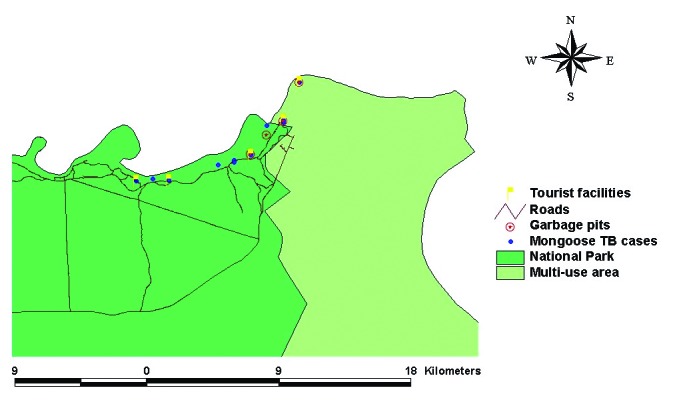
Expansion of ecotourism-based industries, changes in land-use practices, and escalating competition for resources have increased contact between free-ranging wildlife and humans. Although human presence in wildlife areas may provide an important economic benefit through ecotourism, exposure to human pathogens may represent a health risk for wildlife. This report is the first to document introduction of a primary human pathogen into free-ranging wildlife. We describe outbreaks of Mycobacterium tuberculosis, a human pathogen, in free-ranging banded mongooses (Mungos mungo) in Botswana and suricates (Suricata suricatta) in South Africa. Wildlife managers and scientists must address the potential threat that humans pose to the health of free-ranging wildlife.
以生态旅游为基础的产业扩张、土地使用方式的改变以及资源竞争的加剧,增加了自由放养野生动物与人类之间的接触。尽管人类在野生动物区域的存在可能通过生态旅游带来重要的经济效益,但接触人类病原体可能对野生动物构成健康风险。本报告首次记录了一种主要人类病原体传入自由放养野生动物的情况。我们描述了博茨瓦纳自由放养的带状猫鼬(Mungos mungo)和南非狐獴(Suricata suricatta)中人类病原体结核分枝杆菌的暴发。野生动物管理者和科学家必须应对人类对自由放养野生动物健康构成的潜在威胁。