Cahalan Michael D, Parker Ian, Wei Sindy H, Miller Mark J
Department of Physiology, University of California, Irvine, California 92697-4561, USA.
Nat Rev Immunol. 2002 Nov;2(11):872-80. doi: 10.1038/nri935.
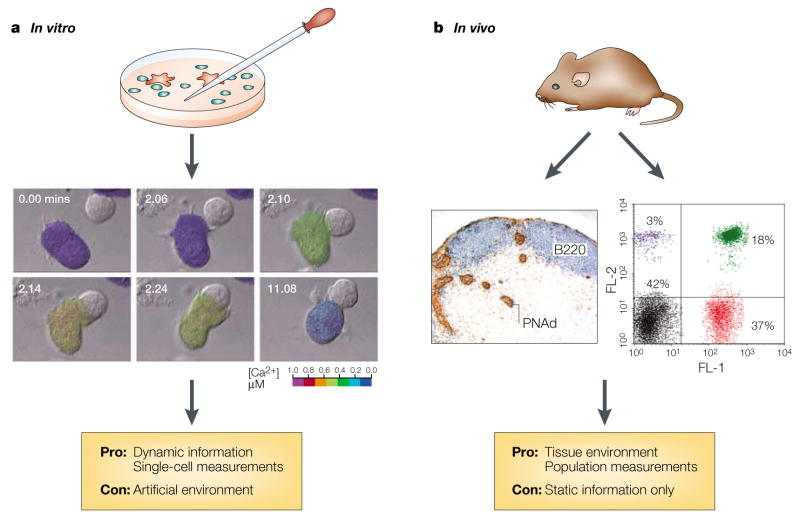
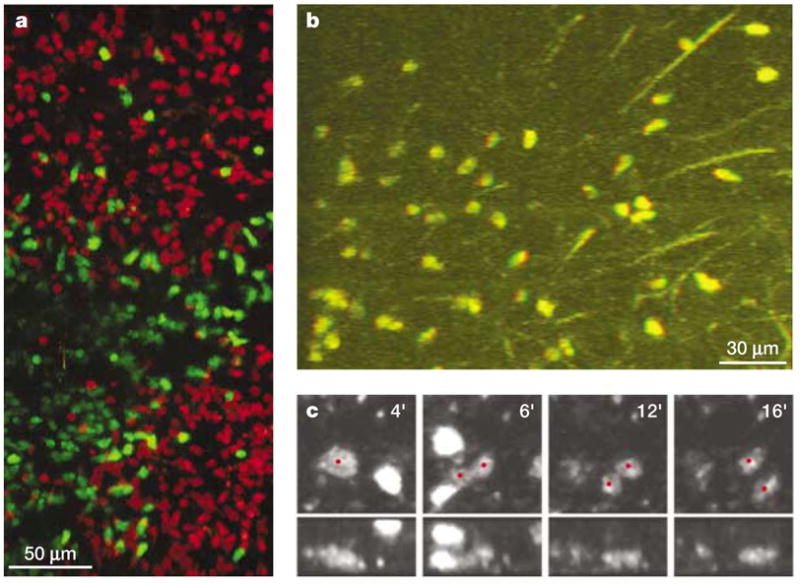
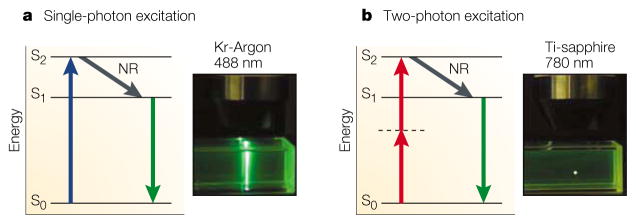
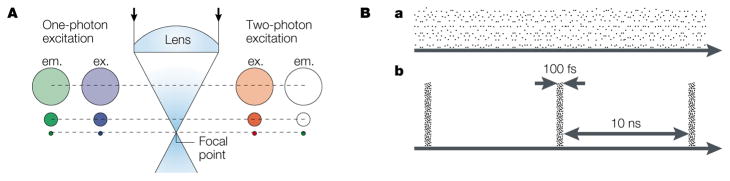
Many lymphocyte functions, such as antigen recognition, take place deep in densely populated lymphoid organs. Because direct in vivo observation was not possible, the dynamics of immune-cell interactions have been inferred or extrapolated from in vitro studies. Two-photon fluorescence excitation uses extremely brief (<1 picosecond) and intense pulses of light to 'see' directly into living tissues, to a greater depth and with less phototoxicity than conventional imaging methods. Two-photon microscopy, in combination with newly developed indicator molecules, promises to extend single-cell approaches to the in vivo setting and to reveal in detail the cellular collaborations that underlie the immune response.
许多淋巴细胞功能,如抗原识别,发生在人口密集的淋巴器官深处。由于无法进行直接的体内观察,免疫细胞相互作用的动态过程一直是从体外研究中推断或外推出来的。双光子荧光激发使用极短(<1皮秒)且强烈的光脉冲直接“观察”活组织,比传统成像方法能达到更深的深度且光毒性更小。双光子显微镜与新开发的指示分子相结合,有望将单细胞方法扩展到体内环境,并详细揭示免疫反应背后的细胞协作。