• 文献检索
  • 文档翻译
  • 深度研究
  • 学术资讯
  • Suppr Zotero 插件Zotero 插件
  • 邀请有礼
  • 套餐&价格
  • 历史记录
应用&插件
Suppr Zotero 插件Zotero 插件浏览器插件Mac 客户端Windows 客户端微信小程序
定价
高级版会员购买积分包购买API积分包
服务
文献检索文档翻译深度研究API 文档MCP 服务
关于我们
关于 Suppr公司介绍联系我们用户协议隐私条款
关注我们

Suppr 超能文献

核心技术专利:CN118964589B侵权必究
粤ICP备2023148730 号-1Suppr @ 2026

文献检索

告别复杂PubMed语法,用中文像聊天一样搜索,搜遍4000万医学文献。AI智能推荐,让科研检索更轻松。

立即免费搜索

文件翻译

保留排版,准确专业,支持PDF/Word/PPT等文件格式,支持 12+语言互译。

免费翻译文档

深度研究

AI帮你快速写综述,25分钟生成高质量综述,智能提取关键信息,辅助科研写作。

立即免费体验

酒精、烟草与乳腺癌——对53项流行病学研究的个体数据进行的联合重新分析,其中包括58515名乳腺癌女性患者和95067名未患该病的女性。

Alcohol, tobacco and breast cancer--collaborative reanalysis of individual data from 53 epidemiological studies, including 58,515 women with breast cancer and 95,067 women without the disease.

作者信息

Hamajima N, Hirose K, Tajima K, Rohan T, Calle E E, Heath C W, Coates R J, Liff J M, Talamini R, Chantarakul N, Koetsawang S, Rachawat D, Morabia A, Schuman L, Stewart W, Szklo M, Bain C, Schofield F, Siskind V, Band P, Coldman A J, Gallagher R P, Hislop T G, Yang P, Kolonel L M, Nomura A M Y, Hu J, Johnson K C, Mao Y, De Sanjosé S, Lee N, Marchbanks P, Ory H W, Peterson H B, Wilson H G, Wingo P A, Ebeling K, Kunde D, Nishan P, Hopper J L, Colditz G, Gajalanski V, Martin N, Pardthaisong T, Silpisornkosol S, Theetranont C, Boosiri B, Chutivongse S, Jimakorn P, Virutamasen P, Wongsrichanalai C, Ewertz M, Adami H O, Bergkvist L, Magnusson C, Persson I, Chang-Claude J, Paul C, Skegg D C G, Spears G F S, Boyle P, Evstifeeva T, Daling J R, Hutchinson W B, Malone K, Noonan E A, Stanford J L, Thomas D B, Weiss N S, White E, Andrieu N, Brêmond A, Clavel F, Gairard B, Lansac J, Piana L, Renaud R, Izquierdo A, Viladiu P, Cuevas H R, Ontiveros P, Palet A, Salazar S B, Aristizabel N, Cuadros A, Tryggvadottir L, Tulinius H, Bachelot A, Lê M G, Peto J, Franceschi S, Lubin F, Modan B, Ron E, Wax Y, Friedman G D, Hiatt R A, Levi F, Bishop T, Kosmelj K, Primic-Zakelj M, Ravnihar B, Stare J, Beeson W L, Fraser G, Bullbrook R D, Cuzick J, Duffy S W, Fentiman I S, Hayward J L, Wang D Y, McMichael A J, McPherson K, Hanson R L, Leske M C, Mahoney M C, Nasca P C, Varma A O, Weinstein A L, Moller T R, Olsson H, Ranstam J, Goldbohm R A, van den Brandt P A, Apelo R A, Baens J, de la Cruz J R, Javier B, Lacaya L B, Ngelangel C A, La Vecchia C, Negri E, Marubini E, Ferraroni M, Gerber M, Richardson S, Segala C, Gatei D, Kenya P, Kungu A, Mati J G, Brinton L A, Hoover R, Schairer C, Spirtas R, Lee H P, Rookus M A, van Leeuwen F E, Schoenberg J A, McCredie M, Gammon M D, Clarke E A, Jones L, Neil A, Vessey M, Yeates D, Appleby P, Banks E, Beral V, Bull D, Crossley B, Goodill A, Green J, Hermon C, Key T, Langston N, Lewis C, Reeves G, Collins R, Doll R, Peto R, Mabuchi K, Preston D, Hannaford P, Kay C, Rosero-Bixby L, Gao Y T, Jin F, Yuan J-M, Wei H Y, Yun T, Zhiheng C, Berry G, Cooper Booth J, Jelihovsky T, MacLennan R, Shearman R, Wang Q-S, Baines C-J, Miller A B, Wall C, Lund E, Stalsberg H, Shu X O, Zheng W, Katsouyanni K, Trichopoulou A, Trichopoulos D, Dabancens A, Martinez L, Molina R, Salas O, Alexander F E, Anderson K, Folsom A R, Hulka B S, Bernstein L, Enger S, Haile R W, Paganini-Hill A, Pike M C, Ross R K, Ursin G, Yu M C, Longnecker M P, Newcomb P, Bergkvist L, Kalache A, Farley T M M, Holck S, Meirik O

机构信息

Cancer Research UK Epidemiology Unit, Gibson Building, Radcliffe Infirmary, Woodstock Road, Oxford OX2 6HE, UK.

出版信息

Br J Cancer. 2002 Nov 18;87(11):1234-45. doi: 10.1038/sj.bjc.6600596.

DOI:10.1038/sj.bjc.6600596
PMID:12439712
原文链接:https://pmc.ncbi.nlm.nih.gov/articles/PMC2562507/
Abstract

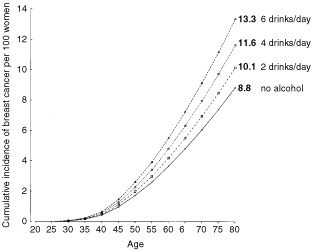
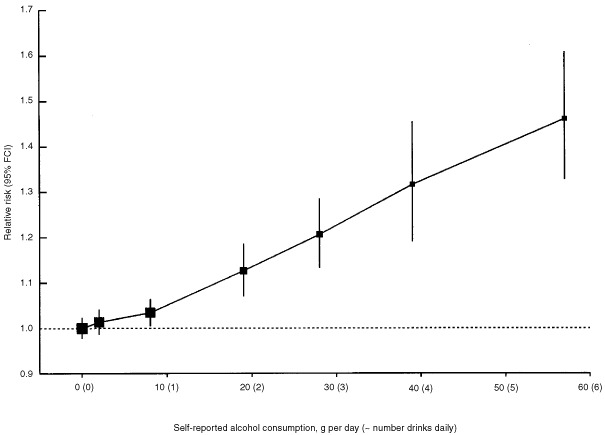
Alcohol and tobacco consumption are closely correlated and published results on their association with breast cancer have not always allowed adequately for confounding between these exposures. Over 80% of the relevant information worldwide on alcohol and tobacco consumption and breast cancer were collated, checked and analysed centrally. Analyses included 58,515 women with invasive breast cancer and 95,067 controls from 53 studies. Relative risks of breast cancer were estimated, after stratifying by study, age, parity and, where appropriate, women's age when their first child was born and consumption of alcohol and tobacco. The average consumption of alcohol reported by controls from developed countries was 6.0 g per day, i.e. about half a unit/drink of alcohol per day, and was greater in ever-smokers than never-smokers, (8.4 g per day and 5.0 g per day, respectively). Compared with women who reported drinking no alcohol, the relative risk of breast cancer was 1.32 (1.19-1.45, P<0.00001) for an intake of 35-44 g per day alcohol, and 1.46 (1.33-1.61, P<0.00001) for >/=45 g per day alcohol. The relative risk of breast cancer increased by 7.1% (95% CI 5.5-8.7%; P<0.00001) for each additional 10 g per day intake of alcohol, i.e. for each extra unit or drink of alcohol consumed on a daily basis. This increase was the same in ever-smokers and never-smokers (7.1% per 10 g per day, P<0.00001, in each group). By contrast, the relationship between smoking and breast cancer was substantially confounded by the effect of alcohol. When analyses were restricted to 22 255 women with breast cancer and 40 832 controls who reported drinking no alcohol, smoking was not associated with breast cancer (compared to never-smokers, relative risk for ever-smokers=1.03, 95% CI 0.98-1.07, and for current smokers=0.99, 0.92-1.05). The results for alcohol and for tobacco did not vary substantially across studies, study designs, or according to 15 personal characteristics of the women; nor were the findings materially confounded by any of these factors. If the observed relationship for alcohol is causal, these results suggest that about 4% of the breast cancers in developed countries are attributable to alcohol. In developing countries, where alcohol consumption among controls averaged only 0.4 g per day, alcohol would have a negligible effect on the incidence of breast cancer. In conclusion, smoking has little or no independent effect on the risk of developing breast cancer; the effect of alcohol on breast cancer needs to be interpreted in the context of its beneficial effects, in moderation, on cardiovascular disease and its harmful effects on cirrhosis and cancers of the mouth, larynx, oesophagus and liver.

摘要

酒精消费与烟草消费密切相关,已发表的关于它们与乳腺癌关联的研究结果,并未总是充分考虑到这些暴露因素之间的混杂作用。全球超过80%的关于酒精和烟草消费以及乳腺癌的相关信息,都在中心层面进行了整理、核查和分析。分析纳入了来自53项研究的58515例浸润性乳腺癌女性和95067例对照。在按研究、年龄、产次进行分层后,以及在适当时按女性生育第一个孩子时的年龄、酒精和烟草消费情况进行分层后,估计了乳腺癌的相对风险。发达国家对照人群报告的酒精平均消费量为每天6.0克,即每天约半单位/杯酒精,且曾经吸烟者的酒精消费量高于从不吸烟者(分别为每天8.4克和每天5.0克)。与报告不饮酒的女性相比,每天酒精摄入量为35 - 44克时,乳腺癌的相对风险为1.32(1.19 - 1.45,P<0.00001),每天酒精摄入量≥45克时,相对风险为1.46(1.33 - 1.61,P<0.00001)。每天每额外摄入10克酒精,即每天每多喝一单位或一杯酒精,乳腺癌的相对风险增加7.1%(95%置信区间5.5 - 8.7%;P<0.00001)。在曾经吸烟者和从不吸烟者中,这种增加幅度相同(每组每天每10克酒精增加7.1%,P<0.00001)。相比之下,吸烟与乳腺癌之间的关系因酒精的影响而存在显著混杂。当分析仅限于22255例乳腺癌女性和40832例报告不饮酒的对照时,吸烟与乳腺癌无关联(与从不吸烟者相比,曾经吸烟者的相对风险 = 1.03,95%置信区间0.98 - 1.07,当前吸烟者的相对风险 = 0.99,0.92 - 1.05)。酒精和烟草的研究结果在不同研究、研究设计之间,或根据女性的15项个人特征,均未表现出显著差异;这些因素也未对研究结果造成实质性混杂。如果观察到的酒精与乳腺癌之间的关系是因果关系,这些结果表明,发达国家约4%的乳腺癌可归因于酒精。在发展中国家,对照人群的酒精平均消费量仅为每天0.4克,酒精对乳腺癌发病率的影响可忽略不计。总之,吸烟对患乳腺癌风险几乎没有或没有独立影响;酒精对乳腺癌的影响需要在其对心血管疾病的适度有益作用以及对肝硬化和口腔、喉、食管及肝癌的有害作用的背景下进行解读。
https://cdn.ncbi.nlm.nih.gov/pmc/blobs/98f6/2562507/03f0e03e4496/87-6600596f5.jpg
https://cdn.ncbi.nlm.nih.gov/pmc/blobs/98f6/2562507/0a48f74abe6e/87-6600596f1.jpg
https://cdn.ncbi.nlm.nih.gov/pmc/blobs/98f6/2562507/8ffc542bf84b/87-6600596f2.jpg
https://cdn.ncbi.nlm.nih.gov/pmc/blobs/98f6/2562507/9d09d252c9a7/87-6600596f3.jpg
https://cdn.ncbi.nlm.nih.gov/pmc/blobs/98f6/2562507/3e10548d421a/87-6600596f4.jpg
https://cdn.ncbi.nlm.nih.gov/pmc/blobs/98f6/2562507/03f0e03e4496/87-6600596f5.jpg
https://cdn.ncbi.nlm.nih.gov/pmc/blobs/98f6/2562507/0a48f74abe6e/87-6600596f1.jpg
https://cdn.ncbi.nlm.nih.gov/pmc/blobs/98f6/2562507/8ffc542bf84b/87-6600596f2.jpg
https://cdn.ncbi.nlm.nih.gov/pmc/blobs/98f6/2562507/9d09d252c9a7/87-6600596f3.jpg
https://cdn.ncbi.nlm.nih.gov/pmc/blobs/98f6/2562507/3e10548d421a/87-6600596f4.jpg
https://cdn.ncbi.nlm.nih.gov/pmc/blobs/98f6/2562507/03f0e03e4496/87-6600596f5.jpg

相似文献

1
Alcohol, tobacco and breast cancer--collaborative reanalysis of individual data from 53 epidemiological studies, including 58,515 women with breast cancer and 95,067 women without the disease.酒精、烟草与乳腺癌——对53项流行病学研究的个体数据进行的联合重新分析,其中包括58515名乳腺癌女性患者和95067名未患该病的女性。
Br J Cancer. 2002 Nov 18;87(11):1234-45. doi: 10.1038/sj.bjc.6600596.
2
Moderate alcohol intake and cancer incidence in women.女性适度饮酒与癌症发病率
J Natl Cancer Inst. 2009 Mar 4;101(5):296-305. doi: 10.1093/jnci/djn514. Epub 2009 Feb 24.
3
Alcohol consumption and cancer incidence in women: interaction with smoking, body mass index and menopausal hormone therapy.饮酒与女性癌症发病率:与吸烟、体重指数和绝经激素治疗的相互作用。
BMC Cancer. 2023 Aug 16;23(1):758. doi: 10.1186/s12885-023-11184-8.
4
Breast cancer and hormonal contraceptives: collaborative reanalysis of individual data on 53 297 women with breast cancer and 100 239 women without breast cancer from 54 epidemiological studies.乳腺癌与激素避孕药:对54项流行病学研究中53297例乳腺癌患者和100239例非乳腺癌患者的个体数据进行的联合重新分析。
Lancet. 1996 Jun 22;347(9017):1713-27. doi: 10.1016/s0140-6736(96)90806-5.
5
Alcohol, smoking, passive smoking and caffeine in relation to breast cancer risk in young women. UK National Case-Control Study Group.酒精、吸烟、被动吸烟及咖啡因与年轻女性患乳腺癌风险的关系。英国国家病例对照研究小组。
Br J Cancer. 1994 Jul;70(1):112-9. doi: 10.1038/bjc.1994.258.
6
Light to moderate intake of alcohol, drinking patterns, and risk of cancer: results from two prospective US cohort studies.酒精的轻度至中度摄入量、饮酒模式与癌症风险:两项美国前瞻性队列研究的结果
BMJ. 2015 Aug 18;351:h4238. doi: 10.1136/bmj.h4238.
7
Alcohol and lung cancer risk among never smokers: A pooled analysis from the international lung cancer consortium and the SYNERGY study.从不吸烟者中酒精与肺癌风险:来自国际肺癌联盟和SYNERGY研究的汇总分析
Int J Cancer. 2017 May 1;140(9):1976-1984. doi: 10.1002/ijc.30618. Epub 2017 Feb 27.
8
Breast cancer and breastfeeding: collaborative reanalysis of individual data from 47 epidemiological studies in 30 countries, including 50302 women with breast cancer and 96973 women without the disease.乳腺癌与母乳喂养:对来自30个国家的47项流行病学研究的个体数据进行的联合重新分析,其中包括50302名乳腺癌患者和96973名未患该病的女性。
Lancet. 2002 Jul 20;360(9328):187-95. doi: 10.1016/S0140-6736(02)09454-0.
9
Breast cancer and hormone replacement therapy: collaborative reanalysis of data from 51 epidemiological studies of 52,705 women with breast cancer and 108,411 women without breast cancer. Collaborative Group on Hormonal Factors in Breast Cancer.乳腺癌与激素替代疗法:对51项流行病学研究数据的联合重新分析,涉及52705例乳腺癌女性和108411例非乳腺癌女性。乳腺癌激素因素协作组
Lancet. 1997 Oct 11;350(9084):1047-59.
10
Incident cancers attributable to alcohol consumption in Germany, 2010.2010年德国归因于酒精消费的新发癌症病例
Cancer Causes Control. 2015 Jun;26(6):903-11. doi: 10.1007/s10552-015-0566-8. Epub 2015 Mar 24.

引用本文的文献

1
Recent strategies in diagnosis, screening, prevention, and treatment of breast cancer in young women.年轻女性乳腺癌诊断、筛查、预防及治疗的最新策略
Discov Oncol. 2025 Aug 11;16(1):1532. doi: 10.1007/s12672-025-03180-0.
2
Genetic Variants in (rs8073069, rs17878467, and rs9904341) Are Associated with Susceptibility in Mexican Patients with Breast Cancer: Clinical Associations and Their Analysis In Silico.(rs8073069、rs17878467和rs9904341)基因变异与墨西哥乳腺癌患者的易感性相关:临床关联及其计算机模拟分析
Genes (Basel). 2025 Jun 30;16(7):786. doi: 10.3390/genes16070786.
3
Optimizing breast cancer screening strategies for women with different BMI levels in Ghana: A simulation-based study on BMI-dependent tumor growth model.

本文引用的文献

1
Alcohol consumption increases the risk of fatal breast cancer (United States).饮酒会增加患致命性乳腺癌的风险(美国)。
Cancer Causes Control. 2001 Dec;12(10):895-902. doi: 10.1023/a:1013737616987.
2
Low-to-moderate alcohol consumption and breast cancer risk by age 50 years among women in Germany.德国女性50岁前低至中度饮酒与乳腺癌风险
Am J Epidemiol. 2001 Oct 1;154(7):624-34. doi: 10.1093/aje/154.7.624.
3
Serum hormones and the alcohol-breast cancer association in postmenopausal women.绝经后女性血清激素与酒精-乳腺癌关联
优化加纳不同BMI水平女性的乳腺癌筛查策略:基于BMI依赖性肿瘤生长模型的模拟研究
PLOS Glob Public Health. 2025 Jul 28;5(7):e0004953. doi: 10.1371/journal.pgph.0004953. eCollection 2025.
4
Associations of alcohol consumption with expression of CD44, CD24, and ALDH1A1 stem cell markers in benign breast biopsy samples.良性乳腺活检样本中酒精摄入与CD44、CD24和ALDH1A1干细胞标志物表达的相关性。
Cancer Causes Control. 2025 Jul 12. doi: 10.1007/s10552-025-02034-y.
5
Bayesian Spatial Analysis of the Incidence Rate of Patients with Breast Cancer in Southern Iran.伊朗南部乳腺癌患者发病率的贝叶斯空间分析
Iran J Med Sci. 2025 May 1;50(5):316-323. doi: 10.30476/ijms.2024.102475.3546. eCollection 2025 May.
6
Aromatics from fossil fuels and breast cancer.来自化石燃料的芳烃与乳腺癌
iScience. 2025 Mar 10;28(4):112204. doi: 10.1016/j.isci.2025.112204. eCollection 2025 Apr 18.
7
A randomized study of 2 risk assessment models for individualized breast cancer risk estimation.一项关于两种用于个体化乳腺癌风险评估的风险评估模型的随机研究。
J Natl Cancer Inst. 2025 Aug 1;117(8):1593-1604. doi: 10.1093/jnci/djaf067.
8
Human Cytomegalovirus Infection and Breast Cancer: A Literature Review of Clinical and Experimental Data.人巨细胞病毒感染与乳腺癌:临床与实验数据的文献综述
Biology (Basel). 2025 Feb 8;14(2):174. doi: 10.3390/biology14020174.
9
Incidence trends of early-onset breast cancer by lifestyle risk factors.早发性乳腺癌按生活方式风险因素划分的发病趋势。
BMC Cancer. 2025 Feb 21;25(1):326. doi: 10.1186/s12885-025-13730-y.
10
A narrative review on alcohol use in women: insight into the telescoping hypothesis from a biopsychosocial perspective.关于女性饮酒的叙述性综述:从生物心理社会角度洞察时间压缩假说。
Am J Drug Alcohol Abuse. 2025 Jan 2;51(1):14-30. doi: 10.1080/00952990.2024.2419540. Epub 2025 Jan 27.
J Natl Cancer Inst. 2001 May 2;93(9):710-5. doi: 10.1093/jnci/93.9.710.
4
The Million Women Study: design and characteristics of the study population. The Million Women Study Collaborative Group.百万女性研究:研究人群的设计与特征。百万女性研究协作组
Breast Cancer Res. 1999;1(1):73-80. doi: 10.1186/bcr16. Epub 1999 Aug 19.
5
Association of menstrual and reproductive factors with breast cancer risk: results from the Shanghai Breast Cancer Study.月经及生殖因素与乳腺癌风险的关联:上海乳腺癌研究结果
Int J Cancer. 2000 Jul 15;87(2):295-300. doi: 10.1002/1097-0215(20000715)87:2<295::aid-ijc23>3.0.co;2-7.
6
Design and analysis issues in a population-based, case-control-family study of the genetic epidemiology of breast cancer and the Co-operative Family Registry for Breast Cancer Studies (CFRBCS).基于人群的乳腺癌遗传流行病学病例对照家系研究及乳腺癌研究合作家系登记处(CFRBCS)中的设计与分析问题。
J Natl Cancer Inst Monogr. 1999(26):95-100. doi: 10.1093/oxfordjournals.jncimonographs.a024232.
7
Passive and active smoking and breast cancer risk in Canada, 1994-97.1994 - 1997年加拿大被动吸烟、主动吸烟与乳腺癌风险
Cancer Causes Control. 2000 Mar;11(3):211-21. doi: 10.1023/a:1008906105790.
8
Breast cancer and hormone replacement therapy: collaborative reanalysis of data from 51 epidemiological studies of 52,705 women with breast cancer and 108,411 women without breast cancer. Collaborative Group on Hormonal Factors in Breast Cancer.乳腺癌与激素替代疗法:对51项流行病学研究数据的联合重新分析,涉及52705例乳腺癌女性和108411例非乳腺癌女性。乳腺癌激素因素协作组
Lancet. 1997 Oct 11;350(9084):1047-59.
9
Breast-cancer risk following long-term oestrogen- and oestrogen-progestin-replacement therapy.长期雌激素和雌激素-孕激素替代疗法后的乳腺癌风险
Int J Cancer. 1999 May 5;81(3):339-44. doi: 10.1002/(sici)1097-0215(19990505)81:3<339::aid-ijc5>3.0.co;2-6.
10
Alcohol consumption and breast cancer oestrogen and progesterone receptor status.饮酒与乳腺癌雌激素和孕激素受体状态。
Br J Cancer. 1999 Mar;79(7-8):1308-14. doi: 10.1038/sj.bjc.6690210.