Levitt David G
Department of Physiology University of Minnesota, Minneapolis, MN 55455, USA.
BMC Clin Pharmacol. 2003 Mar 19;3:1. doi: 10.1186/1472-6904-3-1.
An unknown input function can be determined by deconvolution using the systemic bolus input function (r) determined using an experimental input of duration ranging from a few seconds to many minutes. The quantitative relation between the duration of the input and the accuracy of r is unknown. Although a large number of deconvolution procedures have been described, these routines are not available in a convenient software package.
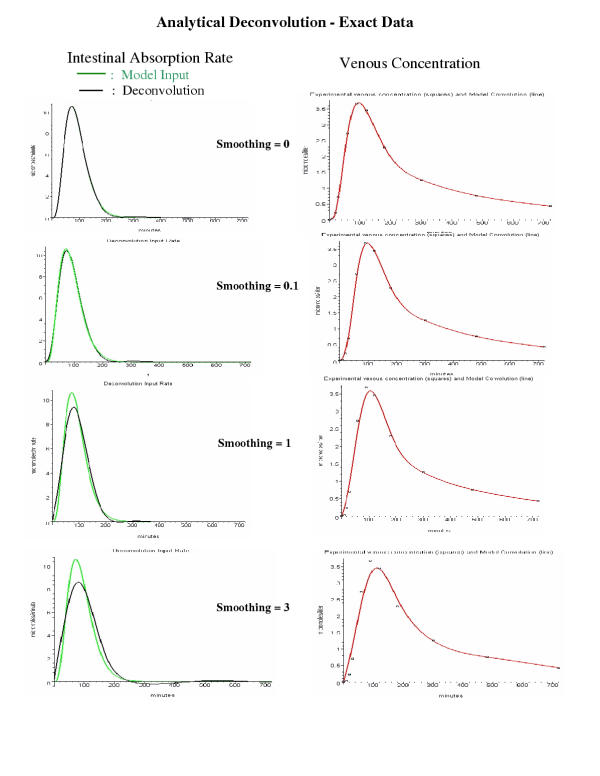
Four deconvolution methods are implemented in a new, user-friendly software program (PKQuest, http://www.pkquest.com). Three of these methods are characterized by input parameters that are adjusted by the user to provide the "best" fit. A new approach is used to determine these parameters, based on the assumption that the input can be approximated by a gamma distribution. Deconvolution methodologies are evaluated using data generated from a physiologically based pharmacokinetic model (PBPK).
The 11-compartment PBPK model is accurately described by either a 2 or 3-exponential function, depending on whether or not there is significant tissue binding. For an accurate estimate of r the first venous sample should be at or before the end of the constant infusion and a long (10 minute) constant infusion is preferable to a bolus injection. For noisy data, a gamma distribution deconvolution provides the best result if the input has the form of a gamma distribution. For other input functions, good results are obtained using deconvolution methods based on modeling the input with either a B-spline or uniform dense set of time points.
未知输入函数可通过反卷积法来确定,该方法使用通过持续时间从几秒到几分钟不等的实验输入所确定的全身团注输入函数(r)。输入持续时间与r的准确性之间的定量关系尚不清楚。尽管已经描述了大量的反卷积程序,但这些程序并未包含在方便的软件包中。
在一个全新的、用户友好的软件程序(PKQuest,http://www.pkquest.com)中实现了四种反卷积方法。其中三种方法的特点是输入参数可由用户进行调整以提供“最佳”拟合。基于输入可由伽马分布近似这一假设,采用一种新方法来确定这些参数。使用基于生理药代动力学模型(PBPK)生成的数据对反卷积方法进行评估。
根据是否存在显著的组织结合情况,11房室PBPK模型可由二指数函数或三指数函数准确描述。为了准确估计r,首次静脉采样应在恒速输注结束时或之前进行,且长时间(10分钟)恒速输注优于单次团注注射。对于有噪声的数据,如果输入具有伽马分布的形式,伽马分布反卷积可提供最佳结果。对于其他输入函数,使用基于用B样条或均匀密集时间点集对输入进行建模的反卷积方法可获得良好结果。