Warburton David, Bellusci Saverio, Del Moral Pierre-Marie, Kaartinen Vesa, Lee Matt, Tefft Denise, Shi Wei
Developmental Biology Program, Childrens Hospital Los Angeles Research Institute and the Center for Craniofacial Molecular Biology, Keck School of Medicine and School of Dentistry, University of Southern California, USA.
Respir Res. 2003;4(1):5. doi: 10.1186/1465-9921-4-5. Epub 2003 Jun 19.
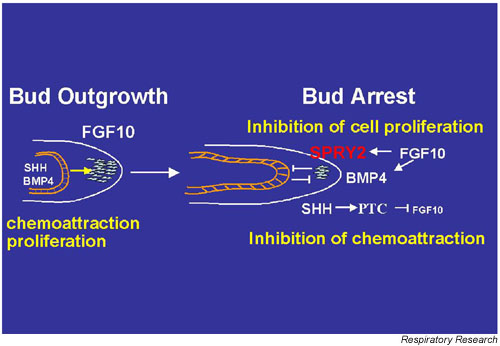
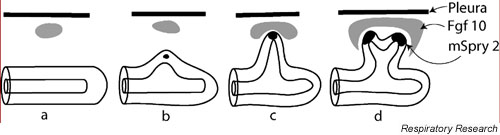
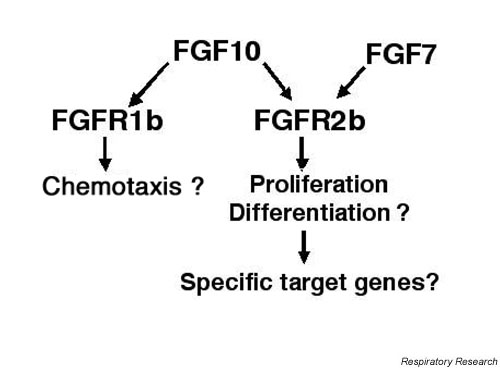
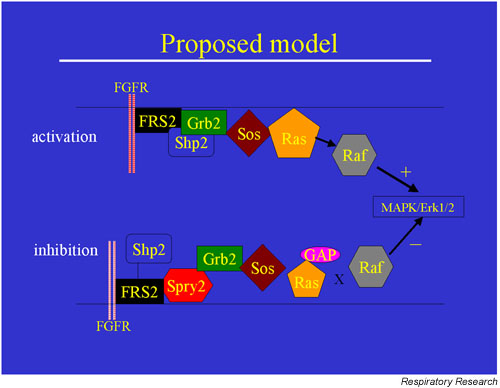
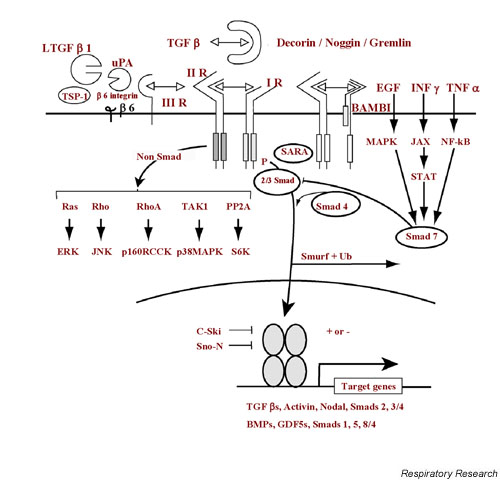
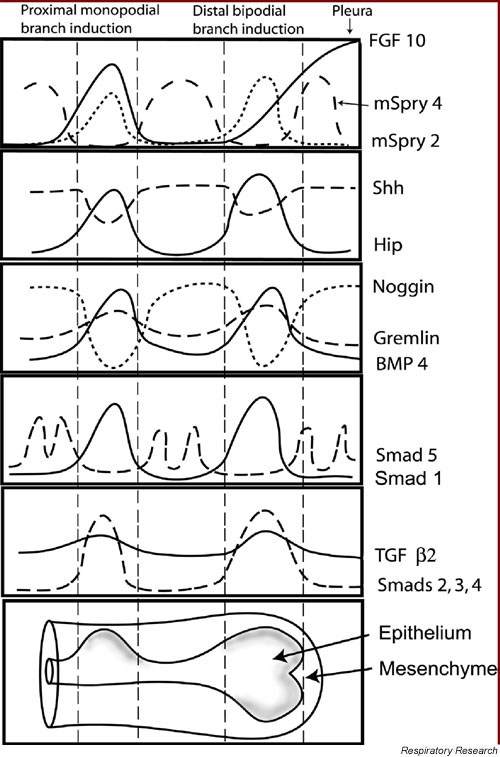
Lung morphogenesis is stereotypic, both for lobation and for the first several generations of airways, implying mechanistic control by a well conserved, genetically hardwired developmental program. This program is not only directed by transcriptional factors and peptide growth factor signaling, but also co-opts and is modulated by physical forces. Peptide growth factors signal within repeating epithelial-mesenchymal temporospatial patterns that constitute morphogenetic centers, automatically directing millions of repetitive events during both stereotypic branching and nonstereotypic branching as well as alveolar surface expansion phases of lung development. Transduction of peptide growth factor signaling within these centers is finely regulated at multiple levels. These may include ligand expression, proteolytic activation of latent ligand, ligand bioavailability, ligand binding proteins and receptor affinity and presentation, receptor complex assembly and kinase activation, phosphorylation and activation of adapter and messenger protein complexes as well as downstream events and cross-talk both inside and outside the nucleus. Herein we review the critical Sonic Hedgehog, Fibroblast Growth Factor, Bone Morphogenetic Protein, Vascular Endothelial Growth Factor and Transforming Growth Factorbeta signaling pathways and propose how they may be functionally coordinated within compound, highly regulated morphogenetic gradients that drive first stereotypic and then non-stereotypic, automatically repetitive, symmetrical as well as asymmetrical branching events in the lung.
肺形态发生是定型的,无论是肺叶形成还是最初几代气道的形成,这意味着由一个高度保守、基因编码的发育程序进行机制控制。该程序不仅受转录因子和肽生长因子信号传导的指导,还会借助物理力并受其调节。肽生长因子在构成形态发生中心的重复上皮-间充质时空模式内发出信号,在肺发育的定型分支、非定型分支以及肺泡表面扩张阶段自动指导数百万次重复事件。这些中心内肽生长因子信号的转导在多个层面受到精细调节。这可能包括配体表达、潜在配体的蛋白水解激活、配体生物利用度、配体结合蛋白以及受体亲和力和呈递、受体复合物组装和激酶激活、衔接蛋白和信使蛋白复合物的磷酸化和激活,以及细胞核内外的下游事件和相互作用。在此,我们综述关键的音猬因子、成纤维细胞生长因子、骨形态发生蛋白、血管内皮生长因子和转化生长因子β信号通路,并提出它们如何在复合的、高度调节的形态发生梯度内进行功能协调,这些梯度驱动肺中首先是定型的,然后是非定型的、自动重复的、对称以及不对称的分支事件。