Lutfalla Georges, Roest Crollius Hugues, Stange-Thomann Nicole, Jaillon Olivier, Mogensen Knud, Monneron Danièle
Défenses antivirales et antitumorales, CNRS-UMR5124, 1919 route de Mende, 34293 Montpellier Cedex 5, France.
BMC Genomics. 2003 Jul 17;4(1):29. doi: 10.1186/1471-2164-4-29.
The high degree of sequence conservation between coding regions in fish and mammals can be exploited to identify genes in mammalian genomes by comparison with the sequence of similar genes in fish. Conversely, experimentally characterized mammalian genes may be used to annotate fish genomes. However, gene families that escape this principle include the rapidly diverging cytokines that regulate the immune system, and their receptors. A classic example is the class II helical cytokines (HCII) including type I, type II and lambda interferons, IL10 related cytokines (IL10, IL19, IL20, IL22, IL24 and IL26) and their receptors (HCRII). Despite the report of a near complete pufferfish (Takifugu rubripes) genome sequence, these genes remain undescribed in fish.
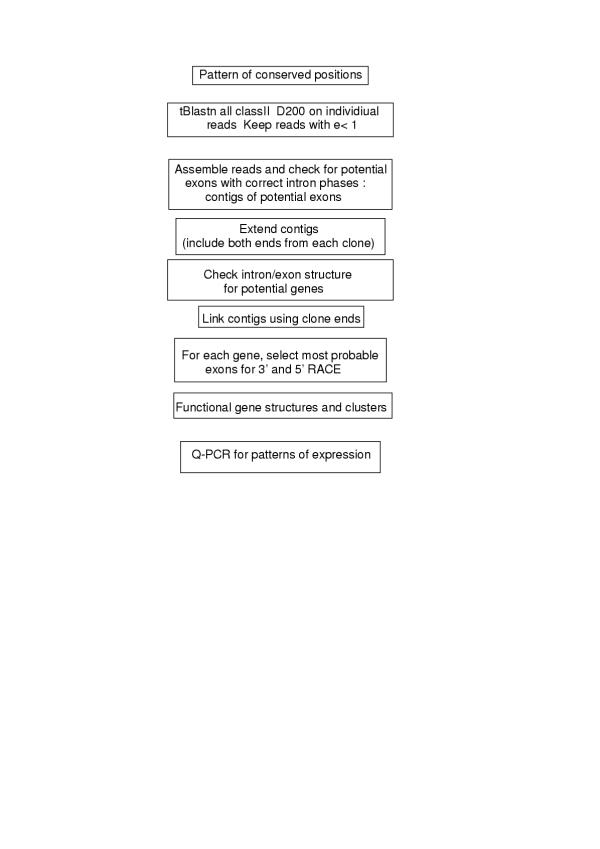
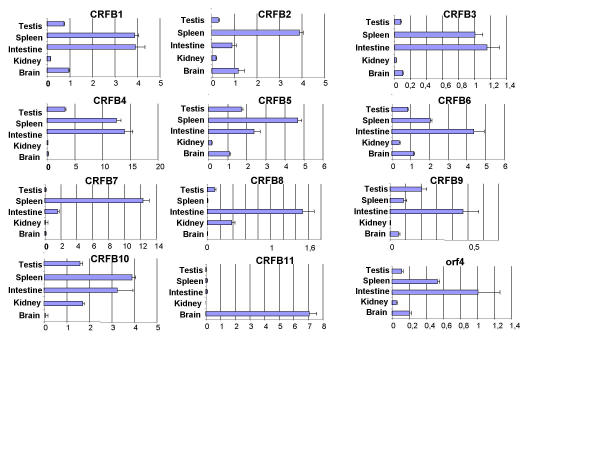
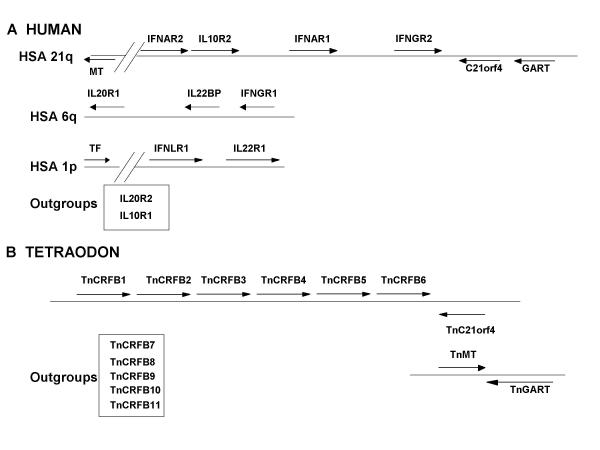
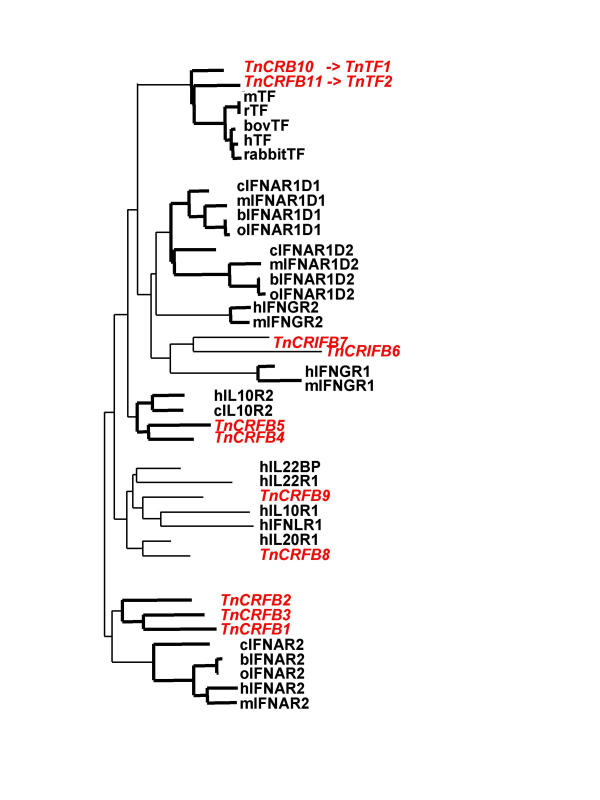
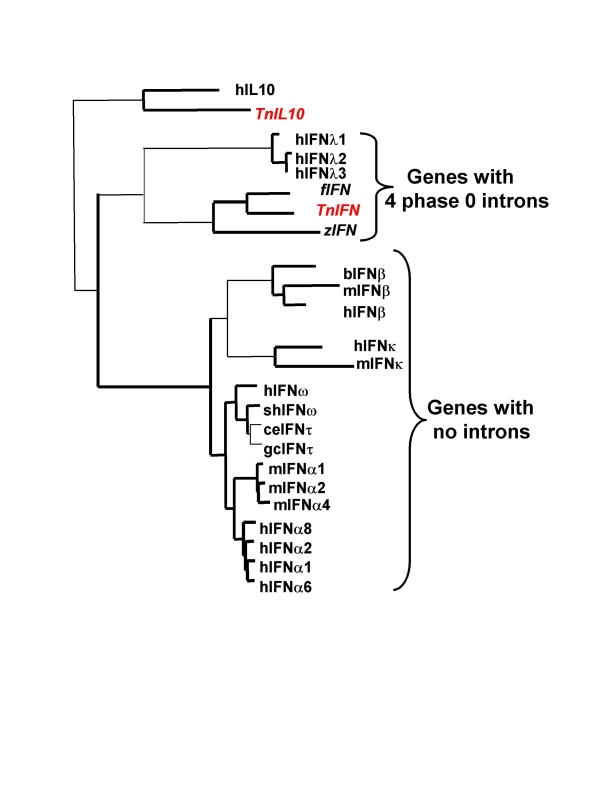
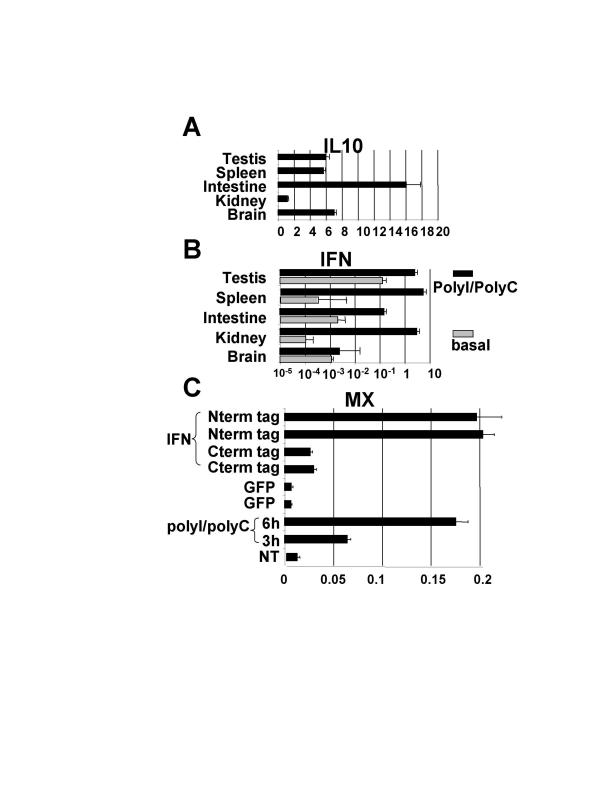
We have used an original strategy based both on conserved amino acid sequence and gene structure to identify HCII and HCRII in the genome of another pufferfish, Tetraodon nigroviridis that is amenable to laboratory experiments. The 15 genes that were identified are highly divergent and include a single interferon molecule, three IL10 related cytokines and their potential receptors together with two Tissue Factor (TF). Some of these genes form tandem clusters on the Tetraodon genome. Their expression pattern was determined in different tissues. Most importantly, Tetraodon interferon was identified and we show that the recombinant protein can induce antiviral MX gene expression in Tetraodon primary kidney cells. Similar results were obtained in Zebrafish which has 7 MX genes.
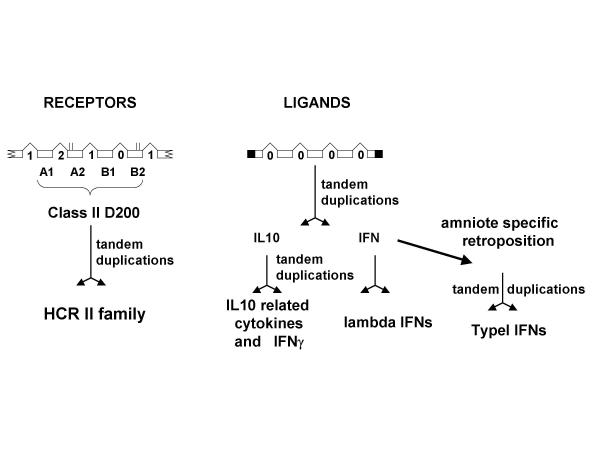
We propose a scheme for the evolution of HCII and their receptors during the radiation of bony vertebrates and suggest that the diversification that played an important role in the fine-tuning of the ancestral mechanism for host defense against infections probably followed different pathways in amniotes and fish.
鱼类和哺乳动物编码区之间高度的序列保守性可用于通过与鱼类中相似基因的序列比较来鉴定哺乳动物基因组中的基因。相反,经实验表征的哺乳动物基因可用于注释鱼类基因组。然而,不受这一原则约束的基因家族包括快速分化的调节免疫系统的细胞因子及其受体。一个经典例子是II类螺旋细胞因子(HCII),包括I型、II型和λ干扰素、IL10相关细胞因子(IL10、IL19、IL20、IL22、IL24和IL26)及其受体(HCRII)。尽管已经报道了近乎完整的河豚(红鳍东方鲀)基因组序列,但这些基因在鱼类中仍未得到描述。
我们采用了一种基于保守氨基酸序列和基因结构的原始策略,在另一种适合实验室实验的河豚——黑青斑河豚的基因组中鉴定HCII和HCRII。鉴定出的15个基因高度分化,包括一个单一的干扰素分子、三种IL10相关细胞因子及其潜在受体以及两个组织因子(TF)。其中一些基因在黑青斑河豚基因组上形成串联簇。我们确定了它们在不同组织中的表达模式。最重要的是,鉴定出了黑青斑河豚干扰素,并且我们表明重组蛋白可以诱导黑青斑河豚原代肾细胞中抗病毒MX基因的表达。在具有7个MX基因的斑马鱼中也获得了类似结果。
我们提出了一个在硬骨脊椎动物辐射过程中HCII及其受体的进化方案,并表明在宿主防御感染的祖先机制微调中起重要作用的多样化可能在羊膜动物和鱼类中遵循了不同的途径。