Bienz K, Egger D, Pfister T, Troxler M
Institute for Medical Microbiology, University of Basel, Switzerland.
J Virol. 1992 May;66(5):2740-7. doi: 10.1128/JVI.66.5.2740-2747.1992.
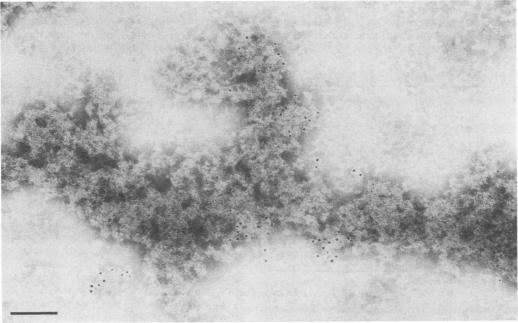
Two populations of membrane-bound replication complexes were isolated from poliovirus-infected HEp-2 cells by sucrose gradient centrifugation. The two fractions show similar ultrastructural features: the replication complex is enclosed in a rosettelike shell of virus-induced vesicles and contains a very tightly packed second membrane system (compact membranes). The vesicular fraction, which bands in 30% sucrose, contains replicative intermediate (RI) and 36S RNA. The fraction banding in 45% sucrose contains only minute amounts of RI and contains mainly 36S RNA, two-thirds of which is encapsidated. In vitro, the two fractions show similar RNA synthesizing capacities and produce 36S plus-strand RNA. Dissolving the membranes within and around synthetically active replication complexes with sodium deoxycholate abolishes the completion of 36S RNA but still allows elongation in the RI. Our findings suggest an architecture of the replication complex that has the nascent plus strands on the RI enclosed in the compact membranes and the replication forks wrapped additionally in protein. Plus-strand RNA can be localized by in situ hybridization with a biotinylated riboprobe between the replication complex and the rosette of the virus-induced vesicles. It was found that the progeny RNA strands are set free soon after completion from the replication complex at the sites where the compact membranes within the replication complex are in close contact with the surrounding virus-induced vesicles.
通过蔗糖梯度离心从感染脊髓灰质炎病毒的HEp - 2细胞中分离出两群膜结合复制复合物。这两个组分显示出相似的超微结构特征:复制复合物被包裹在病毒诱导的囊泡形成的玫瑰花结样外壳中,并包含一个紧密堆积的第二膜系统(致密膜)。在30%蔗糖中形成条带的囊泡组分含有复制中间体(RI)和36S RNA。在45%蔗糖中形成条带的组分仅含有少量RI,主要包含36S RNA,其中三分之二被包装。在体外,这两个组分显示出相似的RNA合成能力,并产生36S正链RNA。用脱氧胆酸钠溶解合成活性复制复合物内部和周围的膜会阻止36S RNA的合成完成,但仍允许RI中的延伸。我们的发现表明复制复合物的一种结构,即RI上的新生正链被包裹在致密膜中,复制叉还被蛋白质包裹。正链RNA可以通过与生物素化核糖探针的原位杂交定位在复制复合物和病毒诱导囊泡的玫瑰花结之间。研究发现,子代RNA链在从复制复合物完成合成后很快就在复制复合物内致密膜与周围病毒诱导囊泡紧密接触的部位被释放出来。