Nakashita H, Shimazu A, Hidaka T, Seto H
Institute of Applied Microbiology, University of Tokyo, Japan.
J Bacteriol. 1992 Nov;174(21):6857-61. doi: 10.1128/jb.174.21.6857-6861.1992.
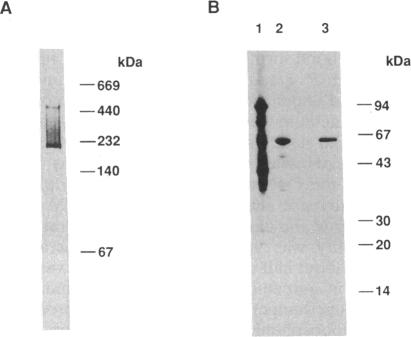
Phosphoenolpyruvate phosphomutase (PEPPM) catalyzes C-P bond formation by intramolecular rearrangement of phosphoenolpyruvate to phosphonopyruvate (PnPy). We purified PEPPM from a gram-negative bacterium, Pseudomonas gladioli B-1 isolated as a C-P compound producer. The equilibrium of this reaction favors the formation of the phosphate ester by cleaving the C-P bond of PnPy, but the C-P bond-forming reaction is physiologically significant. The C-P bond-forming activity of PEPPM was confirmed with a purified protein. The molecular mass of the native enzyme was estimated to be 263 and 220 kDa by gel filtration and polyacrylamide gel electrophoresis, respectively. A subunit molecular mass of 61 kDa was determined by sodium dodecyl sulfate-polyacrylamide gel electrophoresis, indicating that the native protein was a tetramer. The optimum pH and temperature were 7.5 to 8.0 and 40 degrees C, respectively. The Km value for PnPy was 19 +/- 3.5 microM, and the maximum initial velocity of the conversion of PnPy to phosphoenolpyruvate was 200 microM/s/mg. PEPPM was activated by the presence of the divalent metal ion, and the Km values were 3.5 +/- 1.4 microM for Mg2+, 16 +/- 5 nM for Mn2+, 3.0 +/- 1.5 microM for Zn2+, and 1.2 +/- 0.2 microM for Co2+.
磷酸烯醇丙酮酸磷酸变位酶(PEPPM)通过将磷酸烯醇丙酮酸分子内重排为膦酰丙酮酸(PnPy)来催化C-P键的形成。我们从革兰氏阴性菌唐菖蒲假单胞菌B-1中纯化了PEPPM,该菌是作为一种C-P化合物生产者分离得到的。该反应的平衡有利于通过裂解PnPy的C-P键形成磷酸酯,但C-P键形成反应具有生理意义。用纯化的蛋白质证实了PEPPM的C-P键形成活性。通过凝胶过滤和聚丙烯酰胺凝胶电泳分别估计天然酶的分子量为263 kDa和220 kDa。通过十二烷基硫酸钠-聚丙烯酰胺凝胶电泳测定亚基分子量为61 kDa,表明天然蛋白是四聚体。最适pH和温度分别为7.5至8.0和40℃。PnPy的Km值为19±3.5μM,PnPy转化为磷酸烯醇丙酮酸的最大初始速度为200μM/(s·mg)。PEPPM在二价金属离子存在下被激活,Mg2+的Km值为3.5±1.4μM,Mn2+为16±5 nM,Zn2+为3.0±1.5μM,Co2+为1.2±0.2μM。