Akopyanz N, Bukanov N O, Westblom T U, Kresovich S, Berg D E
Department of Molecular Microbiology, Washington University Medical School, St Louis, MO 63110.
Nucleic Acids Res. 1992 Oct 11;20(19):5137-42. doi: 10.1093/nar/20.19.5137.
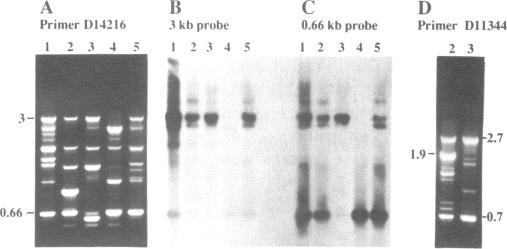
The RAPD (or AP-PCR) DNA fingerprinting method was used to distinguish among clinical isolates of Helicobacter pylori, a bacterium whose long term carriage is associated with gastritis, peptic ulcers and gastric carcinomas. This method uses arbitrarily chosen oligonucleotides to prime DNA synthesis from genomic sites to which they are fortuitously matched, or almost matched. Most 10-nt primers with > or = 60% G + C yielded strain-specific arrays of up to 15 prominent fragments, as did most longer (> or = 17-nt) primers, whereas most 10-nt primers with 50% G+C did not. Each of 64 independent H. pylori isolates, 60 of which were from patients in the same hospital, was distinguishable with a single RAPD primer, which suggests a high level of DNA sequence diversity within this species. In contrast, isolates from initial and followup biopsies were indistinguishable in each of three cases tested.
随机扩增多态性DNA(RAPD,或任意引物PCR)指纹图谱法被用于区分幽门螺杆菌的临床分离株,幽门螺杆菌长期携带与胃炎、消化性溃疡及胃癌相关。该方法使用任意选择的寡核苷酸从与之偶然匹配或几乎匹配的基因组位点起始DNA合成。多数含有≥60% G + C的10个核苷酸的引物产生多达15个突出条带的菌株特异性条带阵列,多数更长(≥17个核苷酸)的引物也是如此,而多数含有50% G + C的10个核苷酸的引物则不然。64株独立的幽门螺杆菌分离株中的每一株(其中60株来自同一家医院的患者)都能用单一的RAPD引物区分,这表明该物种内DNA序列具有高度多样性。相比之下,在检测的三个病例中,初次活检和随访活检的分离株无法区分。