Calandra Thierry, Roger Thierry
Division of Infectious Diseases, Department of Internal Medicine, Centre Hospitalier Universitaire Vaudois, CH-1011 Lausanne, Switzerland.
Nat Rev Immunol. 2003 Oct;3(10):791-800. doi: 10.1038/nri1200.
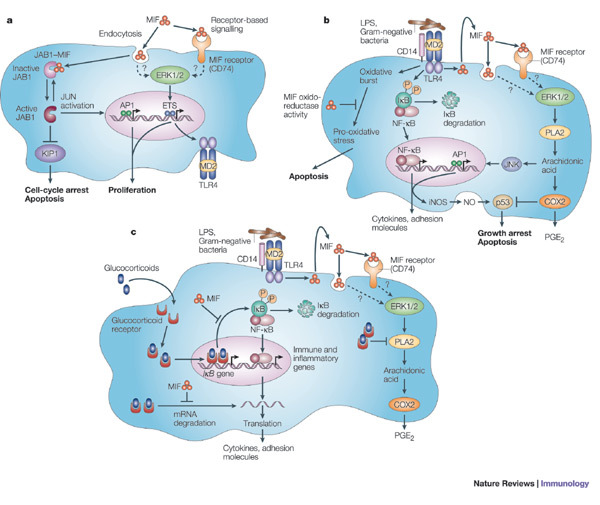
For more than a quarter of a century, macrophage migration inhibitory factor (MIF) has been a mysterious cytokine. In recent years, MIF has assumed an important role as a pivotal regulator of innate immunity. MIF is an integral component of the host antimicrobial alarm system and stress response that promotes the pro-inflammatory functions of immune cells. A rapidly increasing amount of literature indicates that MIF is implicated in the pathogenesis of sepsis, and inflammatory and autoimmune diseases, suggesting that MIF-directed therapies might offer new treatment opportunities for human diseases in the future.
在超过四分之一个世纪的时间里,巨噬细胞移动抑制因子(MIF)一直是一种神秘的细胞因子。近年来,MIF作为先天性免疫的关键调节因子发挥了重要作用。MIF是宿主抗微生物警报系统和应激反应的一个组成部分,可促进免疫细胞的促炎功能。越来越多的文献表明,MIF与脓毒症、炎症和自身免疫性疾病的发病机制有关,这表明针对MIF的疗法可能在未来为人类疾病提供新的治疗机会。