Hwang Eun Jung, Donchin Opher, Smith Maurice A, Shadmehr Reza
Laboratory for Computational Motor Control, Department of Biomedical Engineering, Johns Hopkins School of Medicine, Baltimore, Maryland, USA.
PLoS Biol. 2003 Nov;1(2):E25. doi: 10.1371/journal.pbio.0000025. Epub 2003 Nov 17.
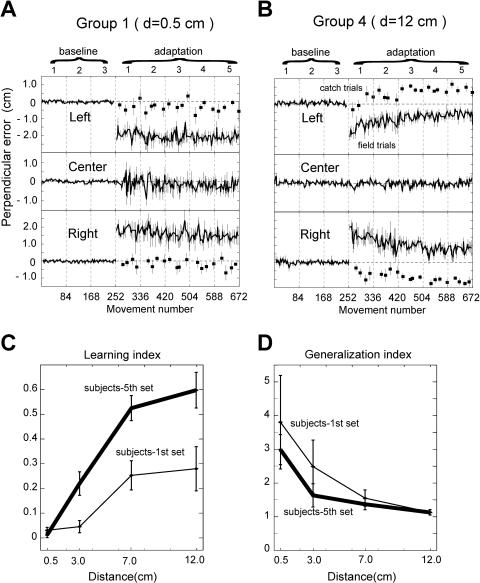
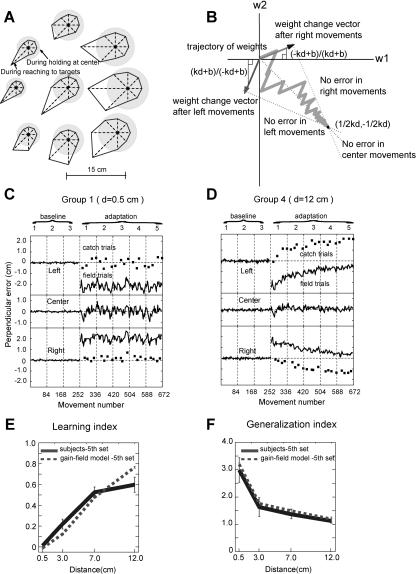
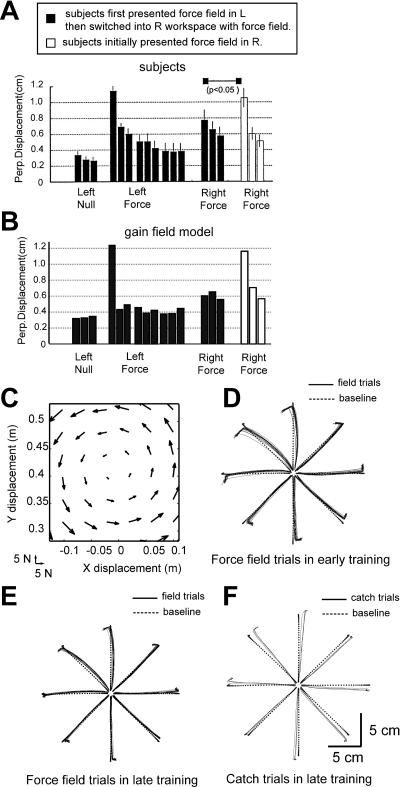
Adaptability of reaching movements depends on a computation in the brain that transforms sensory cues, such as those that indicate the position and velocity of the arm, into motor commands. Theoretical consideration shows that the encoding properties of neural elements implementing this transformation dictate how errors should generalize from one limb position and velocity to another. To estimate how sensory cues are encoded by these neural elements, we designed experiments that quantified spatial generalization in environments where forces depended on both position and velocity of the limb. The patterns of error generalization suggest that the neural elements that compute the transformation encode limb position and velocity in intrinsic coordinates via a gain-field; i.e., the elements have directionally dependent tuning that is modulated monotonically with limb position. The gain-field encoding makes the counterintuitive prediction of hypergeneralization: there should be growing extrapolation beyond the trained workspace. Furthermore, nonmonotonic force patterns should be more difficult to learn than monotonic ones. We confirmed these predictions experimentally.
伸手动作的适应性取决于大脑中的一种计算,这种计算将感觉线索(例如指示手臂位置和速度的线索)转化为运动指令。理论思考表明,实现这种转化的神经元的编码特性决定了误差应如何从一个肢体位置和速度推广到另一个位置和速度。为了估计这些神经元如何编码感觉线索,我们设计了实验,在力取决于肢体位置和速度的环境中量化空间推广。误差推广模式表明,进行这种转化计算的神经元通过增益场在内禀坐标系中编码肢体位置和速度;也就是说,这些神经元具有方向依赖的调谐,且该调谐随肢体位置单调调制。增益场编码做出了超推广这一违反直觉的预测:在训练的工作空间之外应该有越来越多的外推。此外,非单调力模式应该比单调力模式更难学习。我们通过实验证实了这些预测。