Markoff Lewis
Laboratory of Vector-Borne Virus Diseases, Center for Biologics Evaluation and Research, Food and Drug Administration, Bethesda, Maryland 20892, USA.
Adv Virus Res. 2003;59:177-228. doi: 10.1016/s0065-3527(03)59006-6.
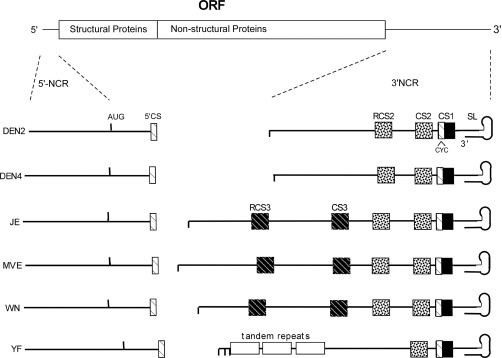
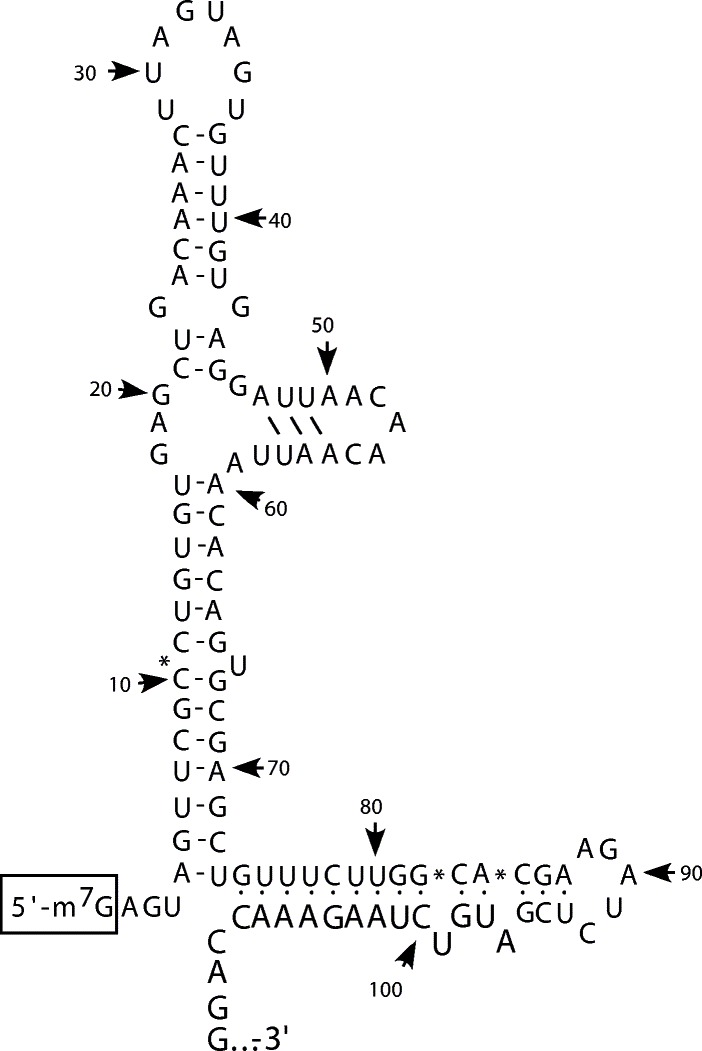
The flavivirus genome is a capped, positive-sense RNA approximately 10.5 kb in length. It contains a single long open reading frame (ORF), flanked by a 5´ noncoding regions (NCR), which is about 100 nucleotides in length, and a 3´ NCR ranging in size from about 400 to 800 nucleotides in length. The conserved structural and nucleotide sequence elements of these NCRs and their function in RNA replication and translation are the subjects of this chapter. The 5´ and 3´ NCRs play a role in the initiation of negative-strand synthesis on virus RNA released from entering virions, switching from negative-strand synthesis to synthesis of progeny plus strand RNA at late times after infection, and possibly in the initiation of translation and in the packaging of virus plus strand RNA into particles. The presence of conserved and nonconserved complementary nucleotide sequences near the 5´ and 3´ termini of flavivirus genomes suggests that ‘‘panhandle’’ or circular RNA structures are formed transiently by hydrogen bonding at some stage during RNA replication.
黄病毒基因组是一种长度约为10.5 kb的加帽正义RNA。它包含一个单一的长开放阅读框(ORF),两侧是一个长度约为100个核苷酸的5´非编码区(NCR)和一个长度在约400至800个核苷酸之间的3´ NCR。这些NCR的保守结构和核苷酸序列元件及其在RNA复制和翻译中的功能是本章的主题。5´和3´ NCR在从进入的病毒粒子释放的病毒RNA上负链合成的起始、感染后期从负链合成向子代正链RNA合成的转换中发挥作用,并且可能在翻译起始以及将病毒正链RNA包装到病毒颗粒中发挥作用。黄病毒基因组5´和3´末端附近存在保守和非保守的互补核苷酸序列,这表明在RNA复制的某个阶段,“柄环”或环状RNA结构通过氢键短暂形成。