Webster Robert G
Division of Virology, Department of Infectious Diseases, St Jude Children's Research Hospital, Memphis, TN 38105, USA.
Lancet. 2004 Jan 17;363(9404):234-6. doi: 10.1016/S0140-6736(03)15329-9.
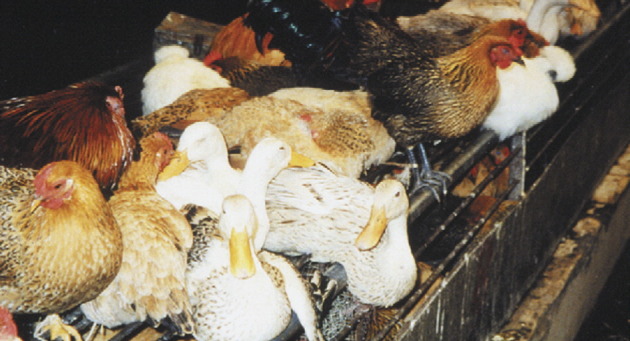
Live-animal markets (wet markets) provide a source of vertebrate and invertebrate animals for customers in tropical and subtropical regions of the world. Wet markets sell live poultry, fish, reptiles, and mammals of every kind. Live-poultry markets (mostly chicken, pigeon, quail, ducks, geese, and a wide range of exotic wild-caught and farm-raised fowl) are usually separated from markets selling fish or red-meat animals, but the stalls can be near each other with no physical separation. Despite the widespread availability of affordable refrigeration, many Asian people prefer live animals for fresh produce. Wet markets are widespread in Asian countries and in countries where Asian people have migrated. Live-poultry markets were the source of the H5N1 bird-influenza virus that transmitted to and killed six of 18 people in Hong Kong.
Yi Guan and colleagues (Science 2003; 302: 276-78) recently reported the isolation of severe acute respiratory syndrome (SARS) coronavirus (CoV) from Himalayan palm civets (Paguna larvata) in wet markets in Shenzen, southern China. These researchers also found serological evidence of infection in raccoon dogs (Nyctereutes procuyoinboides). Serological evidence for SARS CoV in human beings working in these markets, taken together with the earliest cases of SARS in restaurant workers, supports the contention of a potential zoonotic origin for SARS. WHERE NEXT? Will SARS reappear? This question confronts public-health officials worldwide, particularly infectious disease personnel in those regions of the world most affected by the disease and the economic burden of SARS, including China, Taiwan, and Canada. Will the virus re-emerge from wet markets or from laboratories working with SARS CoV, or are asymptomatic infections ongoing in human beings? Similar questions can be asked about a pandemic of influenza that is probably imminent. Knowledge of the ecology of influenza in wet markets can be used as an early-warning system to detect the reappearance of SARS or pandemic influenza.
活禽市场(湿货市场)为世界热带和亚热带地区的顾客提供脊椎动物和无脊椎动物。湿货市场出售各种活禽、鱼类、爬行动物和哺乳动物。活禽市场(主要是鸡、鸽、鹌鹑、鸭、鹅以及多种外来野生捕获和养殖的禽类)通常与出售鱼类或红肉动物的市场分开,但摊位可能彼此相邻,没有物理隔离。尽管有价格实惠的制冷设备广泛可用,但许多亚洲人更喜欢购买活物作为新鲜食材。湿货市场在亚洲国家以及有亚洲人移民的国家广泛存在。活禽市场是H5N1禽流感病毒的源头,该病毒传播到香港并导致18人中的6人死亡。
易冠及同事(《科学》2003年;302卷:276 - 78页)最近报告称,在中国南方深圳的湿货市场的果子狸(Paguna larvata)中分离出严重急性呼吸综合征(SARS)冠状病毒(CoV)。这些研究人员还在貉(Nyctereutes procuyoinboides)中发现了感染的血清学证据。在这些市场工作的人员中存在SARS-CoV的血清学证据,再加上最早在餐厅工作人员中出现的SARS病例,支持了SARS可能源自动物的观点。
下一步走向何方?SARS会再次出现吗?这个问题困扰着全球的公共卫生官员,尤其是在世界上受该疾病及其经济负担影响最严重的地区(包括中国、台湾和加拿大)的传染病防治人员。病毒会从湿货市场还是从事SARS-CoV研究的实验室再次出现,或者人类中是否存在无症状感染?对于可能即将到来的流感大流行也可以提出类似问题。了解湿货市场中流感的生态情况可作为检测SARS或流感大流行再次出现的早期预警系统。