Motoike Howard K, Liu Huajun, Glaaser Ian W, Yang An-Suei, Tateyama Michihiro, Kass Robert S
Department of Pharmacology, College of Physicians & Surgeons of Columbia University, New York, NY 10032, USA.
J Gen Physiol. 2004 Feb;123(2):155-65. doi: 10.1085/jgp.200308929.
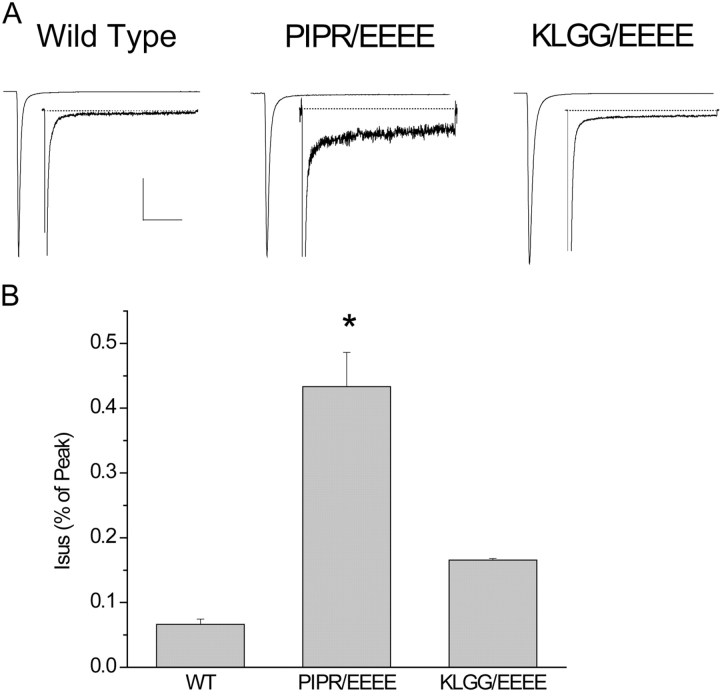
Electrical activity in nerve, skeletal muscle, and heart requires finely tuned activity of voltage-gated Na+ channels that open and then enter a nonconducting inactivated state upon depolarization. Inactivation occurs when the gate, the cytoplasmic loop linking domains III and IV of the alpha subunit, occludes the open pore. Subtle destabilization of inactivation by mutation is causally associated with diverse human disease. Here we show for the first time that the inactivation gate is a molecular complex consisting of the III-IV loop and the COOH terminus (C-T), which is necessary to stabilize the closed gate and minimize channel reopening. When this interaction is disrupted by mutation, inactivation is destabilized allowing a small, but important, fraction of channels to reopen, conduct inward current, and delay cellular repolarization. Thus, our results demonstrate for the first time that physiologically crucial stabilization of inactivation of the Na+ channel requires complex interactions of intracellular structures and indicate a novel structural role of the C-T domain in this process.
神经、骨骼肌和心脏中的电活动需要电压门控钠通道进行精细调节,这些通道在去极化时打开,然后进入非传导性失活状态。当门控结构(连接α亚基结构域III和IV的胞质环)堵塞开放的孔道时,就会发生失活。突变导致失活的细微不稳定与多种人类疾病存在因果关系。在这里,我们首次表明失活门控是一种分子复合物,由III-IV环和COOH末端(C-T)组成,这对于稳定关闭的门控并使通道重新开放最小化是必需的。当这种相互作用因突变而中断时,失活变得不稳定,使得一小部分但很重要的通道能够重新开放、传导内向电流并延迟细胞复极化。因此,我们的结果首次证明,钠通道失活在生理上至关重要的稳定需要细胞内结构的复杂相互作用,并表明C-T结构域在此过程中具有新的结构作用。