Brunner-Weinzierl Monika C, Hoff Holger, Burmester Gerd-R
Molecular Immunology, Deutsches Rheuma-Forschungszentrum Berlin, Germany.
Arthritis Res Ther. 2004;6(2):45-54. doi: 10.1186/ar1158. Epub 2004 Mar 3.
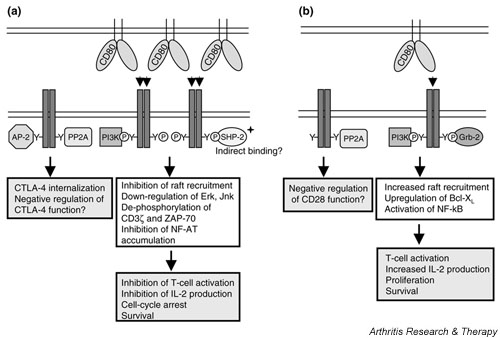
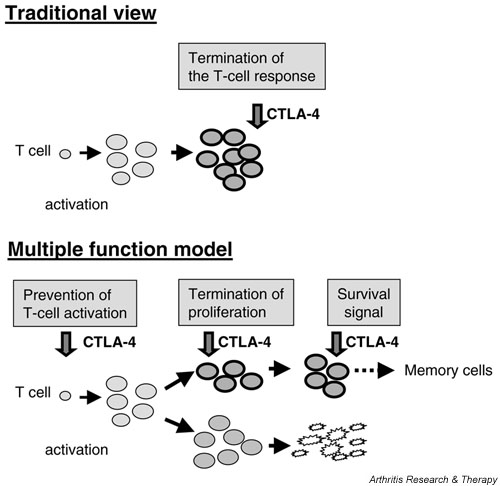
Chronic T cell responses, as they occur in rheumatoid arthritis, are complex and are likely to involve many mechanisms. There is a growing body of evidence that, in concert with the T cell antigen receptor signal, CD28 and cytotoxic T-lymphocyte antigen-4 (CTLA-4; CD152) are the primary regulators of T cell responses. Whereas CD28 primarily activates T cell processes, CTLA-4 inhibits them. The mechanism for this dichotomy is not fully understood, especially as CD28 and CTLA-4 recruit similar signalling molecules. In addition, recent studies demonstrate that CD28 and CTLA-4 have multiple functions during T cell responses. In particular, CTLA-4 exerts independent distinct effects during different phases of T cell responses that could be exploited for the treatment of rheumatoid arthritis.
慢性T细胞反应,如类风湿性关节炎中出现的反应,是复杂的,可能涉及多种机制。越来越多的证据表明,与T细胞抗原受体信号协同作用,CD28和细胞毒性T淋巴细胞抗原4(CTLA-4;CD152)是T细胞反应的主要调节因子。虽然CD28主要激活T细胞过程,但CTLA-4抑制这些过程。这种二分法的机制尚未完全理解,特别是因为CD28和CTLA-4招募相似的信号分子。此外,最近的研究表明,CD28和CTLA-4在T细胞反应过程中具有多种功能。特别是,CTLA-4在T细胞反应的不同阶段发挥独立的不同作用,这可能被用于类风湿性关节炎的治疗。