Pang Haiyan, Rowan Brian G, Al-Dhaheri Mariam, Faber Lee E
Department of Pediatrics, University of Michigan, Ann Arbor, Michigan, USA.
Breast Cancer Res. 2004;6(3):R239-45. doi: 10.1186/bcr780. Epub 2004 Mar 18.
Although the effects of progesterone on cell cycle progression are well known, its role in spreading and adhesion of breast cancer cells has not attracted much attention until recently. Indeed, by controlling cell adhesion proteins, progesterone may play a direct role in breast cancer invasion and metastasis. Progesterone has also been shown to modulate epidermal growth factor (EGF) effects in neoplasia, although EGF effects on progesterone pathways and targets are less well understood. In the present study we identify an effect of EGF on a progesterone target, namely desmoplakin.
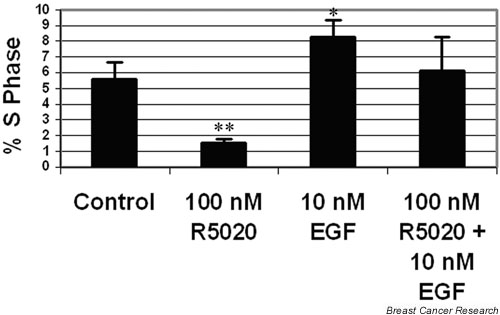
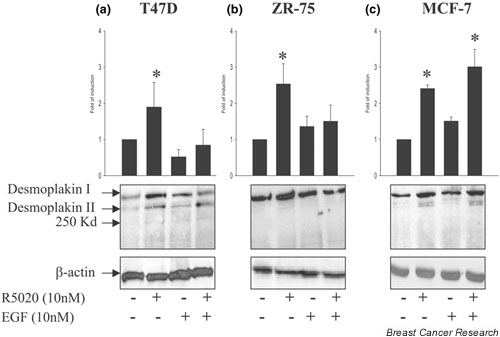
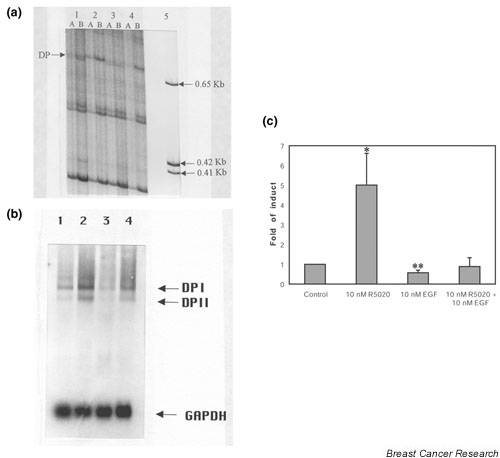
Initially flow cytometry was used to establish the growing conditions and demonstrate that the T47D breast cancer cell line was responding to progesterone and EGF in a classical manner. Differential display RT-PCR was employed to identify differentially expressed genes affected by progesterone and EGF. Western and Northern blotting were used to verify interactions between EGF and progesterone in three breast cancer cell lines: T47D, MCF-7, and ZR-75.
We found the cell adhesion protein desmoplakin to be upregulated by progesterone - a process that was suppressed by EGF. This appears to be a general but not universal effect in breast cancer cell lines.
Our findings suggest that progesterone and EGF may play opposing roles in metastasis. They also suggest that desmoplakin may be a useful biomarker for mechanistic studies designed to analyze the crosstalk between EGF and progesterone dependent events. Our work may help to bridge the fields of metastasis and differentiation, and the mechanisms of steroid action.
尽管孕酮对细胞周期进程的影响已为人熟知,但直到最近,其在乳腺癌细胞扩散和黏附中的作用才受到较多关注。实际上,通过控制细胞黏附蛋白,孕酮可能在乳腺癌侵袭和转移中发挥直接作用。孕酮还被证明可调节肿瘤形成过程中表皮生长因子(EGF)的作用,尽管EGF对孕酮信号通路和靶点的影响尚不太清楚。在本研究中,我们确定了EGF对一种孕酮靶点——桥粒斑蛋白的作用。
最初使用流式细胞术来确定生长条件,并证明T47D乳腺癌细胞系以经典方式对孕酮和EGF作出反应。采用差异显示逆转录聚合酶链反应(RT-PCR)来鉴定受孕酮和EGF影响的差异表达基因。使用蛋白质免疫印迹法(Western blotting)和Northern印迹法来验证EGF与孕酮在三种乳腺癌细胞系(T47D、MCF-7和ZR-75)中的相互作用。
我们发现细胞黏附蛋白桥粒斑蛋白被孕酮上调,而这一过程被EGF抑制。这似乎是乳腺癌细胞系中的一种普遍但并非所有细胞系都有的效应。
我们的研究结果表明,孕酮和EGF可能在转移过程中发挥相反作用。它们还表明,桥粒斑蛋白可能是用于分析EGF和孕酮依赖性事件之间相互作用机制研究的有用生物标志物。我们的工作可能有助于在转移与分化领域以及类固醇作用机制之间架起桥梁。