Meydani Simin Nikbin, Leka Lynette S, Fine Basil C, Dallal Gerard E, Keusch Gerald T, Singh Maria Fiatarone, Hamer Davidson H
Nutritional Immunology Laboratory, Jean Mayer USDA Human Nutrition Research Center on Aging, Tufts University, Boston, Mass 02111, USA.
JAMA. 2004 Aug 18;292(7):828-36. doi: 10.1001/jama.292.7.828.
Respiratory tract infections are prevalent in elderly individuals, resulting in increased morbidity, mortality, and use of health care services. Vitamin E supplementation has been shown to improve immune response in elderly persons. However, the clinical importance of these findings has not been determined.
To determine the effect of 1 year of vitamin E supplementation on respiratory tract infections in elderly nursing home residents.
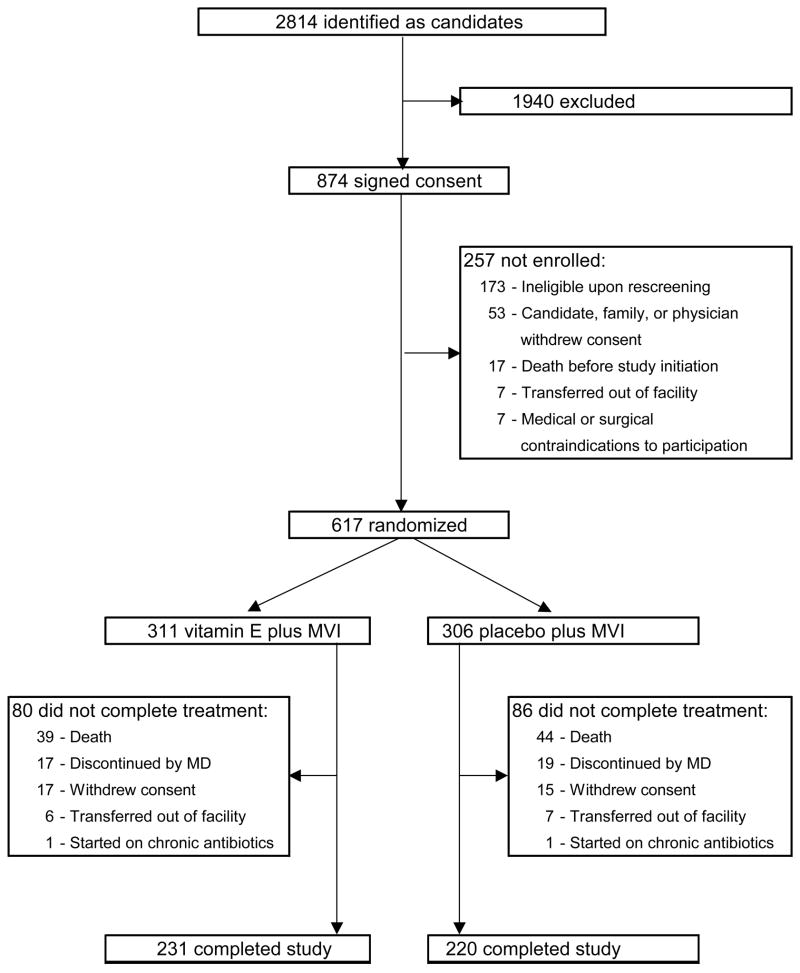
DESIGN, SETTING, AND PARTICIPANTS: A randomized, double-blind, placebo-controlled trial was conducted from April 1998 to August 2001 at 33 long-term care facilities in the Boston, Mass, area. A total of 617 persons aged at least 65 years and who met the study's eligibility criteria were enrolled; 451 (73%) completed the study.
Vitamin E (200 IU) or placebo capsule administered daily; all participants received a capsule containing half the recommended daily allowance of essential vitamins and minerals.
Incidence of respiratory tract infections, number of persons and number of days with respiratory tract infections (upper and lower), and number of new antibiotic prescriptions for respiratory tract infections among all participants randomized and those who completed the study.
Vitamin E had no significant effect on incidence or number of days with infection for all, upper, or lower respiratory tract infections. However, fewer participants receiving vitamin E acquired 1 or more respiratory tract infections (60% vs 68%; risk ratio [RR], 0.88; 95% confidence interval [CI], 0.76-1.00; P =.048 for all participants; and 65% vs 74%; RR, 0.88; 95% CI, 0.75-0.99; P =.04 for completing participants), or upper respiratory tract infections (44% vs 52%; RR, 0.84; 95% CI, 0.69-1.00; P =.05 for all participants; and 50% vs 62%; RR, 0.81; 95% CI, 0.66-0.96; P =.01 for completing participants). When common colds were analyzed in a post hoc subgroup analysis, the vitamin E group had a lower incidence of common cold (0.67 vs 0.81 per person-year; RR, 0.83; 95% CI, 0.68-1.01; P =.06 for all participants; and 0.66 vs 0.83 per person-year; RR, 0.80; 95% CI, 0.64-0.98; P =.04 for completing participants) and fewer participants in the vitamin E group acquired 1 or more colds (40% vs 48%; RR, 0.83; 95% CI, 0.67-1.00; P =.05 for all participants; and 46% vs 57%; RR, 0.80; 95% CI, 0.64-0.96; P =.02 for completing participants). Vitamin E had no significant effect on antibiotic use.
Supplementation with 200 IU per day of vitamin E did not have a statistically significant effect on lower respiratory tract infections in elderly nursing home residents. However, we observed a protective effect of vitamin E supplementation on upper respiratory tract infections, particularly the common cold, that merits further investigation.
呼吸道感染在老年人中很常见,会导致发病率、死亡率增加以及医疗服务使用增多。补充维生素E已被证明可改善老年人的免疫反应。然而,这些发现的临床重要性尚未确定。
确定补充1年维生素E对老年疗养院居民呼吸道感染的影响。
设计、地点和参与者:1998年4月至2001年8月在马萨诸塞州波士顿地区的33个长期护理机构进行了一项随机、双盲、安慰剂对照试验。共有617名年龄至少65岁且符合研究纳入标准的人被纳入研究;451人(73%)完成了研究。
每天服用维生素E(200国际单位)或安慰剂胶囊;所有参与者都接受了一粒含有推荐每日必需维生素和矿物质摄入量一半的胶囊。
呼吸道感染的发生率、呼吸道感染(上呼吸道和下呼吸道)的人数和天数,以及所有随机分组参与者和完成研究的参与者中因呼吸道感染新开抗生素处方的数量。
维生素E对所有呼吸道感染(包括上呼吸道感染和下呼吸道感染)的发生率或感染天数均无显著影响。然而,接受维生素E的参与者中患1次或更多次呼吸道感染的人数较少(60%对68%;风险比[RR],0.88;95%置信区间[CI],0.76 - 1.00;所有参与者P = 0.048;完成研究的参与者中为65%对74%;RR,0.88;95%CI,0.75 - 0.99;P = 0.04),或上呼吸道感染(44%对52%;RR,0.84;95%CI,0.69 - 1.00;所有参与者P = 0.05;完成研究的参与者中为50%对62%;RR,0.81;95%CI,0.66 - 0.96;P = 0.01)。在事后亚组分析中对普通感冒进行分析时,维生素E组普通感冒的发病率较低(每人年0.67次对0.81次;RR,0.83;95%CI,0.68 - 1.01;所有参与者P = 0.06;完成研究的参与者中为每人年0.66次对0.83次;RR,0.80;95%CI,0.64 - 0.98;P = 0.04),且维生素E组患1次或更多次感冒的参与者较少(40%对48%;RR,0.83;95%CI,0.67 - 1.00;所有参与者P = 0.05;完成研究的参与者中为46%对57%;RR,0.80;95%CI,0.64 - 0.96;P = 0.02)。维生素E对抗生素使用无显著影响。
每天补充200国际单位维生素E对老年疗养院居民的下呼吸道感染没有统计学上的显著影响。然而,我们观察到补充维生素E对上呼吸道感染,尤其是普通感冒有保护作用,这值得进一步研究。
