MacLean J Dick, Demers Anne-Marie, Ndao Momar, Kokoskin Evelyne, Ward Brian J, Gyorkos Theresa W
Montreal General Hospital, McGill University Centre for Tropical Diseases, Québec, Canada.
Emerg Infect Dis. 2004 Jul;10(7):1195-201. doi: 10.3201/eid1007.030826.
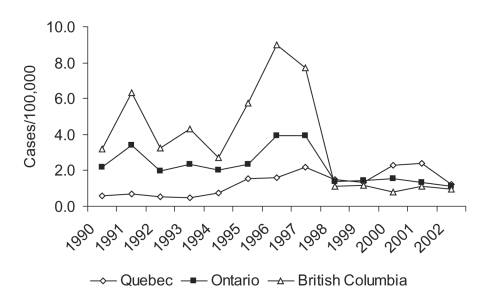
In the past decade, fluctuations in numbers of imported malaria cases have been seen in Canada. In 1997 to 1998, malaria case numbers more than doubled before returning to normal. This increase was not seen in any other industrialized country. The Canadian federal malaria surveillance system collects insufficient data to interpret these fluctuations. Using local (sentinel), provincial, federal, and international malaria surveillance data, we evaluate and interpret these fluctuations. Several epidemics are described. With an ever-increasing immigrant and refugee population of tropical origin, improved surveillance will be necessary to guide public health prevention policy and practice. The Canadian experience is likely to be generalizable to other industrialized countries where malaria is a reportable disease within a passive surveillance system.
在过去十年间,加拿大的输入性疟疾病例数量出现了波动。1997年至1998年,疟疾病例数在恢复正常之前增加了一倍多。这种增长在其他工业化国家均未出现。加拿大联邦疟疾监测系统收集的数据不足以解释这些波动情况。我们利用地方(哨点)、省级、联邦和国际疟疾监测数据,对这些波动进行评估和解读。文中描述了几起疫情。随着来自热带地区的移民和难民人口不断增加,有必要加强监测,以指导公共卫生预防政策和实践。加拿大的经验可能适用于其他工业化国家,在这些国家,疟疾在被动监测系统中属于应报告疾病。