Tamion Fabienne, Le Cam-Duchez Véronique, Menard Jean-François, Girault Christophe, Coquerel Antoine, Bonmarchand Guy
Medical Intensive Care Unit, Rouen University Hospital, Rouen, France.
Crit Care. 2004 Oct;8(5):R328-35. doi: 10.1186/cc2902. Epub 2004 Aug 9.
During sepsis the endocrine, immune and nervous systems elaborate a multitude of biological responses. Little is known regarding the mechanisms responsible for the final circulating erythropoietin (EPO) and renin levels in septic shock. The aim of the present study was to assess the role of EPO and renin as biological markers in patients with septic shock.
A total of 44 critically ill patients with septic shock were evaluated.
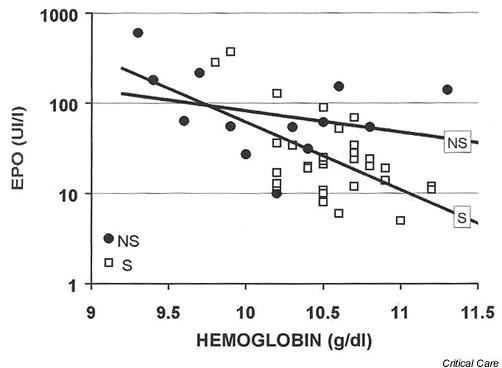
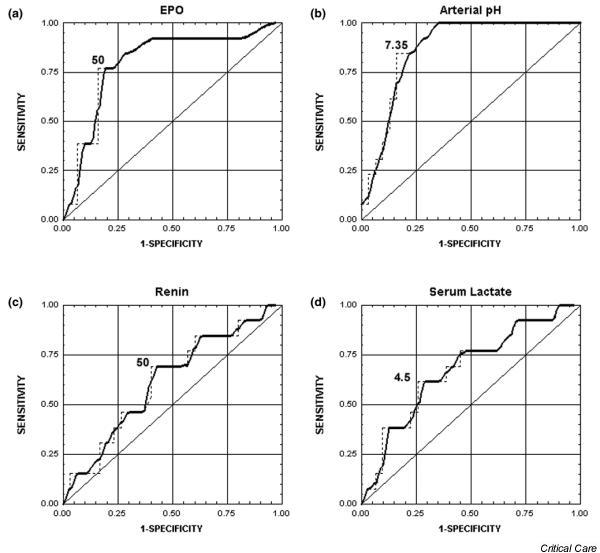
Nonsurvivors had significantly higher serum EPO levels than did survivors on admission (median [minimum-maximum]; 61 [10-602] versus 20 [5-369]). A negative relationship between serum EPO and blood haemoglobin concentrations was observed in the survivor group (r = -0.61; P < 0.001). In contrast, in the nonsurvivors the serum EPO concentration was independent of the blood haemoglobin concentration. Furthermore, we observed significant relationships between EPO concentration and lactate (r = 0.5; P < 0.001), arterial oxygen tension/fractional inspired oxygen ratio (r = -0.41; P < 0.005), arterial pH (r = -0.58; P < 0.001) and renin concentration (r = 0.42; P < 0.005). With regard to renin concentration, significant correlations with lactate (r = 0.52; P < 0.001) and arterial pH (r = -0.33; P < 0.05) were observed.
Our findings show that EPO and renin concentrations increased in patients admitted to the intensive care unit with septic shock. Renin may be a significant mediator of EPO upregulation in patients with septic shock. Further studies regarding the regulation of EPO expression are clearly warranted.
在脓毒症期间,内分泌、免疫和神经系统会产生多种生物学反应。关于脓毒性休克中最终循环促红细胞生成素(EPO)和肾素水平的相关机制,我们知之甚少。本研究的目的是评估EPO和肾素作为脓毒性休克患者生物学标志物的作用。
共评估了44例患有脓毒性休克的危重症患者。
入院时,非存活者的血清EPO水平显著高于存活者(中位数[最小值 - 最大值];61[10 - 602]对20[5 - 369])。在存活者组中,观察到血清EPO与血红蛋白浓度之间呈负相关(r = -0.61;P < 0.001)。相比之下,在非存活者中,血清EPO浓度与血红蛋白浓度无关。此外,我们观察到EPO浓度与乳酸(r = 0.5;P < 0.001)、动脉血氧分压/吸入氧分数比(r = -0.41;P < 0.005)、动脉pH(r = -0.58;P < 0.001)和肾素浓度(r = 0.42;P < 0.005)之间存在显著相关性。关于肾素浓度,观察到与乳酸(r = 0.52;P < 0.001)和动脉pH(r = -0.33;P < 0.05)之间存在显著相关性。
我们的研究结果表明,入住重症监护病房的脓毒性休克患者的EPO和肾素浓度升高。肾素可能是脓毒性休克患者EPO上调的重要介质。显然有必要对EPO表达的调节进行进一步研究。