Dokland T, Lindqvist B H, Fuller S D
European Molecular Biology Laboratory, Biological Structures and Biocomputing Programme, Heidelberg, Germany.
EMBO J. 1992 Mar;11(3):839-46. doi: 10.1002/j.1460-2075.1992.tb05121.x.
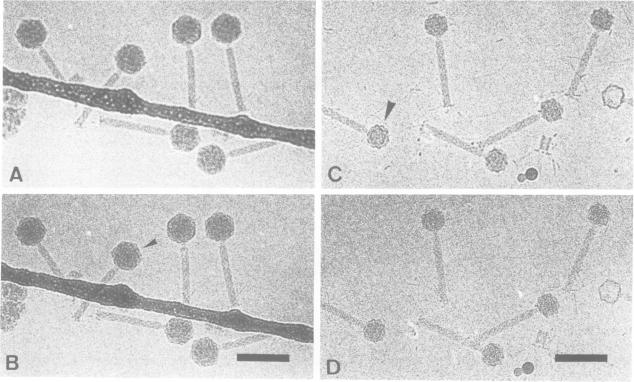
The satellite bacteriophage P4 does not have genes coding for any major structural proteins, but assembles a capsid from the gene products of bacteriophage P2. The capsid assembled under control of P4 is smaller (45 nm) than the normal P2 capsid (60 nm). The low resolution (4.5 nm) structures of P2 and P4 capsids were determined by cryo-electron microscopy and image processing. The capsid of P2 shows T = 7 symmetry with most of the mass clustered as 12 pentamers and 60 hexamers. The P4 capsid has T = 4 symmetry with a similar distribution of mass to P2, but the hexamer geometry has changed. The major capsid protein has a two-domain structure. The major domains form the capsomers proper, while connecting domains form trivalent contacts between the capsomers. The size determination by P4 appears to function by altering hexamer geometry rather than by affecting the interdomain angle alone.
卫星噬菌体P4没有编码任何主要结构蛋白的基因,但它利用噬菌体P2的基因产物组装衣壳。在P4控制下组装的衣壳比正常的P2衣壳(60纳米)小(45纳米)。通过冷冻电子显微镜和图像处理确定了P2和P4衣壳的低分辨率(4.5纳米)结构。P2衣壳显示出T = 7对称性,大部分质量聚集成12个五聚体和60个六聚体。P4衣壳具有T = 4对称性,质量分布与P2相似,但六聚体的几何形状发生了变化。主要衣壳蛋白具有双结构域结构。主要结构域形成了合适的衣壳粒,而连接结构域在衣壳粒之间形成三价接触。P4对大小的确定似乎是通过改变六聚体的几何形状来起作用,而不是仅仅通过影响结构域间的角度。