Chen Chia-Nan, Weng Meng-Shih, Wu Chia-Li, Lin Jen-Kun
Graduate Institute of Biochemistry and Molecular Biology, College of Medicine, National Taiwan University, Section 1, Jen-Ai Road, Taipei 100, Taiwan.
Evid Based Complement Alternat Med. 2004 Sep 1;1(2):175-185. doi: 10.1093/ecam/neh034.
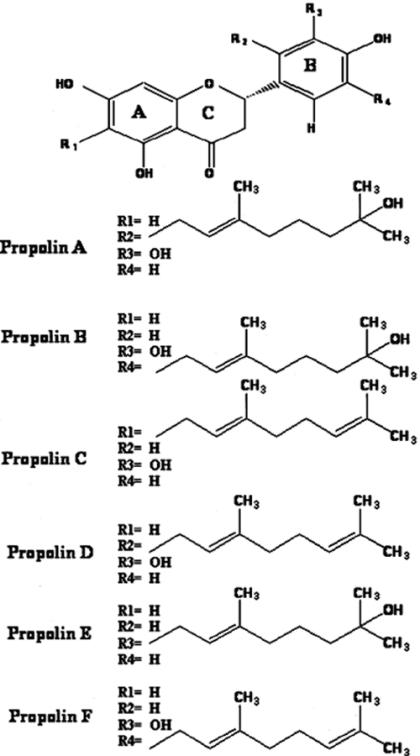
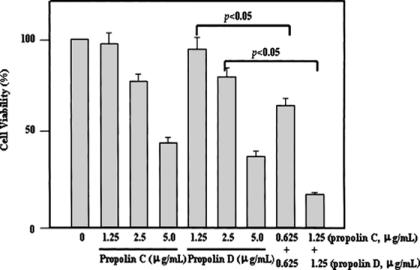
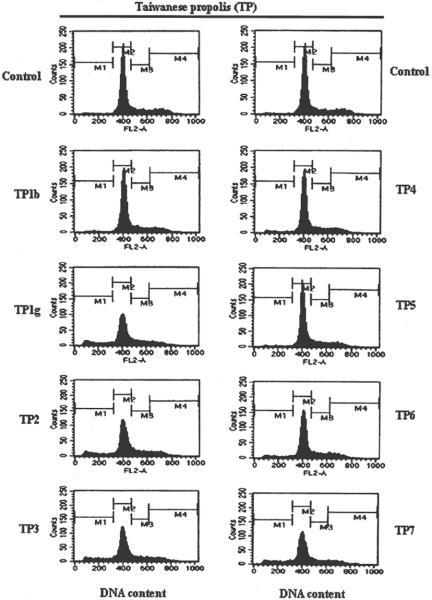
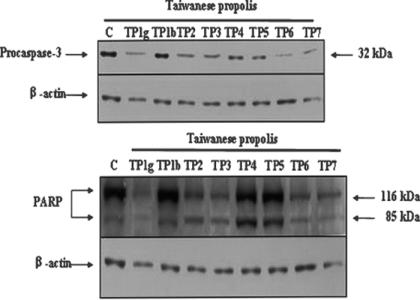
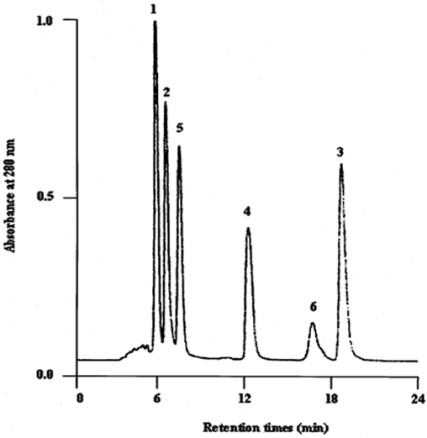
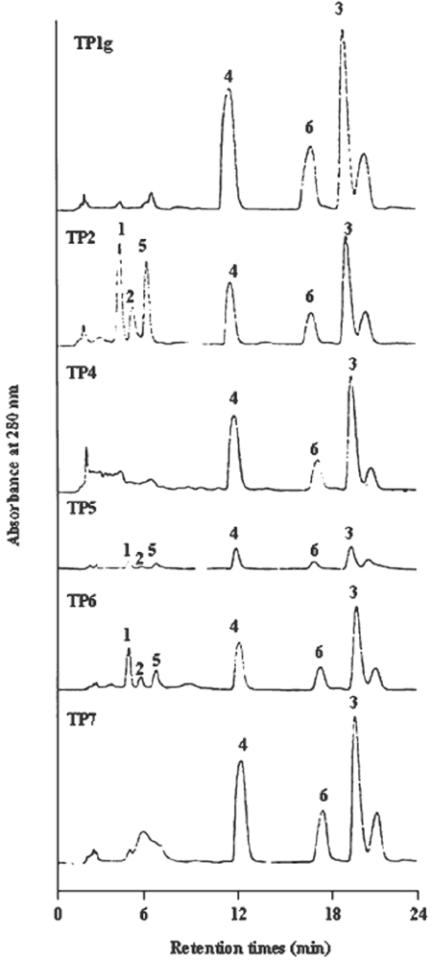
Propolis is a sticky substance that is collected from plants by honeybees. We previously demonstrated that propolins A, B, C, D, E and F, isolated from Taiwanese propolis (TP), could effectively induce human melanoma cell apoptosis and were strong antioxidant agents. In this study, we evaluated TP for free radical scavenging activity by DPPH (1,2-diphenyl-2-picrylhydrazyl). The phenolic concentrations were quantified by the Folin-Ciocalteu method. The apoptosis trigger activity in human melanoma cells was evaluated. TP contained a higher level of phenolic compounds and showed strong capability to scavenge free radicals. Additionally, TP1g, TP3, TP4 and TP7 exhibited a cytotoxic effect on human melanoma cells, with an IC(50) of approximately 2.3, 2.0, 3.3 and 3.3 μg/ml, respectively. Flow cytometric analysis for DNA fragmentation indicated that TP1g, TP2, TP3 and TP7 could induce apoptosis in human melanoma cells and there is a marked loss of cells from the G2/M phase of the cell cycle. To address the mechanism of the apoptosis effect of TP, we evaluated its effects on induction of apoptosis-related proteins in human melanoma cells. The levels of procaspase-3 and PARP [poly(ADP-ribose) polymerase] were markedly decreased. Furthermore, propolins A, B, C, D, E and F in TP were determined using HPLC. The results indicate that TP is a rich source of these compounds. The findings suggest that TP induces apoptosis in human melanoma cells due to its high level of propolins.
蜂胶是蜜蜂从植物中采集的一种粘性物质。我们之前证明,从台湾蜂胶(TP)中分离出的蜂胶素A、B、C、D、E和F能够有效诱导人黑色素瘤细胞凋亡,并且是强抗氧化剂。在本研究中,我们通过DPPH(1,2 - 二苯基 - 2 - 苦基肼)评估了TP的自由基清除活性。采用福林 - 西奥尔特法对酚类浓度进行定量。评估了TP对人黑色素瘤细胞的凋亡触发活性。TP含有较高水平的酚类化合物,并表现出强大的自由基清除能力。此外,TP1g、TP3、TP4和TP7对人黑色素瘤细胞具有细胞毒性作用,IC(50)分别约为2.3、2.0、3.3和3.3 μg/ml。DNA片段化的流式细胞术分析表明,TP1g、TP2、TP3和TP7可诱导人黑色素瘤细胞凋亡,并且细胞周期的G2/M期有明显的细胞损失。为了探究TP凋亡作用的机制,我们评估了其对人黑色素瘤细胞中凋亡相关蛋白诱导的影响。procaspase - 3和PARP[聚(ADP - 核糖)聚合酶]的水平显著降低。此外,使用高效液相色谱法测定了TP中的蜂胶素A、B、C、D、E和F。结果表明TP是这些化合物的丰富来源。研究结果表明,TP因其高含量的蜂胶素而诱导人黑色素瘤细胞凋亡。