O'Cathain Alicia, Thomas Kate J
Medical Care Research Unit, Health Services Research, School of Health and Related Research, University of Sheffield, Regent Court, Sheffield, UK.
BMC Med Res Methodol. 2004 Nov 8;4:25. doi: 10.1186/1471-2288-4-25.
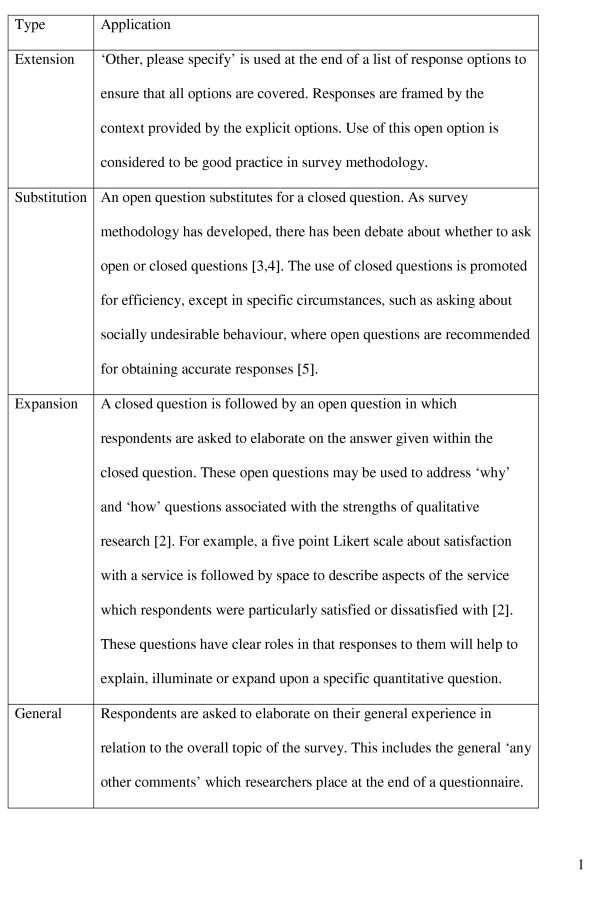
The habitual "any other comments" general open question at the end of structured questionnaires has the potential to increase response rates, elaborate responses to closed questions, and allow respondents to identify new issues not captured in the closed questions. However, we believe that many researchers have collected such data and failed to analyse or present it.
General open questions at the end of structured questionnaires can present a problem because of their uncomfortable status of being strictly neither qualitative nor quantitative data, the consequent lack of clarity around how to analyse and report them, and the time and expertise needed to do so. We suggest that the value of these questions can be optimised if researchers start with a clear understanding of the type of data they wish to generate from such a question, and employ an appropriate strategy when designing the study. The intention can be to generate depth data or 'stories' from purposively defined groups of respondents for qualitative analysis, or to produce quantifiable data, representative of the population sampled, as a 'safety net' to identify issues which might complement the closed questions.
We encourage researchers to consider developing a more strategic use of general open questions at the end of structured questionnaires. This may optimise the quality of the data and the analysis, reduce dilemmas regarding whether and how to analyse such data, and result in a more ethical approach to making best use of the data which respondents kindly provide.
结构化问卷结尾处惯常设置的“其他意见”这一开放性问题,有可能提高回复率,详细阐述对封闭式问题的回答,并使受访者能够指出封闭式问题未涵盖的新问题。然而,我们认为许多研究人员虽收集了此类数据,但却未能对其进行分析或呈现。
结构化问卷结尾处的开放性问题可能会带来问题,因为它们处于一种尴尬的状态,严格来说既不是定性数据也不是定量数据,因此在如何分析和报告这些问题方面缺乏清晰度,并且进行分析和报告需要时间和专业知识。我们建议,如果研究人员在开始时能清楚了解他们希望从此类问题中生成的数据类型,并在设计研究时采用适当的策略,那么这些问题的价值就能得到优化。目的可以是从有目的地界定的受访者群体中生成深度数据或“故事”用于定性分析,或者生成可量化的数据,作为抽样人群的“安全网”,以识别可能补充封闭式问题的问题。
我们鼓励研究人员考虑对结构化问卷结尾处的开放性问题进行更具策略性的运用。这可能会优化数据质量和分析,减少在是否以及如何分析此类数据方面的困境,并形成一种更符合道德规范的方法,以充分利用受访者善意提供的数据。