Lu Tim, Costello Christine M, Croucher Peter J P, Häsler Robert, Deuschl Günther, Schreiber Stefan
Department of Medicine, Christian-Albrechts-University, Kiel, Germany.
BMC Bioinformatics. 2005 Feb 23;6:37. doi: 10.1186/1471-2105-6-37.
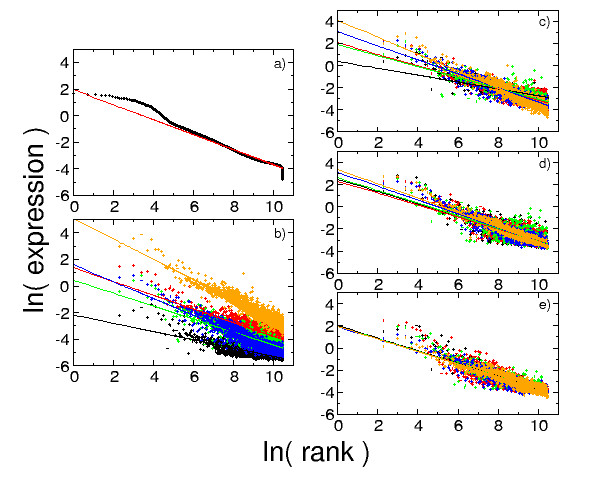
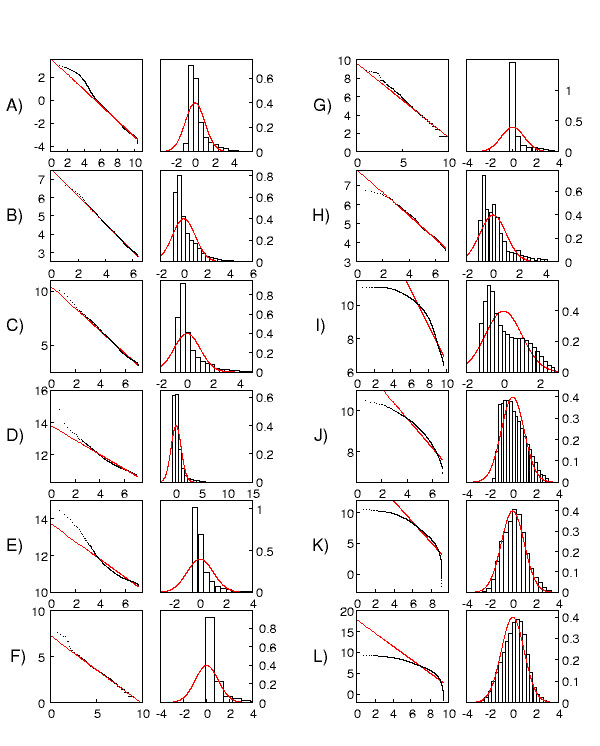
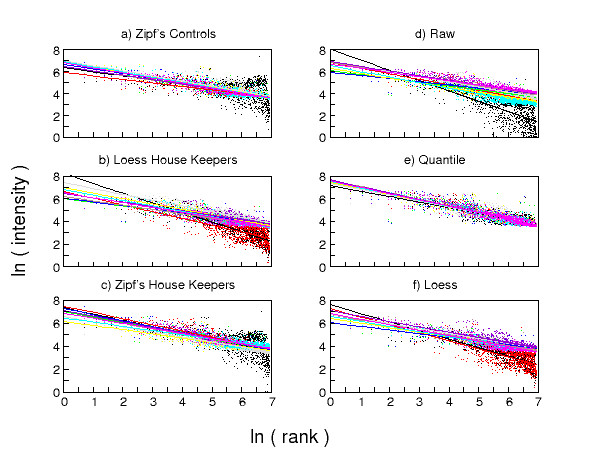
Normalization is the process of removing non-biological sources of variation between array experiments. Recent investigations of data in gene expression databases for varying organisms and tissues have shown that the majority of expressed genes exhibit a power-law distribution with an exponent close to -1 (i.e. obey Zipf's law). Based on the observation that our single channel and two channel microarray data sets also followed a power-law distribution, we were motivated to develop a normalization method based on this law, and examine how it compares with existing published techniques. A computationally simple and intuitively appealing technique based on this observation is presented.
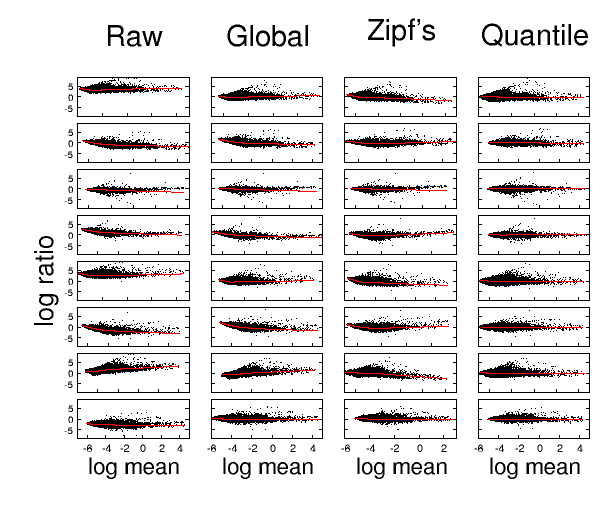
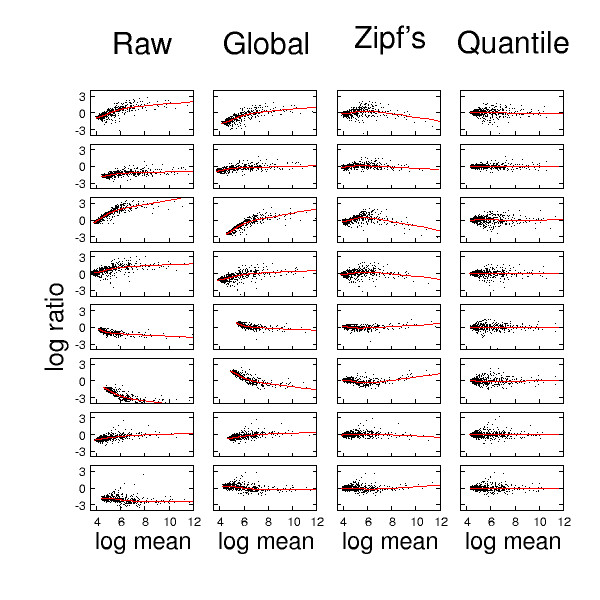
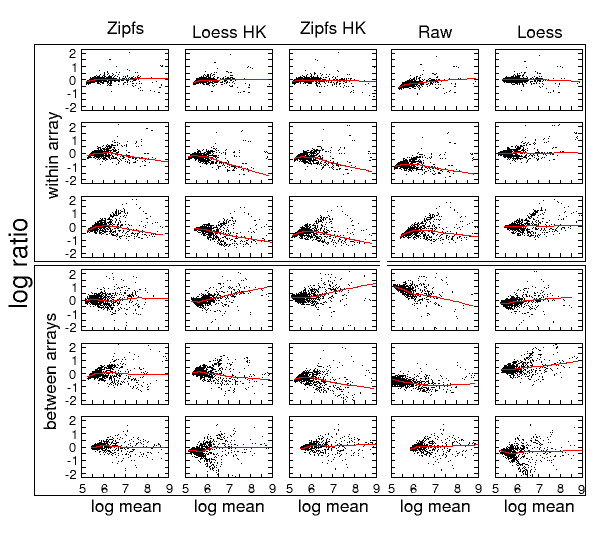
Using pairwise comparisons using MA plots (log ratio vs. log intensity), we compared this novel method to previously published normalization techniques, namely global normalization to the mean, the quantile method, and a variation on the loess normalization method designed specifically for boutique microarrays. Results indicated that, for single channel microarrays, the quantile method was superior with regard to eliminating intensity-dependent effects (banana curves), but Zipf's law normalization does minimize this effect by rotating the data distribution such that the maximal number of data points lie on the zero of the log ratio axis. For two channel boutique microarrays, the Zipf's law normalizations performed as well as, or better than existing techniques.
Zipf's law normalization is a useful tool where the Quantile method cannot be applied, as is the case with microarrays containing functionally specific gene sets (boutique arrays).
标准化是消除阵列实验之间非生物学变异来源的过程。最近对不同生物体和组织的基因表达数据库中的数据进行的研究表明,大多数表达基因呈现幂律分布,指数接近 -1(即服从齐普夫定律)。基于我们的单通道和双通道微阵列数据集也遵循幂律分布这一观察结果,我们有动力开发一种基于该定律的标准化方法,并研究它与现有已发表技术相比如何。本文提出了一种基于这一观察结果的计算简单且直观吸引人的技术。
使用MA图(对数比值与对数强度)进行成对比较,我们将这种新方法与先前发表的标准化技术进行了比较,即全局均值标准化、分位数法以及专门为精品微阵列设计的局部加权回归标准化方法的一种变体。结果表明,对于单通道微阵列,分位数法在消除强度依赖性效应(香蕉曲线)方面更优,但齐普夫定律标准化通过旋转数据分布,使最大数量的数据点位于对数比值轴的零处,从而最小化了这种效应。对于双通道精品微阵列,齐普夫定律标准化的性能与现有技术相当,甚至更好。
在无法应用分位数法的情况下,例如对于包含功能特异性基因集的微阵列(精品阵列),齐普夫定律标准化是一种有用的工具。