Compagnone Gaetano, Pagan Laura, Bergamini Carlo
Medical Physics Department, S. Orsola-Malpighi Hospital, Via Massarenti 9, 40138 Bologna, Italy.
J Appl Clin Med Phys. 2005 Winter;6(1):101-13. doi: 10.1120/jacmp.v6i1.2020. Epub 2005 Jan 12.
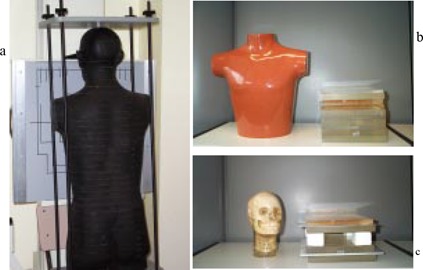
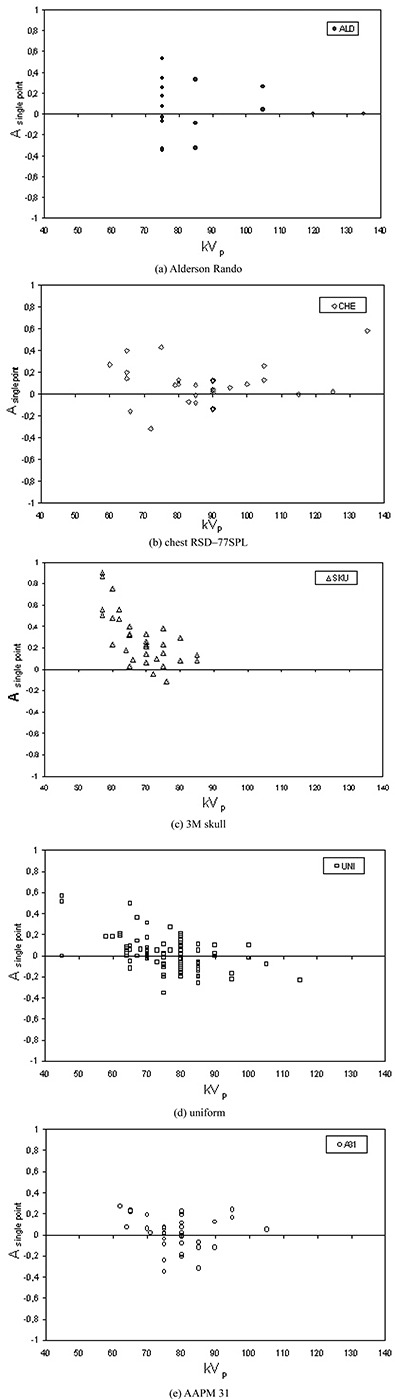
Entrance skin dose (ESD) is an important parameter for assessing the dose received by a patient in a single radiographic exposure. The most useful way to evaluate ESD is either by direct measurement on phantoms using an ionization chamber or using calculations based on a mathematical model. We compared six phantoms (three anthropomorphic, two physical, and one mathematical) in 11 standard clinical examinations (anterior-posterior (AP) abdomen, posterior-anterior (PA) chest, AP chest, lateral (LAT) chest, AP lumbar spine, LAT lumbar spine, LAT lumbo-sacral joint, AP pelvis, PA skull, LAT skull, and AP urinary tract) for two reasons: to determine the conversion factors to use for ESDs measured on different phantoms and to validate the mathematical model used. First, a comparison was done between the three anthropomorphic phantoms (Alderson Rando, chest RSD-77SPL, and 3M skull) and the two physical phantoms (Uniform and AAPM 31); for each examination we obtained "relative entrance skin dose factors." Second, we compared these five phantoms with the mathematical phantom: the overall accuracy of the model was better than 14%. Total mathematical model and total ionization chamber uncertainties, calculated by quadratic propagation of errors of the single components, were estimated to be on the order of +/-12% and +/-3%, respectively. To reduce the most significant source of uncertainty, the overall accuracy of the model was recalculated using new backscatter factors. The overall accuracy of the model improved: better than 12%. For each examination an anthropomorphic phantom was considered as the gold standard relative to the physical phantoms. In this way, it was possible to analyze the variations in phantom design and characteristics. Finally, the mathematical model was validated by more than 400 measurements taken on different phantoms and using a variety of radiological equipment. We conclude that the mathematical model can be used satisfactorily in ESD evaluations because it optimizes available resources, it is based on direct measurements, and it is an easy dynamic tool.
入射皮肤剂量(ESD)是评估患者在单次X线摄影照射中所接受剂量的一个重要参数。评估ESD最有用的方法要么是使用电离室在模体上直接测量,要么是基于数学模型进行计算。我们在11项标准临床检查(前后位(AP)腹部、后前位(PA)胸部、AP胸部、侧位(LAT)胸部、AP腰椎、LAT腰椎、LAT腰骶关节、AP骨盆、PA颅骨、LAT颅骨和AP尿路)中比较了六种模体(三种人体模型、两种物理模体和一种数学模体),原因有两个:确定用于在不同模体上测量ESD的转换因子,并验证所使用的数学模型。首先,对三种人体模型模体(奥尔德森·兰多、胸部RSD - 77SPL和3M颅骨)和两种物理模体(均匀模体和美国医学物理学会31号模体)进行了比较;对于每项检查,我们获得了“相对入射皮肤剂量因子”。其次,我们将这五种模体与数学模体进行了比较:该模型的总体准确性优于14%。通过单个组件误差的二次传播计算得出的总数学模型和总电离室不确定度估计分别约为±12%和±3%。为了减少最主要的不确定度来源,使用新的反向散射因子重新计算了模型的总体准确性。模型的总体准确性得到了提高:优于12%。对于每项检查,相对于物理模体,将人体模型模体视为金标准。通过这种方式,有可能分析模体设计和特性的变化。最后,通过在不同模体上进行的400多次测量并使用各种放射设备对数学模型进行了验证。我们得出结论,数学模型可令人满意地用于ESD评估,因为它优化了可用资源,基于直接测量,并且是一个易于使用的动态工具。