Sutherland Colin J, Ord Rosalynn, Dunyo Sam, Jawara Musa, Drakeley Christopher J, Alexander Neal, Coleman Rosalind, Pinder Margaret, Walraven Gijs, Targett Geoffrey A T
Department of Infectious and Tropical Diseases, London School of Hygiene and Tropical Medicine, United Kingdom.
PLoS Med. 2005 Apr;2(4):e92. doi: 10.1371/journal.pmed.0020092. Epub 2005 Apr 26.
Resistance of malaria parasites to chloroquine (CQ) and sulphadoxine-pyrimethamine (SP) is increasing in prevalence in Africa. Combination therapy can both improve treatment and provide important public health benefits if it curbs the spread of parasites harbouring resistance genes. Thus, drug combinations must be identified which minimise gametocyte emergence in treated cases, and so prevent selective transmission of parasites resistant to any of the partner drugs.
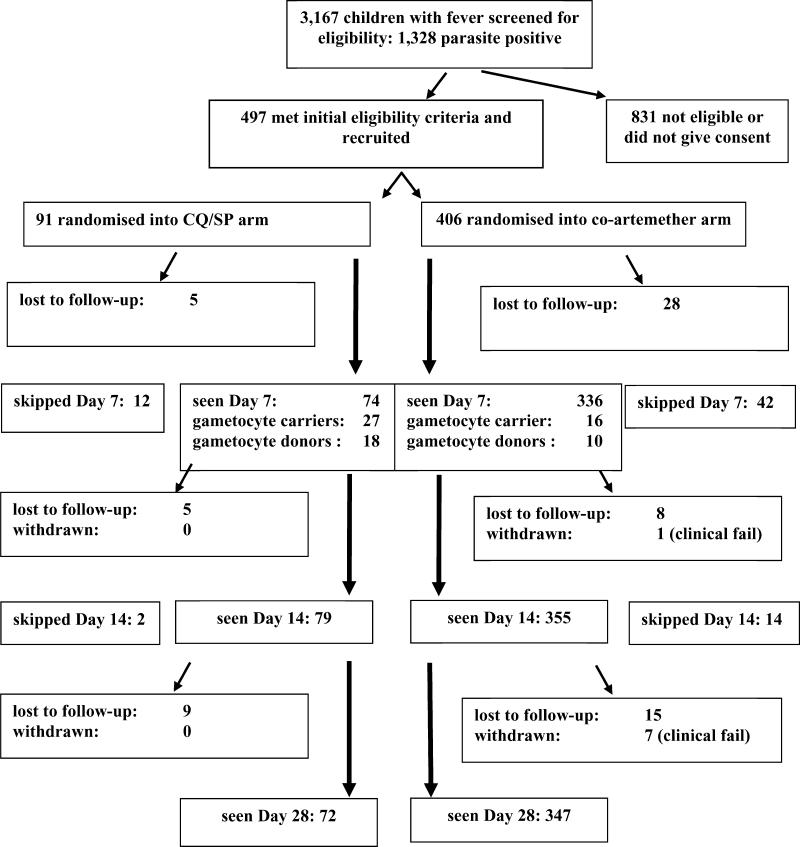
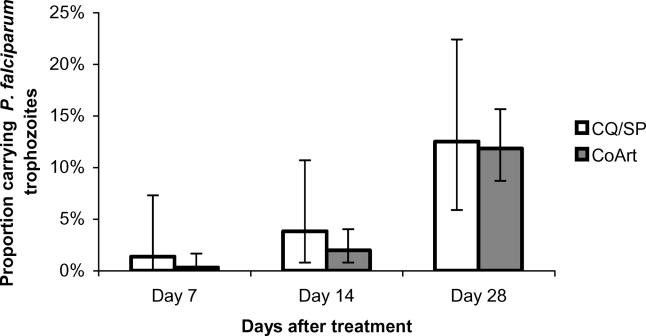
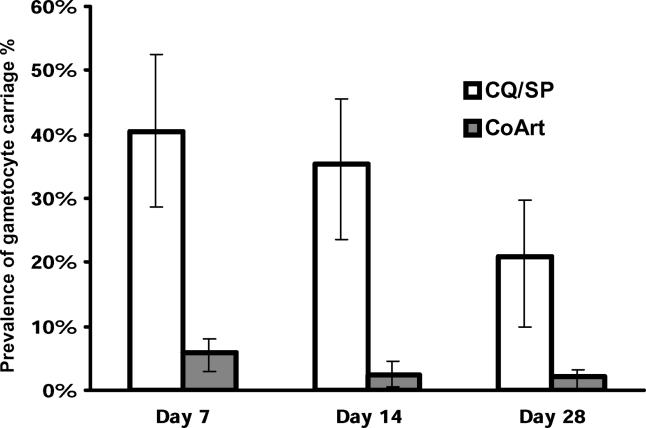
In a randomised controlled trial, 497 children with uncomplicated falciparum malaria were treated with CQ and SP (three doses and one dose respectively; n = 91), or six doses of artemether in fixed combination with lumefantrine (co-artemether [Coartem, Riamet]) (n = 406). Carriage rates of Plasmodium falciparum gametocytes and trophozoites were measured 7, 14, and 28 d after treatment. The infectiousness of venous blood from 29 children carrying P. falciparum gametocytes 7 d after treatment was tested by membrane-feeding of Anopheles mosquitoes. Children treated with co-artemether were significantly less likely to carry gametocytes within the 4 weeks following treatment than those receiving CQ/SP (30 of 378 [7.94%] versus 42 of 86 [48.8%]; p < 0.0001). Carriers in the co-artemether group harboured gametocytes at significantly lower densities, for shorter periods (0.3 d versus 4.2 d; p < 0.0001) and were less infectious to mosquitoes at day 7 (p < 0.001) than carriers who had received CQ/SP.
Co-artemether is highly effective at preventing post-treatment transmission of P. falciparum. Our results suggest that co-artemether has specific activity against immature sequestered gametocytes, and has the capacity to minimise transmission of drug-resistant parasites.
在非洲,疟原虫对氯喹(CQ)和磺胺多辛-乙胺嘧啶(SP)的耐药性正日益普遍。如果联合疗法能抑制携带耐药基因的寄生虫传播,那么它既能改善治疗效果,又能带来重要的公共卫生益处。因此,必须确定能将治疗病例中配子体出现率降至最低的药物组合,从而防止对任何一种联合用药产生耐药性的寄生虫的选择性传播。
在一项随机对照试验中,497例患单纯性恶性疟的儿童分别接受了CQ和SP治疗(分别为三剂和一剂;n = 91),或接受六剂蒿甲醚与本芴醇的固定复方制剂(蒿甲醚-本芴醇[科泰复,力康特])治疗(n = 406)。在治疗后第7、14和28天测量恶性疟原虫配子体和滋养体的携带率。通过用按蚊进行膜饲法检测了29例在治疗后7天携带恶性疟原虫配子体的儿童静脉血的传染性。与接受CQ/SP治疗的儿童相比,接受蒿甲醚-本芴醇治疗的儿童在治疗后4周内携带配子体的可能性显著降低(378例中的30例[7.94%] 对86例中的42例[48.8%];p < 0.0001)。与接受CQ/SP治疗的携带者相比,蒿甲醚-本芴醇组的携带者配子体密度显著更低,携带时间更短(0.3天对4.2天;p < 0.0001),且在第7天对蚊子的传染性更低(p < 0.001)。
蒿甲醚-本芴醇在预防治疗后恶性疟原虫传播方面非常有效。我们的结果表明,蒿甲醚-本芴醇对未成熟的隐匿性配子体具有特异性活性,并有能力将耐药寄生虫的传播降至最低。