Vanagas Giedrius, Bihari-Axelsson Susanna
Preventive Medicine dept., Kaunas University of Medicine, Kaunas, Eiveniu 4, Lithuania.
BMC Health Serv Res. 2005 Jun 10;5:45. doi: 10.1186/1472-6963-5-45.
There are number of studies showing that general practice is one of the most stressful workplace among health care workers. Since Baltic States regained independence in 1990, the reform of the health care system took place in which new role and more responsibilities were allocated to general practitioners' in Lithuania. This study aimed to explore the psychosocial stress level among Lithuanian general practitioner's and examine the relationship between psychosocial stress and work characteristics.
The cross-sectional study of 300 Lithuanian General practitioners. Psychosocial stress was investigated with a questionnaire based on the Reeder scale. Job demands were investigated with the R. Karasek scale. The analysis included descriptive statistics; interrelationship analysis between characteristics and multivariate logistic regression to estimate odds ratios for each of the independent variables in the model.
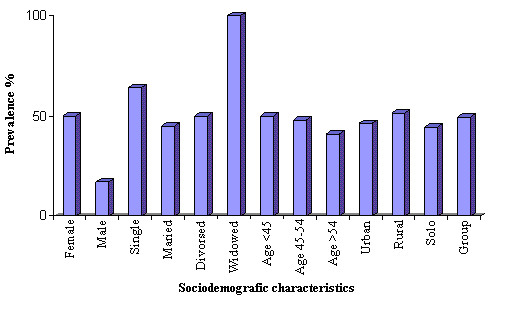
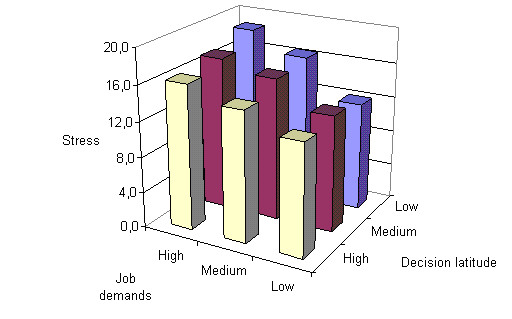
Response rate 66% (N = 197). Our study highlighted highest prevalence of psychosocial stress among widowed, single and female general practitioners. Lowest prevalence of psychosocial stress was among males and older age general practitioners. Psychosocial stress occurs when job demands are high and job decision latitude is low (chi2 = 18,9; p < 0,01). The multivariate analysis shows that high job demands (OR 4,128; CI 2,102-8,104; p < 0,001), patient load more than 18 patients per day (OR 5,863; CI 1,549-22,188; p < 0,01) and young age of GP's (OR 6,874; CI 1,292-36,582; p < 0,05) can be assigned as significant predictors for psychosocial stress.
One half of respondents suffering from work related psychosocial stress. High psychological workload demands combined with low decision latitude has the greatest impact to stress caseness among GP's. High job demands, high patient load and young age of GP's can be assigned as significant predictors of psychosocial stress among GP's.
大量研究表明,普通科医疗是医护人员中压力最大的工作领域之一。自波罗的海国家于1990年重新独立以来,立陶宛进行了医疗保健系统改革,赋予了全科医生新的角色和更多职责。本研究旨在探讨立陶宛全科医生的心理社会压力水平,并检验心理社会压力与工作特征之间的关系。
对300名立陶宛全科医生进行横断面研究。采用基于里德量表的问卷调查心理社会压力。用R. 卡拉克量表调查工作需求。分析包括描述性统计;特征之间的相互关系分析以及多变量逻辑回归,以估计模型中每个自变量的比值比。
回复率为66%(N = 197)。我们的研究突出显示,丧偶、单身和女性全科医生的心理社会压力患病率最高。心理社会压力患病率最低的是男性和年龄较大的全科医生。当工作需求高且工作决策自由度低时,会出现心理社会压力(χ² = 18.9;p < 0.01)。多变量分析表明,高工作需求(比值比4.128;可信区间2.102 - 8.104;p < 0.001)、每天患者负荷超过18人(比值比5.863;可信区间1.549 - 22.188;p < 0.01)以及全科医生年龄较小(比值比6.874;可信区间1.292 - 36.582;p < 0.05)可被视为心理社会压力的重要预测因素。
一半的受访者遭受与工作相关的心理社会压力。高心理工作量需求与低决策自由度相结合,对全科医生的压力情况影响最大。高工作需求、高患者负荷和全科医生年龄较小可被视为全科医生心理社会压力的重要预测因素。