• 文献检索
  • 文档翻译
  • 深度研究
  • 学术资讯
  • Suppr Zotero 插件Zotero 插件
  • 邀请有礼
  • 套餐&价格
  • 历史记录
应用&插件
Suppr Zotero 插件Zotero 插件浏览器插件Mac 客户端Windows 客户端微信小程序
定价
高级版会员购买积分包购买API积分包
服务
文献检索文档翻译深度研究API 文档MCP 服务
关于我们
关于 Suppr公司介绍联系我们用户协议隐私条款
关注我们

Suppr 超能文献

核心技术专利:CN118964589B侵权必究
粤ICP备2023148730 号-1Suppr @ 2026

文献检索

告别复杂PubMed语法,用中文像聊天一样搜索,搜遍4000万医学文献。AI智能推荐,让科研检索更轻松。

立即免费搜索

文件翻译

保留排版,准确专业,支持PDF/Word/PPT等文件格式,支持 12+语言互译。

免费翻译文档

深度研究

AI帮你快速写综述,25分钟生成高质量综述,智能提取关键信息,辅助科研写作。

立即免费体验

立陶宛家庭医生的未来前景:一项为期10年的预测研究。

The future prospects of Lithuanian family physicians: a 10-year forecasting study.

作者信息

Starkiene Liudvika, Smigelskas Kastytis, Padaiga Zilvinas, Reamy Jack

机构信息

Department of Preventive Medicine, Kaunas University of Medicine, Mickeviciaus str. 9, LT-44307 Kaunas, Lithuania.

出版信息

BMC Fam Pract. 2005 Oct 4;6:41. doi: 10.1186/1471-2296-6-41.

DOI:10.1186/1471-2296-6-41
PMID:16202148
原文链接:https://pmc.ncbi.nlm.nih.gov/articles/PMC1262706/
Abstract

BACKGROUND

When health care reform was started in 1991, the physician workforce in Lithuania was dominated by specialists, and the specialty of family physician (FP) did not exist at all. During fifteen years of Lithuania's independence this specialty evolved rapidly and over 1,900 FPs were trained or retrained. Since 2003, the Lithuanian health care sector has undergone restructuring to optimize the network of health care institutions as well as the delivery of services; specific attention has been paid to the development of services provided by FPs, with more health care services shifted from the hospital level to the primary health care level. In this paper we analyze if an adequate workforce of FPs will be available in the future to take over new emerging tasks.

METHODS

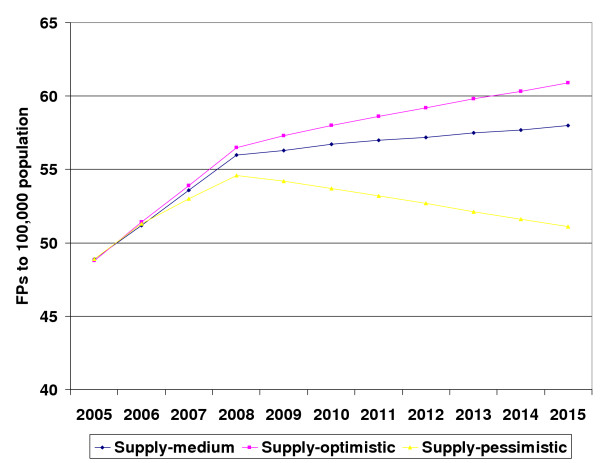
A computer spreadsheet simulation model was used to project the supply of FPs in 2006-2015. The supply was projected according to three scenarios, which took into account different rates of retirement, migration and drop out from training. In addition different population projections and enrollment numbers in residency programs were also considered. Three requirement scenarios were made using different approaches. In the first scenario we used the requirement estimated by a panel of experts using the Delphi technique. The second scenario was based on the number of visits to FPs in 2003 and took into account the goal to increase the number of visits. The third scenario was based on the determination that one FP should serve no more than 2,000 inhabitants. The three scenarios for the projection of supply were compared with the three requirement scenarios.

RESULTS

The supply of family physicians will be higher in 2015 compared to 2005 according to all projection scenarios. The largest differences in the supply scenarios were caused by different migration rates, enrollment numbers to training programs and the retirement age. The second supply scenario, which took into account 1.1% annual migration rate, stable enrollment to residency programs and later retirement, appears to be the most probable. The first requirement scenario, which was based on the opinion of well-informed key experts in the field, appears to be the best reflection of FP requirements; however none of the supply scenarios considered would satisfy these requirements.

CONCLUSION

Despite the rapid expansion of the FP workforce during the last fifteen years, ten-year forecasts of supply and requirement indicate that the number of FPs in 2015 will not be sufficient. The annual enrollment in residency training programs should be increased by at least 20% for the next three years. Accurate year-by-year monitoring of the workforce is crucial in order to prevent future shortages and to maintain the desired family physician workforce.

摘要

背景

1991年医疗改革启动时,立陶宛的医师队伍以专科医生为主,家庭医生这一专业根本不存在。在立陶宛独立的15年里,这一专业迅速发展,1900多名家庭医生接受了培训或再培训。自2003年以来,立陶宛医疗部门进行了重组,以优化医疗机构网络和服务提供;特别关注家庭医生提供的服务发展,更多的医疗服务从医院层面转移到了初级医疗层面。在本文中,我们分析未来是否会有足够的家庭医生队伍来承担新出现的任务。

方法

使用计算机电子表格模拟模型预测2006 - 2015年家庭医生的供应情况。根据三种情景预测供应情况,这三种情景考虑了不同的退休率、移民率和培训辍学率。此外,还考虑了不同的人口预测和住院医师培训项目的招生人数。使用不同方法制定了三种需求情景。在第一种情景中,我们使用专家小组采用德尔菲技术估计的需求。第二种情景基于2003年家庭医生的就诊人数,并考虑了增加就诊人数的目标。第三种情景基于确定一名家庭医生服务的居民人数不应超过2000人。将三种供应预测情景与三种需求情景进行比较。

结果

根据所有预测情景,2015年家庭医生的供应量将高于2005年。供应情景中最大的差异是由不同的移民率、培训项目的招生人数和退休年龄造成的。第二种供应情景,即考虑到每年1.1%的移民率、住院医师培训项目稳定的招生人数和较晚的退休年龄,似乎是最有可能的。第一种需求情景基于该领域消息灵通的关键专家的意见,似乎最能反映家庭医生的需求;然而,所考虑的任何供应情景都无法满足这些需求。

结论

尽管在过去15年里家庭医生队伍迅速扩大,但供应和需求的十年预测表明,2015年家庭医生的数量将不足。未来三年住院医师培训项目的年度招生人数应至少增加

20%。对劳动力进行准确的逐年监测对于防止未来短缺和维持理想的家庭医生队伍至关重要。
https://cdn.ncbi.nlm.nih.gov/pmc/blobs/990c/1262706/444b37f5fc1a/1471-2296-6-41-1.jpg

相似文献

1
The future prospects of Lithuanian family physicians: a 10-year forecasting study.立陶宛家庭医生的未来前景:一项为期10年的预测研究。
BMC Fam Pract. 2005 Oct 4;6:41. doi: 10.1186/1471-2296-6-41.
2
[Demographic forecasts of medical workforce supply in France (2000-2050). What numerus clausus for what future?].[法国医疗劳动力供应的人口预测(2000 - 2050年)。怎样的定额制度适合怎样的未来?]
Cah Sociol Demogr Med. 2004 Jan-Mar;44(1):101-48.
3
Benchmarking the future generalist workforce.对未来全科医疗劳动力进行基准评估。
Eff Clin Pract. 2002 Mar-Apr;5(2):58-66.
4
The United States rheumatology workforce: supply and demand, 2005-2025.美国风湿病专业人员队伍:2005年至2025年的供需情况
Arthritis Rheum. 2007 Mar;56(3):722-9. doi: 10.1002/art.22437.
5
Intergenerational differences in workloads among primary care physicians: a ten-year, population-based study.基层医疗医生工作量的代际差异:一项基于人群的十年研究。
Health Aff (Millwood). 2006 Nov-Dec;25(6):1620-8. doi: 10.1377/hlthaff.25.6.1620.
6
Projections of the future supply of family physicians in Connecticut: a basis for regional planning.康涅狄格州家庭医生未来供应情况预测:区域规划的基础
J Fam Pract. 1995 Nov;41(5):451-5.
7
A physician workforce for the 21st century.21世纪的医师队伍。
Ann Thorac Surg. 1995 Nov;60(5):1541-6. doi: 10.1016/0003-4975(95)00797-O.
8
Forecasting the need for physicians in the United States: the Health Resources and Services Administration's physician requirements model.预测美国医生需求:卫生资源与服务管理局的医生需求模型
Health Serv Res. 1997 Feb;31(6):723-37.
9
Physician workforce planning and the transition to primary health care in former socialist countries.前社会主义国家的医生劳动力规划与向初级卫生保健的过渡。
Cah Sociol Demogr Med. 2005 Apr-Sep;45(2-3):307-25.
10
Modelling workforce skill-mix: how can dental professionals meet the needs and demands of older people in England?建模劳动力技能组合:英格兰的牙科专业人员如何满足老年人的需求?
Br Dent J. 2010 Feb 13;208(3):E6; discussion 116-7. doi: 10.1038/sj.bdj.2010.106. Epub 2010 Feb 5.

引用本文的文献

1
Health workforce forecast in the university hospital: evidence from Lithuania.大学医院的卫生人力预测:来自立陶宛的证据。
BMC Nurs. 2024 Sep 18;23(1):663. doi: 10.1186/s12912-024-02326-9.
2
Methods and Tools Used to Estimate the Shortages of Medical Staff in European Countries-Scoping Review.方法和工具用于估计欧洲国家医疗人员短缺-范围审查。
Int J Environ Res Public Health. 2023 Feb 8;20(4):2945. doi: 10.3390/ijerph20042945.
3
Consultation Management during the COVID-19 Pandemic: The Experience of Lithuanian Physicians.新冠疫情期间的会诊管理:立陶宛医生的经验

本文引用的文献

1
The factors associated to psychosocial stress among general practitioners in Lithuania. Cross-sectional study.立陶宛全科医生心理社会压力的相关因素。横断面研究。
BMC Health Serv Res. 2005 Jun 10;5:45. doi: 10.1186/1472-6963-5-45.
2
Health care reform and job satisfaction of primary health care physicians in Lithuania.立陶宛初级医疗保健医生的医疗改革与工作满意度
BMC Fam Pract. 2005 Mar 7;6(1):10. doi: 10.1186/1471-2296-6-10.
3
[The survey of Lithuanian physicians and medical residents regarding possible migration to the European Union].
Healthcare (Basel). 2022 Dec 7;10(12):2472. doi: 10.3390/healthcare10122472.
4
Application of a system dynamics model in forecasting the supply and age distribution of physicians.系统动力学模型在预测医生供应及年龄分布中的应用。
Croat Med J. 2020 Apr 30;61(2):100-106. doi: 10.3325/cmj.2020.61.100.
5
A dynamic, multi-professional, needs-based simulation model to inform human resources for health planning.一个动态的、多专业的、基于需求的模拟模型,为卫生人力资源规划提供信息。
Hum Resour Health. 2019 Jun 13;17(1):42. doi: 10.1186/s12960-019-0376-2.
6
Global Brain Drain: How Can the Maslow Theory of Motivation Improve Our Understanding of Physician Migration?全球人才流失:动机的马斯洛理论如何帮助我们理解医生移民?
Int J Environ Res Public Health. 2019 Apr 2;16(7):1182. doi: 10.3390/ijerph16071182.
7
Handling healthcare workforce planning with care: where do we stand?谨慎对待医疗人力规划:我们目前的状况如何?
Hum Resour Health. 2015 May 24;13:38. doi: 10.1186/s12960-015-0028-0.
8
Forecasting the need for medical specialists in Spain: application of a system dynamics model.预测西班牙对医学专家的需求:系统动力学模型的应用。
Hum Resour Health. 2010 Oct 29;8:24. doi: 10.1186/1478-4491-8-24.
9
The appropriateness of gatekeeping in the provision of reproductive health care for adolescents in Lithuania:the general practice perspective.立陶宛青少年生殖健康保健中守门人的适宜性:全科医疗视角
BMC Fam Pract. 2006 Mar 14;7:16. doi: 10.1186/1471-2296-7-16.
[关于立陶宛医生和医学住院医师可能向欧盟移民情况的调查]
Medicina (Kaunas). 2004;40(1):68-74.
4
Physicians resources in Lithuania: change comes slowly.立陶宛的医生资源:变化缓慢。
Croat Med J. 2003 Apr;44(2):207-13.
5
Medical workforce planning in Australia.澳大利亚的医疗劳动力规划。
Aust Health Rev. 2000;23(4):8-26.
6
The urology work force in Ontario for the 21st century: feast or famine?21世纪安大略省的泌尿外科医疗队伍:前景是盛宴还是饥荒?
Can J Surg. 1999 Jun;42(3):181-9.