Godin Isabelle, Kittel France, Coppieters Yves, Siegrist Johannes
Health Psychology Unit CP 596, School of Public Health, Université Libre de Bruxelles, 808 Route de Lennik, 1070 Brussels, Belgium.
BMC Public Health. 2005 Jun 15;5:67. doi: 10.1186/1471-2458-5-67.
This study tests associations between psychosocial stress at work measured by the effort-reward imbalance model in a dynamic perspective, and multiple indicators of poor mental health, in a prospective design.
1986 male and female employees from four Belgian enterprises were followed-up over one year within the framework of the Somstress study. Based on two consecutive measurements, an index of cumulative job stress was constructed and its associations with five indicators of mental health were studied, excluding caseness at entry (for depression, anxiety, somatisation, chronic fatigue and psychotropic drug consumption respectively). Taking into account the longitudinal design, four categories of job stress are defined: 1) employees free from stress at both measures, 2) job stress present at first measure but not at the second one, 3) recent onset of job stress as evidenced by second measure 4) workers exposed to stress at both measures. Multivariate logistic regression with appropriate adjustments was applied.
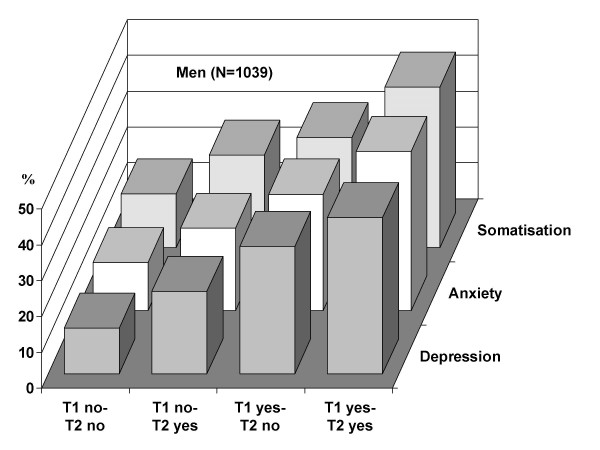
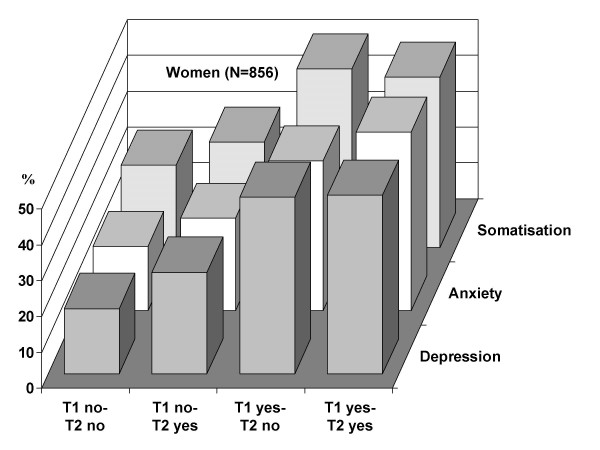
In bivariate analysis, a clear graded association of cumulative job stress with all five mental health indicators is observed, both in men and women. In multivariate logistic regression analysis, recent onset of stress is strongly associated with poor mental health among men (odds ratios ranging from 1.8 to 4.6), while cumulative stress shows strongest effects on mental health in women (odds ratios ranging from 1.4 to 7.1).
Cumulative experience and recent onset of job stress in terms of high effort spent and low reward received is associated with elevated risk of all five indicators of poor mental health at follow-up in a large cohort of employees.
本研究以前瞻性设计,从动态角度测试了用努力-回报失衡模型衡量的工作心理社会压力与多种心理健康不佳指标之间的关联。
在Somstress研究框架内,对来自比利时四家企业的1986名男女员工进行了为期一年的随访。基于连续两次测量,构建了累积工作压力指数,并研究了其与五种心理健康指标的关联,排除了入组时的病例情况(分别针对抑郁、焦虑、躯体化、慢性疲劳和精神药物消费)。考虑到纵向设计,定义了四类工作压力:1)两次测量均无压力的员工;2)首次测量时有工作压力但第二次测量时没有的员工;3)第二次测量证明最近开始出现工作压力的员工;4)两次测量均承受压力的员工。应用了进行适当调整的多变量逻辑回归。
在双变量分析中,观察到累积工作压力与所有五项心理健康指标之间存在明显的分级关联,男女皆是如此。在多变量逻辑回归分析中,最近开始出现压力与男性心理健康不佳密切相关(比值比范围为1.8至4.6),而累积压力对女性心理健康的影响最为显著(比值比范围为1.4至7.1)。
在一大群员工中,从高付出低回报角度来看,累积的工作压力经历和最近开始出现的工作压力与随访时所有五项心理健康不佳指标的风险升高相关。