Sporbert Anje, Domaing Petra, Leonhardt Heinrich, Cardoso M Cristina
Max Delbrueck Center for Molecular Medicine 13125 Berlin, Germany.
Nucleic Acids Res. 2005 Jun 21;33(11):3521-8. doi: 10.1093/nar/gki665. Print 2005.
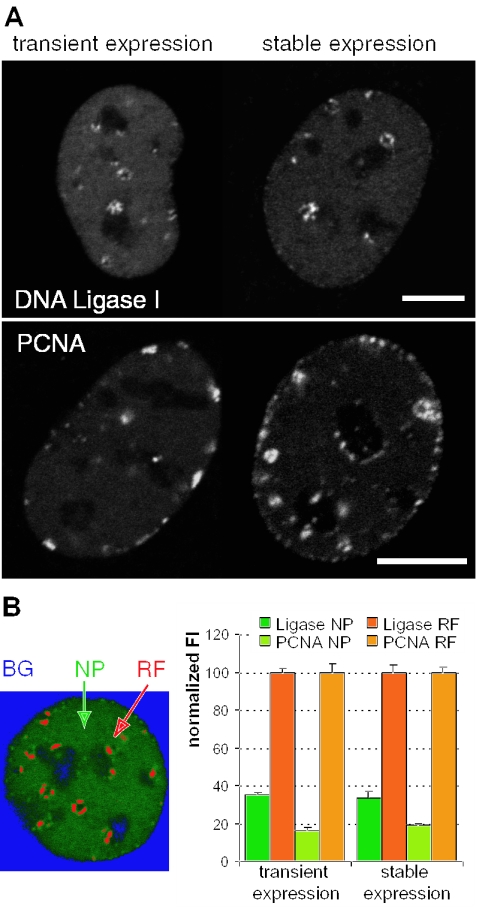
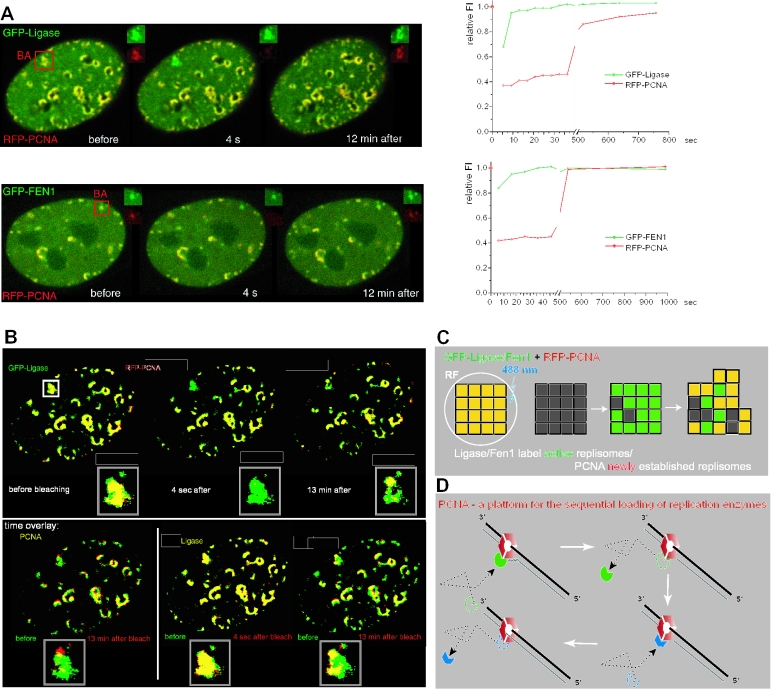
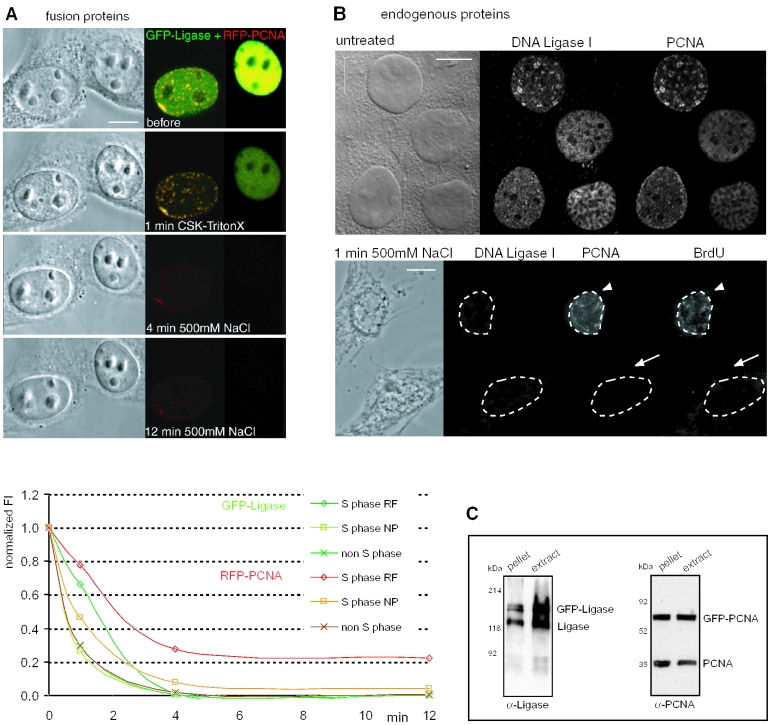
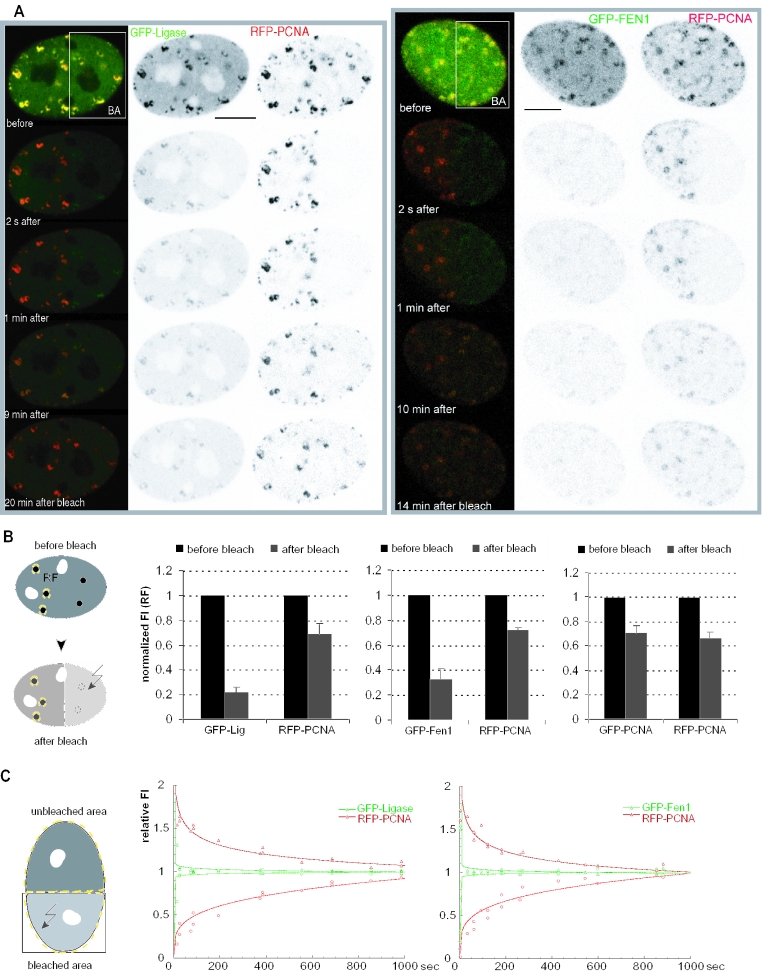
In DNA replication, the leading strand is synthesized continuously, but lagging strand synthesis requires the complex, discontinuous synthesis of Okazaki fragments, and their subsequent joining. We have used a combination of in situ extraction and dual color photobleaching to compare the dynamic properties of three proteins essential for lagging strand synthesis: the polymerase clamp proliferating cell nuclear antigen (PCNA) and two proteins that bind to it, DNA Ligase I and Fen1. All three proteins are localized at replication foci (RF), but in contrast to PCNA, Ligase and Fen1 were readily extracted. Dual photobleaching combined with time overlays revealed a rapid exchange of Ligase and Fen1 at RF, which is consistent with de novo loading at every Okazaki fragment, while the slow recovery of PCNA mostly occurred at adjacent, newly assembled RF. These data indicate that PCNA works as a stationary loading platform that is reused for multiple Okazaki fragments, while PCNA binding proteins only transiently associate and are not stable components of the replication machinery.
在DNA复制过程中,前导链是连续合成的,但滞后链的合成需要复杂的、不连续的冈崎片段合成及其后续连接。我们使用原位提取和双色光漂白相结合的方法,比较了滞后链合成所必需的三种蛋白质的动态特性:聚合酶钳增殖细胞核抗原(PCNA)以及与之结合的两种蛋白质,DNA连接酶I和Fen1。这三种蛋白质都定位于复制位点(RF),但与PCNA不同的是,连接酶和Fen1很容易被提取出来。双色光漂白结合时间叠加显示,连接酶和Fen1在RF处快速交换,这与每个冈崎片段的从头加载一致,而PCNA的缓慢恢复大多发生在相邻的、新组装的RF处。这些数据表明,PCNA作为一个固定的加载平台,可被多个冈崎片段重复使用,而与PCNA结合的蛋白质只是短暂结合,并非复制机制的稳定组成部分。