Shriberg Lawrence D, McSweeny Jane L, Anderson Bruce E, Campbell Thomas F, Chial Michael R, Green Jordan R, Hauner Katherina K, Moore Christopher A, Rusiewicz Heather L, Wilson David L
Phonology Project, Waisman Center, University of Wisconsin-Madison, 53705, USA.
Clin Linguist Phon. 2005 Jun;19(4):335-59. doi: 10.1080/02699200500085426.
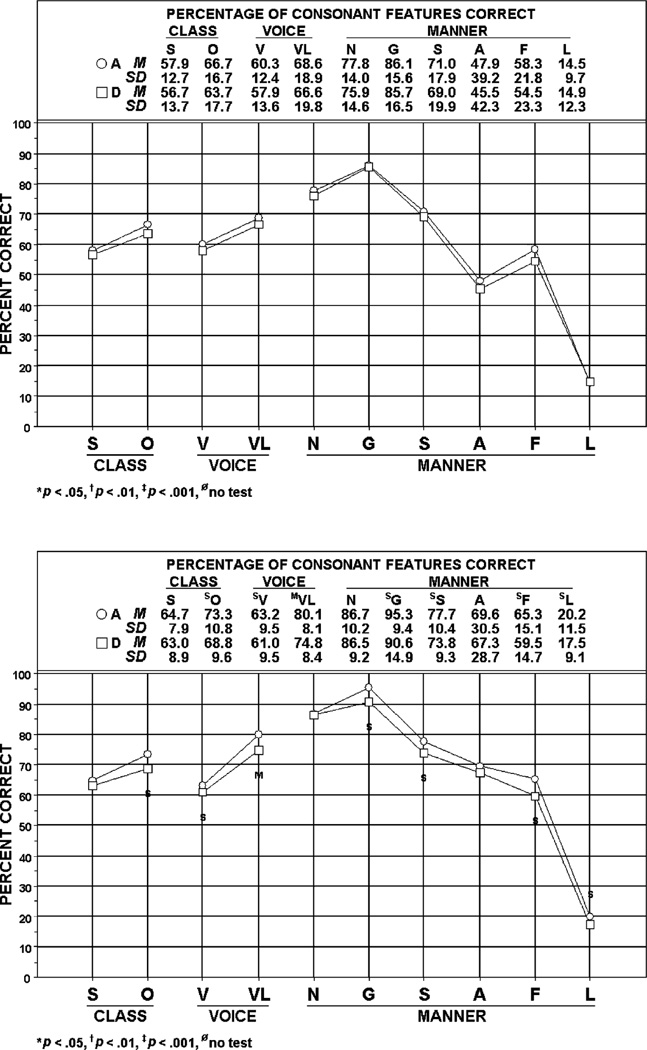
Few empirical findings or technical guidelines are available on the current transition from analog to digital audio recording in childhood speech sound disorders. Of particular concern in the present context was whether a transition from analog- to digital-based transcription and coding of prosody and voice features might require re-standardizing a reference database for research in childhood speech sound disorders. Two research transcribers with different levels of experience glossed, transcribed, and prosody-voice coded conversational speech samples from eight children with mild to severe speech disorders of unknown origin. The samples were recorded, stored, and played back using representative analog and digital audio systems. Effect sizes calculated for an array of analog versus digital comparisons ranged from negligible to medium, with a trend for participants' speech competency scores to be slightly lower for samples obtained and transcribed using the digital system. We discuss the implications of these and other findings for research and clinical practise.
关于目前儿童语音障碍从模拟音频记录向数字音频记录的转变,几乎没有实证研究结果或技术指南。在当前背景下,特别令人关注的是,从基于模拟的韵律和语音特征转录及编码向基于数字的转录及编码转变,是否可能需要重新规范儿童语音障碍研究的参考数据库。两名经验水平不同的研究转录员对八名患有不明原因轻度至重度语音障碍儿童的对话语音样本进行了注释、转录以及韵律-语音编码。这些样本使用具有代表性的模拟和数字音频系统进行录制、存储和回放。对一系列模拟与数字比较计算得出的效应量范围从可忽略不计到中等,使用数字系统获取和转录的样本,参与者的语音能力得分有略低的趋势。我们讨论了这些及其他研究结果对研究和临床实践的意义。