Cyrys Josef, Hochadel Matthias, Gehring Ulrike, Hoek Gerard, Diegmann Volker, Brunekreef Bert, Heinrich Joachim
GSF, National Research Center for Environment and Health, Institute of Epidemiology, Neuherberg, Germany.
Environ Health Perspect. 2005 Aug;113(8):987-92. doi: 10.1289/ehp.7662.
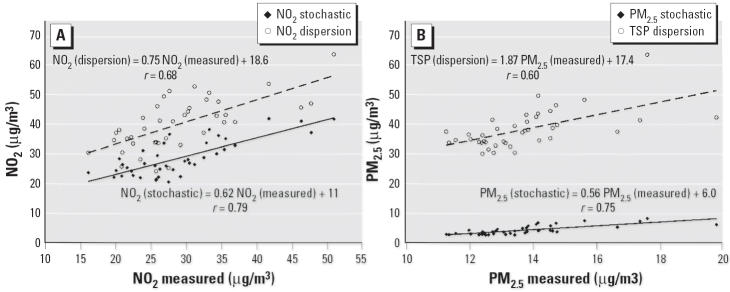
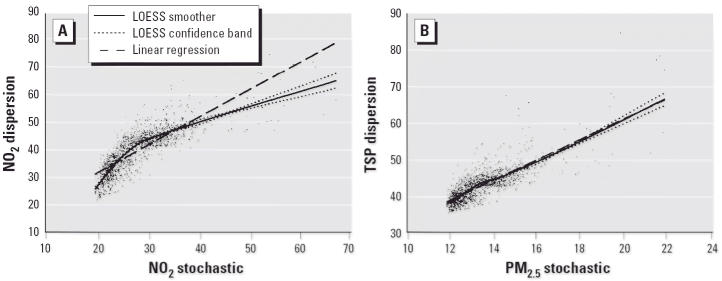
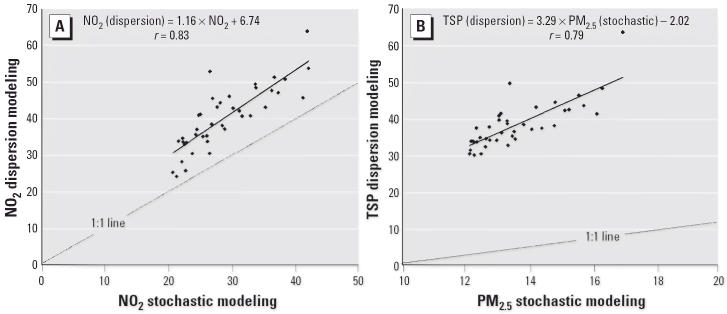
Stochastic modeling was used to predict nitrogen dioxide and fine particles [particles collected with an upper 50% cut point of 2.5 microm aerodynamic diameter (PM2.5)] levels at 1,669 addresses of the participants of two ongoing birth cohort studies conducted in Munich, Germany. Alternatively, the Gaussian multisource dispersion model IMMIS(net/em) was used to estimate the annual mean values for NO2 and total suspended particles (TSP) for the 40 measurement sites and for all study subjects. The aim of this study was to compare the measured NO2 and PM2.5 levels with the levels predicted by the two modeling approaches (for the 40 measurement sites) and to compare the results of the stochastic and dispersion modeling for all study infants (1,669 sites). NO2 and PM2.5 concentrations obtained by the stochastic models were in the same range as the measured concentrations, whereas the NO2 and TSP levels estimated by dispersion modeling were higher than the measured values. However, the correlation between stochastic- and dispersion-modeled concentrations was strong for both pollutants: At the 40 measurement sites, for NO2, r = 0.83, and for PM, r = 0.79; at the 1,669 cohort sites, for NO2, r = 0.83 and for PM, r = 0.79. Both models yield similar results regarding exposure estimate of the study cohort to traffic-related air pollution, when classified into tertiles; that is, 70% of the study subjects were classified into the same category. In conclusion, despite different assumptions and procedures used for the stochastic and dispersion modeling, both models yield similar results regarding exposure estimation of the study cohort to traffic-related air pollutants.
采用随机模型预测了德国慕尼黑正在进行的两项出生队列研究中1669名参与者住址处的二氧化氮和细颗粒物[空气动力学直径上限为2.5微米的颗粒物(PM2.5)]水平。另外,使用高斯多源扩散模型IMMIS(net/em)估算了40个测量点以及所有研究对象的二氧化氮和总悬浮颗粒物(TSP)年均值。本研究的目的是将测量的二氧化氮和PM2.5水平与两种建模方法预测的水平(针对40个测量点)进行比较,并比较所有研究婴儿(1669个住址)的随机模型和扩散模型结果。随机模型得出的二氧化氮和PM2.5浓度与测量浓度处于同一范围,而扩散模型估算的二氧化氮和TSP水平高于测量值。然而,两种污染物在随机模型和扩散模型浓度之间的相关性都很强:在40个测量点,二氧化氮的r = 0.83,颗粒物的r = 0.79;在1669个队列住址处,二氧化氮的r = 0.83,颗粒物的r = 0.79。当将研究队列的交通相关空气污染暴露估计值分为三分位数时,两种模型得出的结果相似;也就是说,70%的研究对象被归入同一类别。总之,尽管随机模型和扩散模型采用了不同的假设和程序,但在研究队列的交通相关空气污染物暴露估计方面,两种模型得出的结果相似。