• 文献检索
  • 文档翻译
  • 深度研究
  • 学术资讯
  • Suppr Zotero 插件Zotero 插件
  • 邀请有礼
  • 套餐&价格
  • 历史记录
应用&插件
Suppr Zotero 插件Zotero 插件浏览器插件Mac 客户端Windows 客户端微信小程序
定价
高级版会员购买积分包购买API积分包
服务
文献检索文档翻译深度研究API 文档MCP 服务
关于我们
关于 Suppr公司介绍联系我们用户协议隐私条款
关注我们

Suppr 超能文献

核心技术专利:CN118964589B侵权必究
粤ICP备2023148730 号-1Suppr @ 2026

文献检索

告别复杂PubMed语法,用中文像聊天一样搜索,搜遍4000万医学文献。AI智能推荐,让科研检索更轻松。

立即免费搜索

文件翻译

保留排版,准确专业,支持PDF/Word/PPT等文件格式,支持 12+语言互译。

免费翻译文档

深度研究

AI帮你快速写综述,25分钟生成高质量综述,智能提取关键信息,辅助科研写作。

立即免费体验

欧洲新生儿重症监护病房经皮血气监测调查

A survey of transcutaneous blood gas monitoring among European neonatal intensive care units.

作者信息

Rüdiger Mario, Töpfer Kerstin, Hammer Hannes, Schmalisch Gerd, Wauer Roland R

机构信息

Clinic of Neonatology, Universitätsmedizin Berlin, Charité-Mitte, Germany.

出版信息

BMC Pediatr. 2005 Aug 10;5:30. doi: 10.1186/1471-2431-5-30.

DOI:10.1186/1471-2431-5-30
PMID:16092957
原文链接:https://pmc.ncbi.nlm.nih.gov/articles/PMC1192805/
Abstract

BACKGROUND

PCO2 and PO2 are important monitoring parameters in neonatal intensive care units (NICU). Compared to conventional blood gas measurements that cause significant blood loss in preterms, transcutaneous (tc) measurements allow continuous, non-invasive monitoring of blood gas levels. The aim of the study was to survey the usage and opinions among German speaking NICUs concerning tc blood gas monitoring.

METHODS

A questionnaire was developed and sent to 56 head nurses of different NICUs in Germany, Switzerland and Austria.

RESULTS

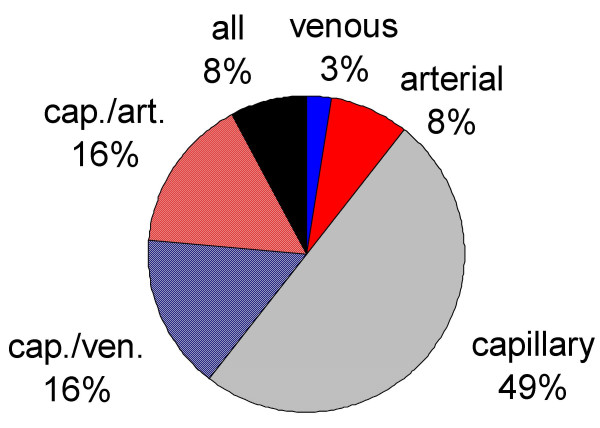
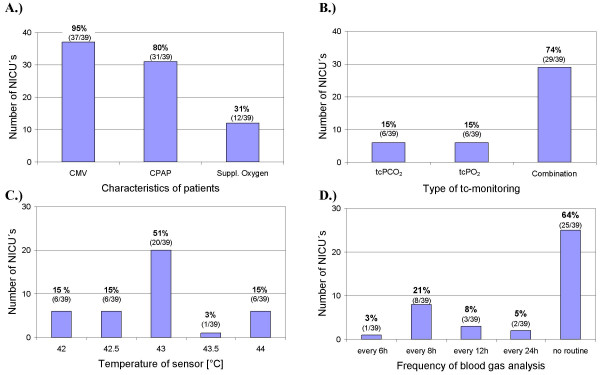
A completely answered questionnaire was obtained from 41 NICUs. In two of these units tc measurements are not performed. In most NICUs (77%), both PtcO2 and PtcCO2 are measured simultaneously. Most units change the sensors every 3 hours; however, the recommended temperature of 44 degrees C is used in only 15% of units. In only 8% of units are arterial blood gases obtained to validate tc values. Large variations were found concerning the targeted level of oxygen saturation [median upper limit: 95% (range 80-100%); median lower limit: 86% (range 75-93%)] and PO2 [median upper limit: 70 mmHg (range 45-90 mmHg); median lower limit: 44 mmHg (range 30-60 mmHg)].

CONCLUSION

Our survey shows that the use of tc monitors remains widespread among German speaking NICUs, despite earlier data suggesting that their use had been abandoned in many NICUs worldwide. In addition, we suggest that the current method of monitoring oxygenation may not prevent hyperoxemia in preterm infants.

摘要

背景

二氧化碳分压(PCO₂)和氧分压(PO₂)是新生儿重症监护病房(NICU)重要的监测参数。与导致早产儿大量失血的传统血气测量相比,经皮(tc)测量可实现对血气水平的连续、无创监测。本研究旨在调查德语区NICU对tc血气监测的使用情况和看法。

方法

设计了一份问卷,并发送给德国、瑞士和奥地利不同NICU的56名护士长。

结果

从41个NICU获得了完整填写的问卷。其中两个单位未进行tc测量。在大多数NICU(77%)中,同时测量经皮氧分压(PtcO₂)和经皮二氧化碳分压(PtcCO₂)。大多数单位每3小时更换一次传感器;然而,只有15%的单位使用推荐的44摄氏度温度。只有8%的单位采集动脉血气以验证tc值。在氧饱和度目标水平[中位数上限:95%(范围80 - 100%);中位数下限:86%(范围75 - 93%)]和PO₂[中位数上限:70 mmHg(范围45 - 90 mmHg);中位数下限:44 mmHg(范围30 - 60 mmHg)]方面发现了很大差异。

结论

我们的调查表明,尽管早期数据表明全球许多NICU已不再使用tc监测仪,但tc监测仪在德语区NICU中仍广泛使用。此外,我们认为目前的氧合监测方法可能无法预防早产儿高氧血症。
https://cdn.ncbi.nlm.nih.gov/pmc/blobs/e96e/1192805/55dab53da271/1471-2431-5-30-2.jpg
https://cdn.ncbi.nlm.nih.gov/pmc/blobs/e96e/1192805/055854c17325/1471-2431-5-30-1.jpg
https://cdn.ncbi.nlm.nih.gov/pmc/blobs/e96e/1192805/55dab53da271/1471-2431-5-30-2.jpg
https://cdn.ncbi.nlm.nih.gov/pmc/blobs/e96e/1192805/055854c17325/1471-2431-5-30-1.jpg
https://cdn.ncbi.nlm.nih.gov/pmc/blobs/e96e/1192805/55dab53da271/1471-2431-5-30-2.jpg

相似文献

1
A survey of transcutaneous blood gas monitoring among European neonatal intensive care units.欧洲新生儿重症监护病房经皮血气监测调查
BMC Pediatr. 2005 Aug 10;5:30. doi: 10.1186/1471-2431-5-30.
2
Pulse oximeter saturation target limits for preterm infants: a survey among European neonatal intensive care units.早产儿脉搏血氧饱和度目标限值:欧洲新生儿重症监护病房的一项调查
Eur J Pediatr. 2017 Jan;176(1):51-56. doi: 10.1007/s00431-016-2804-9. Epub 2016 Nov 16.
3
Transcutaneous blood gas monitoring among neonatal intensive care units in Japan.日本新生儿重症监护病房中的经皮血气监测
Pediatr Int. 2020 Feb;62(2):169-174. doi: 10.1111/ped.14107. Epub 2020 Feb 16.
4
Accuracy of Transcutaneous CO Values Compared With Arterial and Capillary Blood Gases.经皮二氧化碳值与动脉血和毛细血管血气值的准确性比较。
Respir Care. 2018 Jul;63(7):907-912. doi: 10.4187/respcare.05936. Epub 2018 May 8.
5
Nurse opinions and pulse oximeter saturation target limits for preterm infants.护士对早产儿的看法及脉搏血氧饱和度目标限值
Pediatrics. 2008 May;121(5):e1039-46. doi: 10.1542/peds.2007-2257.
6
[Non-invasive method of arterial oxygen saturation monitoring in the neonatal intensive care unit (with a review of blood oxygen monitoring methods)].新生儿重症监护病房中动脉血氧饱和度监测的无创方法(附血氧监测方法综述)
Tijdschr Kindergeneeskd. 1988 Feb;56(1):20-6.
7
Neonatal Transcutaneous Carbon Dioxide Monitoring--Effect on Clinical Management and Outcomes.新生儿经皮二氧化碳监测——对临床管理及结局的影响
Respir Care. 2016 Jan;61(1):90-7. doi: 10.4187/respcare.04212. Epub 2015 Oct 27.
8
Breastfeeding support in neonatal intensive care: a national survey.新生儿重症监护室中的母乳喂养支持:一项全国性调查。
J Hum Lact. 2012 Aug;28(3):370-9. doi: 10.1177/0890334412440846. Epub 2012 Jun 6.
9
A comparison of two transcutaneous monitors for the measurement of arterial PO2 and PCO2 in neonates.两种经皮监测仪用于测量新生儿动脉血氧分压和二氧化碳分压的比较。
Anaesth Intensive Care. 1995 Dec;23(6):708-14. doi: 10.1177/0310057X9502300610.
10
Less invasive ventilation in extremely low birth weight infants from 1997 to 2011: survey versus evidence.1997年至2011年极低出生体重儿的无创通气:调查与证据
Eur J Pediatr. 2015 Sep;174(9):1189-96. doi: 10.1007/s00431-015-2519-3. Epub 2015 Apr 1.

引用本文的文献

1
A Moving Target: Studying the Effect of Continuous Transcutaneous CO Monitoring in ELBW Infants During an Equipoise Shift.一个动态目标:研究在平衡状态转变期间持续经皮二氧化碳监测对超低出生体重儿的影响。
J Clin Med. 2024 Oct 29;13(21):6472. doi: 10.3390/jcm13216472.
2
Hand-held electron spin resonance scanner for subcutaneous oximetry using OxyChip.手持式电子自旋共振扫描仪,用于使用 OxyChip 进行皮下血氧饱和度测量。
Magn Reson Med. 2024 Jul;92(1):430-439. doi: 10.1002/mrm.30066. Epub 2024 Feb 27.
3
Transcutaneous CO Monitoring in Extremely Low Birth Weight Premature Infants.

本文引用的文献

1
Center differences and outcomes of extremely low birth weight infants.极低出生体重儿的中心差异与结局
Pediatrics. 2004 Apr;113(4):781-9. doi: 10.1542/peds.113.4.781.
2
Hypocapnia and other ventilation-related risk factors for cerebral palsy in low birth weight infants.
Pediatr Res. 2001 Dec;50(6):712-9. doi: 10.1203/00006450-200112000-00014.
3
Hypocapnia and hypercapnia in respiratory management of newborn infants.新生儿呼吸管理中的低碳酸血症和高碳酸血症
Clin Perinatol. 2001 Sep;28(3):517-31. doi: 10.1016/s0095-5108(05)70104-4.
极低出生体重早产儿的经皮二氧化碳监测
J Clin Med. 2023 Sep 4;12(17):5757. doi: 10.3390/jcm12175757.
4
Improving the Clinical Interpretation of Transcutaneous Carbon Dioxide and Oxygen Measurements in the Neonatal Intensive Care Unit.提高新生儿重症监护病房经皮二氧化碳和氧测量的临床解读。
Neonatology. 2023;120(3):308-316. doi: 10.1159/000529187. Epub 2023 Mar 30.
5
Real-Time Monitoring of Blood Parameters in the Intensive Care Unit: State-of-the-Art and Perspectives.重症监护病房血液参数的实时监测:现状与展望
J Clin Med. 2022 Apr 25;11(9):2408. doi: 10.3390/jcm11092408.
6
Recent Insights into the Measurement of Carbon Dioxide Concentrations for Clinical Practice in Respiratory Medicine.近期对呼吸医学临床实践中二氧化碳浓度测量的深入了解。
Sensors (Basel). 2021 Aug 21;21(16):5636. doi: 10.3390/s21165636.
7
Evaluation of time courses of agreement between minutely obtained transcutaneous blood gas data and the gold standard arterial data from spontaneously breathing Asian adults, and various subgroup analyses.评价分钟级经皮血气数据与自发性呼吸亚洲成年人金标准动脉数据之间的一致性时间过程,并进行各种亚组分析。
BMC Pulm Med. 2020 May 29;20(1):151. doi: 10.1186/s12890-020-01184-w.
8
Novel transcutaneous sensor combining optical tcPO and electrochemical tcPCO monitoring with reflectance pulse oximetry.新型经皮传感器结合光学 tcPO 和电化学 tcPCO 监测与反射脉冲血氧测定。
Med Biol Eng Comput. 2020 Feb;58(2):239-247. doi: 10.1007/s11517-019-02067-x. Epub 2019 Nov 18.
9
Short term general anesthesia for retro-bulbar block in ophthalmic surgery generates no significant hypercapnia.眼科手术球后阻滞的短期全身麻醉不会产生明显的高碳酸血症。
J Clin Monit Comput. 2018 Apr;32(2):351-358. doi: 10.1007/s10877-017-0011-5. Epub 2017 Mar 11.
10
Monitoring Oxygenation and Gas Exchange in Neonatal Intensive Care Units: Current Practice in the Netherlands.监测新生儿重症监护病房中的氧合和气体交换:荷兰的当前实践。
Front Pediatr. 2015 Nov 3;3:94. doi: 10.3389/fped.2015.00094. eCollection 2015.
4
The clinical utility of arterialized earlobe capillary blood in the assessment of patients for long-term oxygen therapy.动脉化耳垂毛细血管血在评估患者长期氧疗中的临床应用。
Respir Med. 2001 Aug;95(8):655-60. doi: 10.1053/rmed.2001.1118.
5
Randomized trial of permissive hypercapnia in preterm infants.早产儿允许性高碳酸血症的随机试验。
Pediatrics. 1999 Nov;104(5 Pt 1):1082-8. doi: 10.1542/peds.104.5.1082.
6
Responsibility for clinical innovation. A case study in neonatal medicine.
Eval Health Prof. 1998 Mar;21(1):3-26. doi: 10.1177/016327879802100101.
7
Carbon dioxide-induced retinopathy in the neonatal rat.新生大鼠二氧化碳诱导性视网膜病变
Curr Eye Res. 1998 Jun;17(6):608-16.
8
Evaluation of the newborn's blood gas status. National Academy of Clinical Biochemistry.新生儿血气状态评估。美国国家临床生物化学学会。
Clin Chem. 1997 Jan;43(1):215-21.
9
Doctors and the health industry: a case study of transcutaneous oxygen monitoring in neonatal intensive care.
Soc Sci Med. 1996 May;42(9):1247-58. doi: 10.1016/0277-9536(95)00222-7.
10
Measurement of transcutaneous carbon dioxide in low birthweight infants during the first two weeks of life.
Am J Perinatol. 1994 May;11(3):237-41. doi: 10.1055/s-2008-1040754.