Mudge Joann, Cannon Steven B, Kalo Peter, Oldroyd Giles E D, Roe Bruce A, Town Christopher D, Young Nevin D
Dept of Plant Pathology, University of Minnesota, St. Paul, MN 55108, USA.
BMC Plant Biol. 2005 Aug 15;5:15. doi: 10.1186/1471-2229-5-15.
Recent genome sequencing enables mega-base scale comparisons between related genomes. Comparisons between animals, plants, fungi, and bacteria demonstrate extensive synteny tempered by rearrangements. Within the legume plant family, glimpses of synteny have also been observed. Characterizing syntenic relationships in legumes is important in transferring knowledge from model legumes to crops that are important sources of protein, fixed nitrogen, and health-promoting compounds.
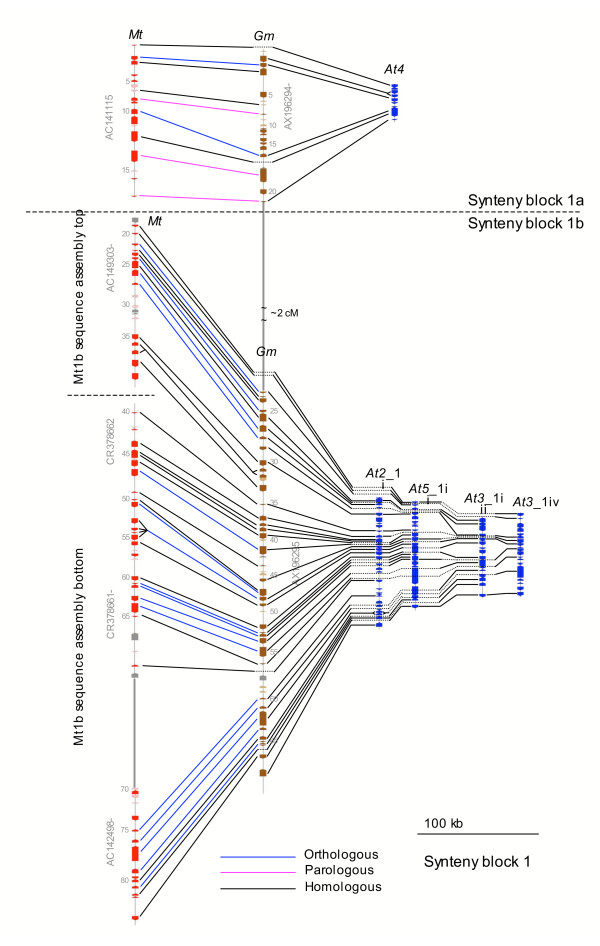
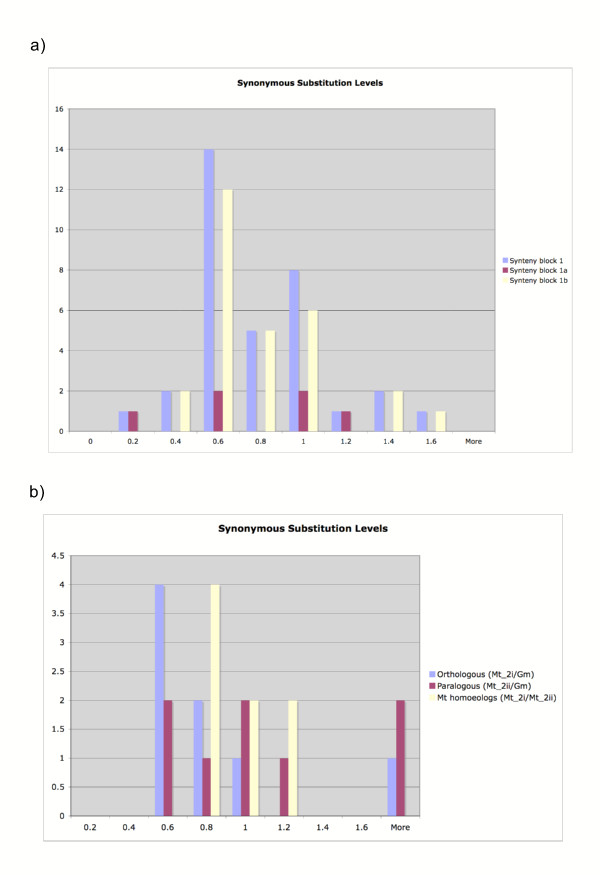
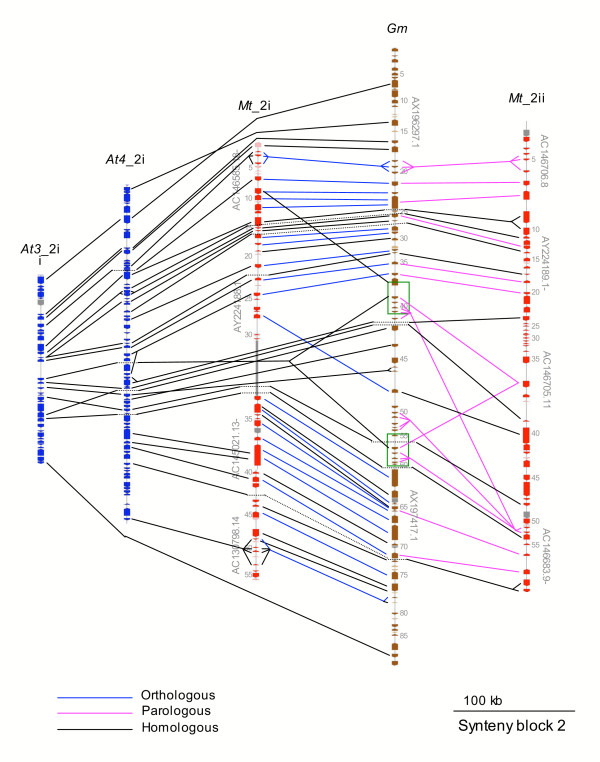
We have uncovered two large soybean regions exhibiting synteny with M. truncatula and with a network of segmentally duplicated regions in Arabidopsis. In all, syntenic regions comprise over 500 predicted genes spanning 3 Mb. Up to 75% of soybean genes are colinear with M. truncatula, including one region in which 33 of 35 soybean predicted genes with database support are colinear to M. truncatula. In some regions, 60% of soybean genes share colinearity with a network of A. thaliana duplications. One region is especially interesting because this 500 kbp segment of soybean is syntenic to two paralogous regions in M. truncatula on different chromosomes. Phylogenetic analysis of individual genes within these regions demonstrates that one is orthologous to the soybean region, with which it also shows substantially denser synteny and significantly lower levels of synonymous nucleotide substitutions. The other M. truncatula region is inferred to be paralogous, presumably resulting from a duplication event preceding speciation.
The presence of well-defined M. truncatula segments showing orthologous and paralogous relationships with soybean allows us to explore the evolution of contiguous genomic regions in the context of ancient genome duplication and speciation events.
近期的基因组测序使得相关基因组之间能够进行兆碱基规模的比较。动物、植物、真菌和细菌之间的比较表明,尽管存在重排,但仍有广泛的共线性。在豆科植物家族中,也观察到了共线性的迹象。表征豆科植物中的共线性关系对于将知识从模式豆科植物转移到作为蛋白质、固定氮和促进健康化合物重要来源的作物上至关重要。
我们发现了两个与蒺藜苜蓿以及拟南芥中一个片段重复区域网络呈现共线性的大豆大片段区域。总体而言,共线性区域包含跨越3 Mb的500多个预测基因。高达75%的大豆基因与蒺藜苜蓿共线,包括一个区域,其中35个有数据库支持的大豆预测基因中有33个与蒺藜苜蓿共线。在某些区域,60%的大豆基因与拟南芥重复网络具有共线性。一个区域特别有趣,因为这个500 kbp的大豆片段与蒺藜苜蓿不同染色体上的两个旁系同源区域共线。对这些区域内单个基因的系统发育分析表明,其中一个与大豆区域是直系同源的,它与大豆区域还表现出明显更密集的共线性以及显著更低水平的同义核苷酸替换。另一个蒺藜苜蓿区域被推断为旁系同源的,推测是由物种形成之前的一次重复事件导致的。
存在与大豆呈现直系同源和旁系同源关系的明确界定的蒺藜苜蓿片段,这使我们能够在古代基因组重复和物种形成事件的背景下探索连续基因组区域的进化。