Fang Shou Guo, Shen Shuo, Tay Felicia P L, Liu D X
Institute of Molecular and Cell Biology, 61 Biopolis Drive, Proteos, Singapore 138673, Singapore.
Biochem Biophys Res Commun. 2005 Oct 21;336(2):417-23. doi: 10.1016/j.bbrc.2005.08.105.
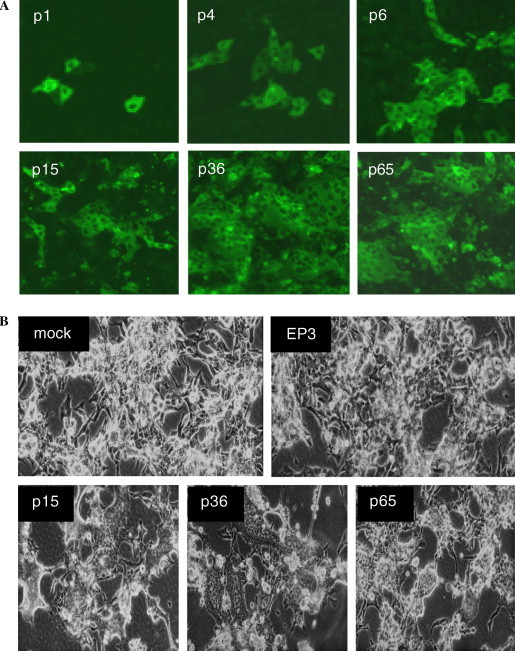
An interesting question posed by the current evidence that severe acute respiratory syndrome coronavirus may be originated from an animal coronavirus is how such an animal coronavirus breaks the host species barrier and becomes zoonotic. In this report, we study the chronological order of genotypic changes in the spike protein of avian coronavirus infectious bronchitis virus (IBV) during its adaptation to a primate cell line. Adaptation of the Beaudette strain of IBV from chicken embryo to Vero cells showed the accumulation of 49 amino acid mutations. Among them, 26 (53.06%) substitutions were located in the S protein. Sequencing analysis and comparison of the S gene demonstrated that the majority of the mutations were accumulated and fixed at passage 7 on Vero cells and minor variants were isolated in several passages. Evidence present suggests that the dominant Vero cell-adapted IBV strain may be derived from the chicken embryo passages by selection of and potential recombination between the minor variants. This may explain why adaptation is a rapid process and the dominant strain, once adapted to a new host cell, becomes relatively stable.
当前有证据表明严重急性呼吸综合征冠状病毒可能起源于一种动物冠状病毒,由此引出了一个有趣的问题,即这样一种动物冠状病毒是如何突破宿主物种屏障并成为人畜共患病原体的。在本报告中,我们研究了禽冠状病毒传染性支气管炎病毒(IBV)在适应灵长类细胞系过程中,其刺突蛋白基因型变化的时间顺序。将IBV的Beaudette毒株从鸡胚适应至Vero细胞的过程中,共出现了49个氨基酸突变。其中,26个(53.06%)替换位于S蛋白中。对S基因的测序分析和比较表明,大多数突变在Vero细胞传代至第7代时积累并固定下来,且在几个传代过程中分离出了少量变体。现有证据表明,占主导地位的适应Vero细胞的IBV毒株可能是通过对少量变体的选择和潜在重组,从鸡胚传代中衍生而来。这或许可以解释为什么适应是一个快速的过程,以及主导毒株一旦适应新的宿主细胞就会变得相对稳定。