Harrison Joe J, Turner Raymond J, Ceri Howard
Department of Biological Sciences, University of Calgary, Calgary, Alberta, T2N 1N4, Canada.
BMC Microbiol. 2005 Oct 3;5:53. doi: 10.1186/1471-2180-5-53.
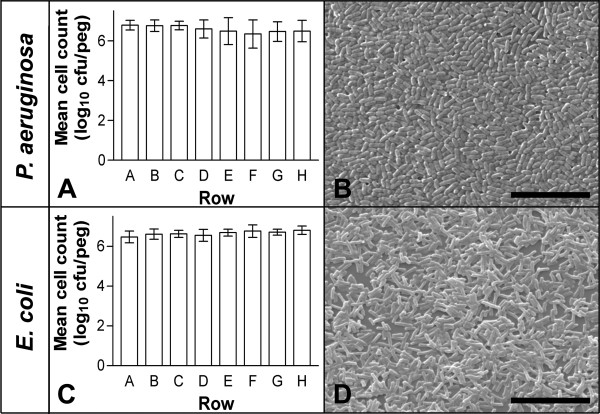
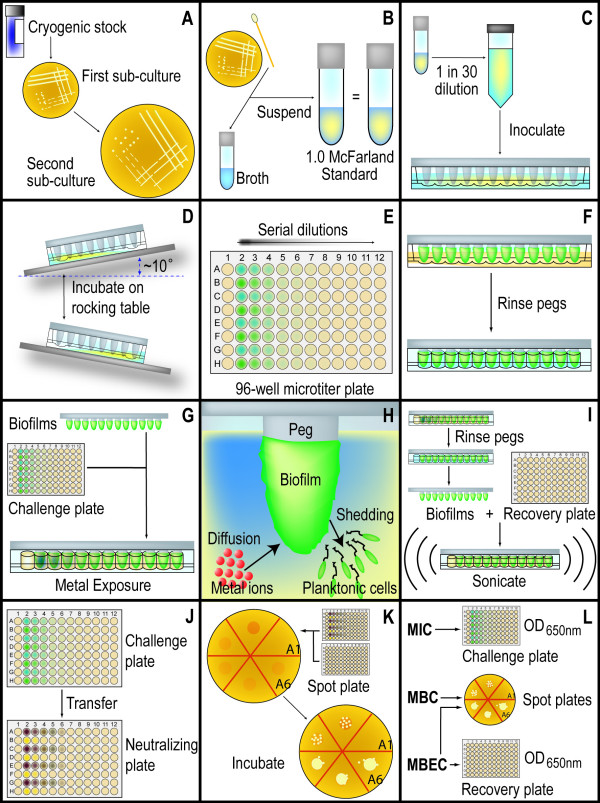
Microbial biofilms exist all over the natural world, a distribution that is paralleled by metal cations and oxyanions. Despite this reality, very few studies have examined how biofilms withstand exposure to these toxic compounds. This article describes a batch culture technique for biofilm and planktonic cell metal susceptibility testing using the MBEC assay. This device is compatible with standard 96-well microtiter plate technology. As part of this method, a two part, metal specific neutralization protocol is summarized. This procedure minimizes residual biological toxicity arising from the carry-over of metals from challenge to recovery media. Neutralization consists of treating cultures with a chemical compound known to react with or to chelate the metal. Treated cultures are plated onto rich agar to allow metal complexes to diffuse into the recovery medium while bacteria remain on top to recover. Two difficulties associated with metal susceptibility testing were the focus of two applications of this technique. First, assays were calibrated to allow comparisons of the susceptibility of different organisms to metals. Second, the effects of exposure time and growth medium composition on the susceptibility of E. coli JM109 biofilms to metals were investigated.
This high-throughput method generated 96-statistically equivalent biofilms in a single device and thus allowed for comparative and combinatorial experiments of media, microbial strains, exposure times and metals. By adjusting growth conditions, it was possible to examine biofilms of different microorganisms that had similar cell densities. In one example, Pseudomonas aeruginosa ATCC 27853 was up to 80 times more resistant to heavy metalloid oxyanions than Escherichia coli TG1. Further, biofilms were up to 133 times more tolerant to tellurite (TeO3(2-)) than corresponding planktonic cultures. Regardless of the growth medium, the tolerance of biofilm and planktonic cell E. coli JM109 to metals was time-dependent.
This method results in accurate, easily reproducible comparisons between the susceptibility of planktonic cells and biofilms to metals. Further, it was possible to make direct comparisons of the ability of different microbial strains to withstand metal toxicity. The data presented here also indicate that exposure time is an important variable in metal susceptibility testing of bacteria.
微生物生物膜遍布自然界,金属阳离子和氧阴离子也有类似的分布。尽管如此,很少有研究探讨生物膜如何耐受这些有毒化合物。本文介绍了一种使用MBEC检测法进行生物膜和浮游细胞金属敏感性测试的分批培养技术。该装置与标准的96孔微量滴定板技术兼容。作为该方法的一部分,总结了一个两部分的、针对特定金属的中和方案。该程序可将因金属从攻击培养基转移到复苏培养基而产生的残留生物毒性降至最低。中和包括用一种已知能与金属反应或螯合金属的化合物处理培养物。将处理过的培养物接种到富含琼脂的培养基上,使金属络合物扩散到复苏培养基中,而细菌则留在顶部进行复苏。与金属敏感性测试相关的两个难题是该技术两项应用的重点。第一,对检测方法进行校准,以便比较不同生物体对金属的敏感性。第二,研究了暴露时间和生长培养基组成对大肠杆菌JM109生物膜对金属敏感性的影响。
这种高通量方法在单个装置中生成96个统计学上等效的生物膜,从而能够进行培养基、微生物菌株、暴露时间和金属的比较和组合实验。通过调整生长条件,可以检测具有相似细胞密度的不同微生物的生物膜。在一个例子中,铜绿假单胞菌ATCC 27853对重金属类氧阴离子的抗性比大肠杆菌TG1高80倍。此外,生物膜对亚碲酸盐(TeO3(2-))的耐受性比相应的浮游培养物高133倍。无论生长培养基如何,生物膜和浮游细胞大肠杆菌JM109对金属的耐受性都与时间有关。
该方法能够准确、容易地重现浮游细胞和生物膜对金属敏感性的比较。此外,还可以直接比较不同微生物菌株耐受金属毒性的能力。此处提供的数据还表明,暴露时间是细菌金属敏感性测试中的一个重要变量。