van der Helm-van Mil Annette H M, Verpoort Kirsten N, Breedveld Ferdinand C, Toes René E M, Huizinga Tom W J
Department of Rheumatology, Leiden University Medical Center, Leiden, The Netherlands.
Arthritis Res Ther. 2005;7(5):R949-58. doi: 10.1186/ar1767. Epub 2005 Jun 14.
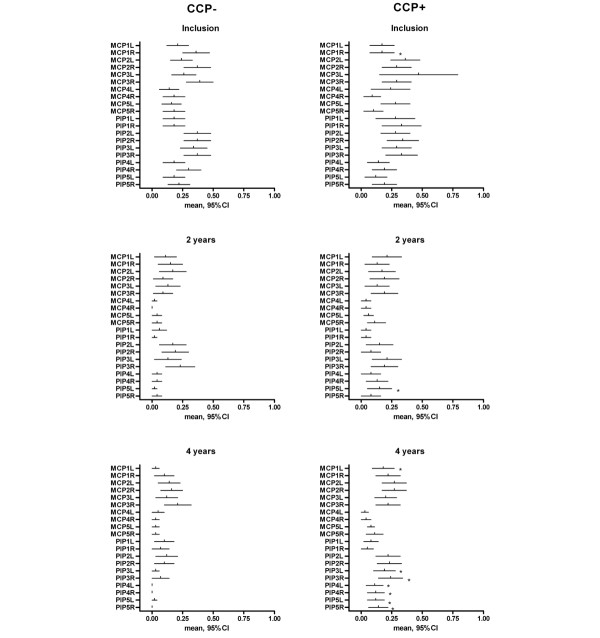
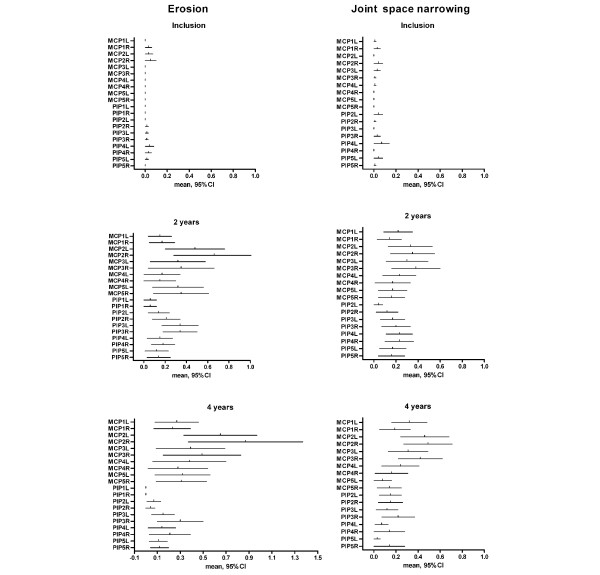
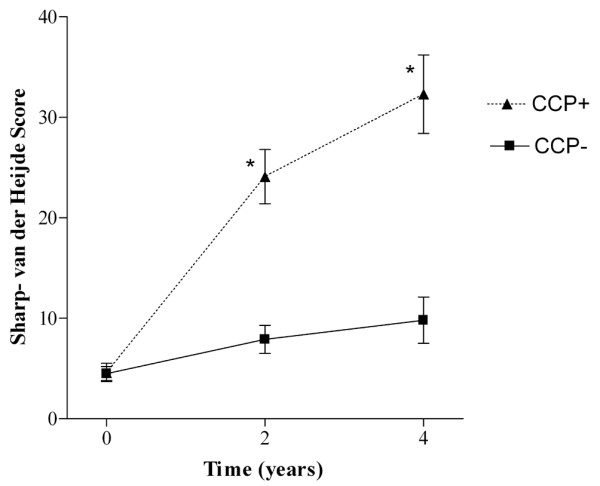
Antibodies to citrullinated proteins (anti-cyclic-citrullinated peptide [anti-CCP] antibodies) are highly specific for rheumatoid arthritis (RA) and precede the onset of disease symptoms, indicating a pathogenetic role for these antibodies in RA. We recently showed that distinct genetic risk factors are associated with either anti-CCP-positive disease or anti-CCP-negative disease. These data are important as they indicate that distinct pathogenic mechanisms are underlying anti-CCP-positive disease or anti-CCP-negative disease. Likewise, these observations raise the question of whether anti-CCP-positive RA and anti-CCP-negative RA are clinically different disease entities. We therefore investigated whether RA patients with anti-CCP antibodies have a different clinical presentation and disease course compared with patients without these autoantibodies. In a cohort of 454 incident patients with RA, 228 patients were anti-CCP-positive and 226 patients were anti-CCP-negative. The early symptoms, tender and swollen joint count, and C-reactive protein level at inclusion, as well as the swollen joint count and radiological destruction during 4 years of follow-up, were compared for the two groups. There were no differences in morning stiffness, type, location and distribution of early symptoms, patients' rated disease activity and C-reactive protein at inclusion between RA patients with and without anti-CCP antibodies. The mean tender and swollen joint count for the different joints at inclusion was similar. At follow-up, patients with anti-CCP antibodies had more swollen joints and more severe radiological destruction. Nevertheless, the distribution of affected joints, for swelling, bone erosions and joint space narrowing, was similar. In conclusion, the phenotype of RA patients with or without anti-CCP antibodies is similar with respect to clinical presentation but differs with respect to disease course.
瓜氨酸化蛋白抗体(抗环瓜氨酸肽[抗CCP]抗体)对类风湿关节炎(RA)具有高度特异性,且在疾病症状出现之前就已存在,这表明这些抗体在RA的发病机制中发挥作用。我们最近发现,不同的遗传风险因素与抗CCP阳性疾病或抗CCP阴性疾病相关。这些数据很重要,因为它们表明抗CCP阳性疾病和抗CCP阴性疾病存在不同的致病机制。同样,这些观察结果也提出了抗CCP阳性RA和抗CCP阴性RA在临床上是否为不同疾病实体的问题。因此,我们研究了与没有这些自身抗体的患者相比,具有抗CCP抗体的RA患者是否有不同的临床表现和疾病进程。在一组454例初发RA患者中,228例患者抗CCP阳性,226例患者抗CCP阴性。比较了两组患者的早期症状、压痛和肿胀关节计数、纳入时的C反应蛋白水平,以及随访4年期间的肿胀关节计数和放射学破坏情况。有抗CCP抗体和无抗CCP抗体的RA患者在晨僵、早期症状的类型、部位和分布、患者自评疾病活动度以及纳入时的C反应蛋白水平方面没有差异。纳入时不同关节的平均压痛和肿胀关节计数相似。在随访中,有抗CCP抗体的患者肿胀关节更多,放射学破坏更严重。然而,在肿胀、骨侵蚀和关节间隙变窄方面,受累关节的分布相似。总之,有或无抗CCP抗体的RA患者在临床表现方面相似,但在疾病进程方面有所不同。