Peper Martin, Klett Martin, Morgenstern Rudolf
Charité Universitätsmedizin Berlin, Institute of Pharmacology and Toxicology (CCM), Dorotheenstr. 94, 10117 Berlin, Germany.
Environ Health. 2005 Oct 19;4:22. doi: 10.1186/1476-069X-4-22.
Exposure to indoor air of private or public buildings contaminated with polychlorinated biphenyls (PCBs) has raised health concerns in long-term users. This exploratory neuropsychological group study investigated the potential adverse effects of chronic low-dose exposure to specific air-borne low chlorinated PCBs on well-being and behavioral measures in adult humans.
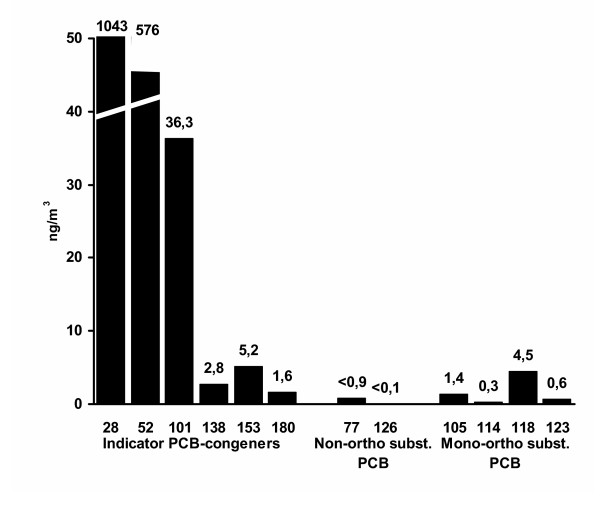
Thirty employees exposed to indoor air contaminated with PCBs from elastic sealants in a school building were compared to 30 non-exposed controls matched for education and age, controlling for gender (age range 37-61 years). PCB exposure was verified by external exposure data and biological monitoring (PCB 28, 101, 138, 153, 180). Subjective complaints, learning and memory, executive function, and visual-spatial function was assessed by standardized neuropsychological testing. Since exposure status depended on the use of contaminated rooms, an objectively exposed subgroup (N = 16; PCB 28 = 0.20 microg/l; weighted exposure duration 17.9 +/- 7 years) was identified and compared with 16 paired controls.
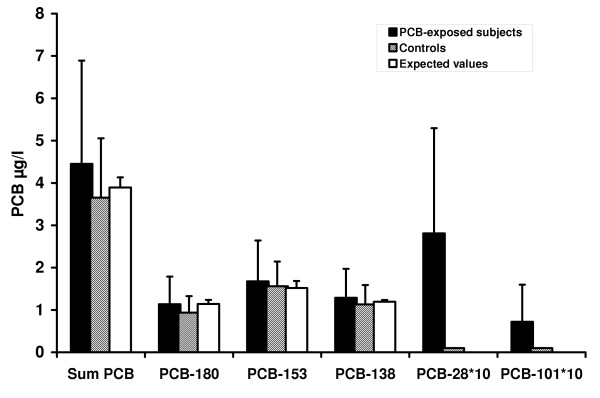
Blood analyses indicated a moderate exposure effect size (d) relative to expected background exposure for total PCB (4.45 +/- 2.44 microg/l; d = 0.4). A significant exposure effect was found for the low chlorinated PCBs 28 (0.28 +/- 0.25 microg/l; d = 1.5) and 101 (0.07 +/- 0.09 microg/l; d = 0.7). Although no neuropsychological effects exceeded the adjusted significance level, estimation statistics showed elevated effect sizes for several variables. The objectively exposed subgroup showed a trend towards increased subjective attentional and emotional complaints (tiredness and slowing of practical activities, emotional state) as well as attenuated attentional performance (response shifting and alertness in a cued reaction task).
Chronic inhalation of low chlorinated PCBs that involved elevated blood levels was associated with a subtle attenuation of emotional well-being and attentional function. Extended research is needed to replicate the potential long-term low PCB effects in a larger sample.
长期接触受多氯联苯(PCBs)污染的私人或公共建筑室内空气引发了人们对健康的担忧。这项探索性神经心理学群体研究调查了长期低剂量接触特定空气传播的低氯多氯联苯对成年人类幸福感和行为指标的潜在不良影响。
将30名在学校建筑中接触受弹性密封剂中多氯联苯污染的室内空气的员工与30名在教育程度和年龄上匹配的未接触对照组进行比较,并对性别进行了控制(年龄范围37 - 61岁)。通过外部暴露数据和生物监测(多氯联苯28、101、138、153、180)验证多氯联苯暴露情况。通过标准化神经心理学测试评估主观症状、学习和记忆、执行功能以及视觉空间功能。由于暴露状态取决于对受污染房间的使用情况,确定了一个客观暴露亚组(N = 16;多氯联苯28 = 0.20微克/升;加权暴露持续时间17.9 +/- 7年),并与16名配对对照组进行比较。
血液分析表明,相对于预期背景暴露,总多氯联苯的暴露效应大小适中(d)(4.45 +/- 2.44微克/升;d = 0.4)。发现低氯多氯联苯28(0.28 +/- 0.25微克/升;d = 1.5)和101(0.07 +/- 0.09微克/升;d = 0.7)有显著的暴露效应。尽管没有神经心理学效应超过调整后的显著性水平,但估计统计显示几个变量的效应大小有所升高。客观暴露亚组显示出主观注意力和情绪症状增加的趋势(疲劳和实际活动减慢、情绪状态)以及注意力表现减弱(线索反应任务中的反应转换和警觉性)。
长期吸入导致血液水平升高的低氯多氯联苯与情绪幸福感和注意力功能的轻微减弱有关。需要进行进一步研究以在更大样本中复制潜在的长期低多氯联苯效应。