Brandman Onn, Ferrell James E, Li Rong, Meyer Tobias
Department of Molecular Pharmacology, Stanford University School of Medicine, Stanford, CA, 94305, USA.
Science. 2005 Oct 21;310(5747):496-8. doi: 10.1126/science.1113834.
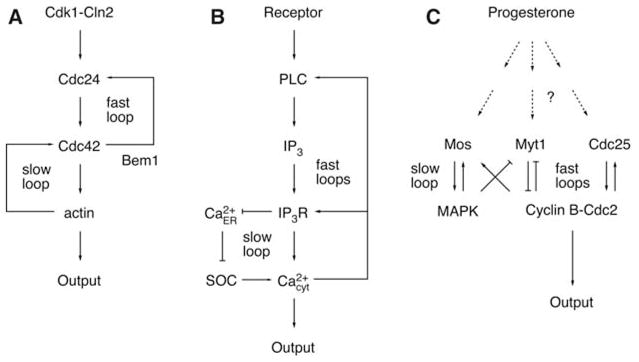
Positive feedback is a ubiquitous signal transduction motif that allows systems to convert graded inputs into decisive, all-or-none outputs. Here we investigate why the positive feedback switches that regulate polarization of budding yeast, calcium signaling, Xenopus oocyte maturation, and various other processes use multiple interlinked loops rather than single positive feedback loops. Mathematical simulations revealed that linking fast and slow positive feedback loops creates a "dual-time" switch that is both rapidly inducible and resistant to noise in the upstream signaling system.
正反馈是一种普遍存在的信号转导基序,它使系统能够将渐变输入转换为决定性的全或无输出。在此,我们研究了为何调控出芽酵母极化、钙信号传导、非洲爪蟾卵母细胞成熟及其他各种过程的正反馈开关使用多个相互关联的回路,而非单个正反馈回路。数学模拟表明,将快速和慢速正反馈回路相连接会产生一种“双时”开关,它既能快速诱导,又能抵抗上游信号系统中的噪声。