Veals S A, Schindler C, Leonard D, Fu X Y, Aebersold R, Darnell J E, Levy D E
Kaplan Comprehensive Cancer Center, NYU School of Medicine, New York 10016.
Mol Cell Biol. 1992 Aug;12(8):3315-24. doi: 10.1128/mcb.12.8.3315-3324.1992.
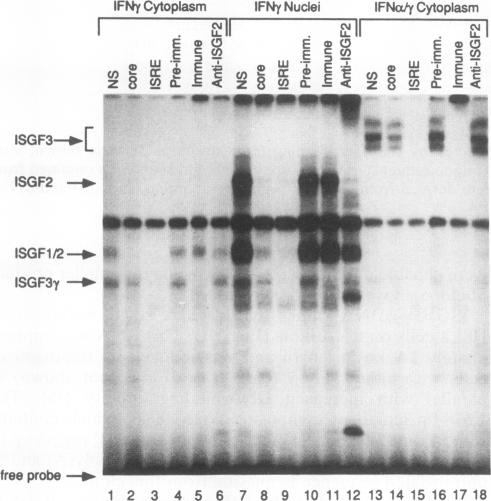
Alpha interferon stimulates transcription by converting the positive transcriptional regulator ISGF3 from a latent to an active form. This receptor-mediated event occurs in the cytoplasm, with subsequent translocation of the activated factor to the nucleus. ISGF3 has two components, termed ISGF3 alpha and ISGF3 gamma. ISGF3 gamma serves as the DNA recognition subunit, while ISGF3 alpha, which appears to consist of three polypeptides, is a target for alpha interferon signaling and serves as a regulatory component whose activation is required to form ISGF3. ISGF3 gamma DNA-binding activity was identified as a 48-kDa polypeptide, and partial amino acid sequence has allowed isolation of cDNA clones. ISGF3 gamma translated in vitro from recombinant clones bound DNA with a specificity indistinguishable from that of ISGF3 gamma purified from HeLa cells. Sequencing of ISGF3 gamma cDNA clones revealed significant similarity to the interferon regulatory factor (IRF) family of DNA binding proteins in the amino-terminal 117 residues of ISGF3 gamma. The other IRF family proteins bind DNA with a specificity related to but distinct from that of ISGF3 gamma. We note sequence similarities between the related regions of IRF family proteins and the imperfect tryptophan repeats which constitute the DNA-binding domain of the c-myb oncoprotein. These sequence similarities suggest that ISGF3 gamma and IRF proteins and the c-myb oncoprotein use a common structural motif for DNA recognition. Recombinant ISGF3 gamma, like the natural protein, interacted with HeLa cell ISGF3 alpha to form the mature ISGF3 DNA-binding complex. We suggest that other IRF family members may participate in signaling pathways by interacting with as yet unidentified regulatory subunits analogous to ISGF3 alpha.
α干扰素通过将正向转录调节因子ISGF3从潜伏形式转变为活性形式来刺激转录。这种受体介导的事件发生在细胞质中,随后活化因子转位至细胞核。ISGF3有两个组分,称为ISGF3α和ISGF3γ。ISGF3γ作为DNA识别亚基,而ISGF3α似乎由三种多肽组成,是α干扰素信号传导的靶点,并作为一种调节组分,其激活是形成ISGF3所必需的。ISGF3γ的DNA结合活性被鉴定为一种48 kDa的多肽,部分氨基酸序列已使得能够分离cDNA克隆。从重组克隆体外翻译的ISGF3γ与DNA结合,其特异性与从HeLa细胞纯化的ISGF3γ无法区分。ISGF3γ cDNA克隆的测序显示,在ISGF3γ的氨基末端117个残基中,与DNA结合蛋白的干扰素调节因子(IRF)家族有显著相似性。其他IRF家族蛋白以与ISGF3γ相关但不同的特异性结合DNA。我们注意到IRF家族蛋白的相关区域与构成c-myb癌蛋白DNA结合结构域的不完全色氨酸重复序列之间的序列相似性。这些序列相似性表明,ISGF3γ、IRF蛋白和c-myb癌蛋白使用共同的结构基序进行DNA识别。重组ISGF3γ与天然蛋白一样,与HeLa细胞ISGF3α相互作用,形成成熟的ISGF3 DNA结合复合物。我们认为,其他IRF家族成员可能通过与类似于ISGF3α的尚未鉴定的调节亚基相互作用而参与信号传导途径。