Dhingra Amit, Folta Kevin M
Horticultural Sciences Department, University of Florida, Gainesville, FL 32611, USA.
BMC Genomics. 2005 Dec 7;6:176. doi: 10.1186/1471-2164-6-176.
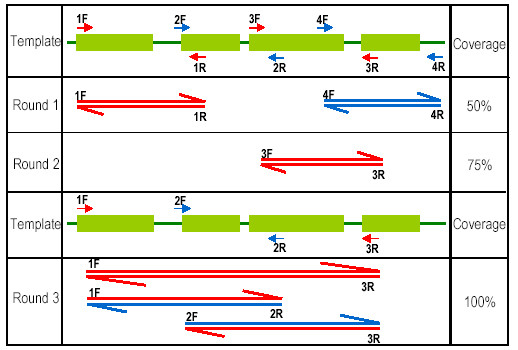
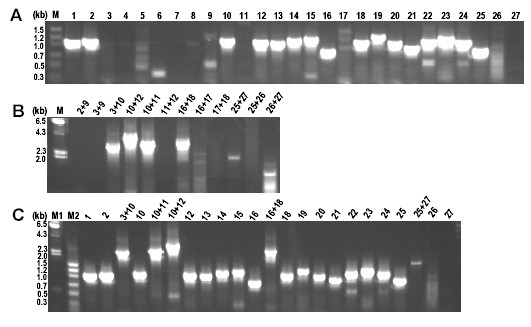
Availability of DNA sequence information is vital for pursuing structural, functional and comparative genomics studies in plastids. Traditionally, the first step in mining the valuable information within a chloroplast genome requires sequencing a chloroplast plasmid library or BAC clones. These activities involve complicated preparatory procedures like chloroplast DNA isolation or identification of the appropriate BAC clones to be sequenced. Rolling circle amplification (RCA) is being used currently to amplify the chloroplast genome from purified chloroplast DNA and the resulting products are sheared and cloned prior to sequencing. Herein we present a universal high-throughput, rapid PCR-based technique to amplify, sequence and assemble plastid genome sequence from diverse species in a short time and at reasonable cost from total plant DNA, using the large inverted repeat region from strawberry and peach as proof of concept. The method exploits the highly conserved coding regions or intergenic regions of plastid genes. Using an informatics approach, chloroplast DNA sequence information from 5 available eudicot plastomes was aligned to identify the most conserved regions. Cognate primer pairs were then designed to generate approximately 1 - 1.2 kb overlapping amplicons from the inverted repeat region in 14 diverse genera.
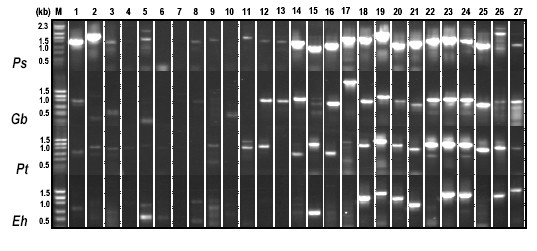
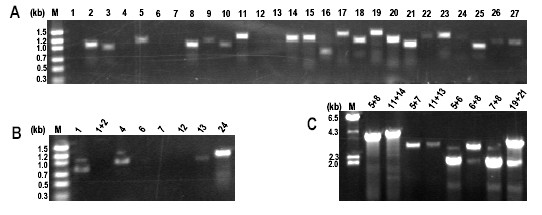
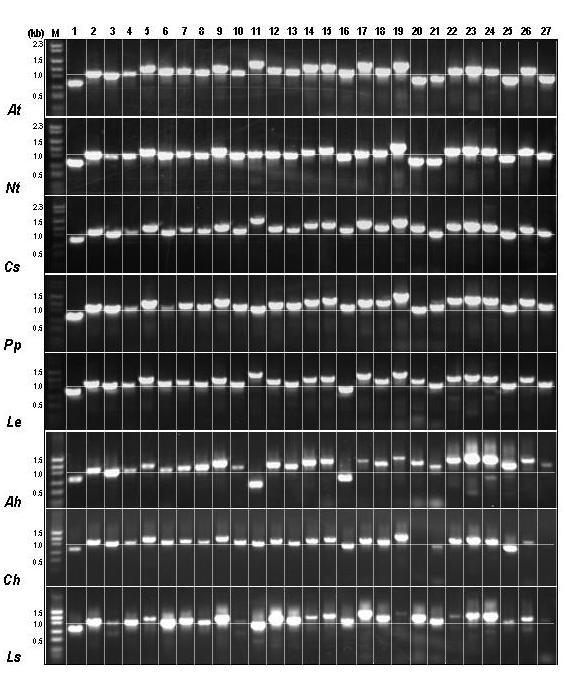
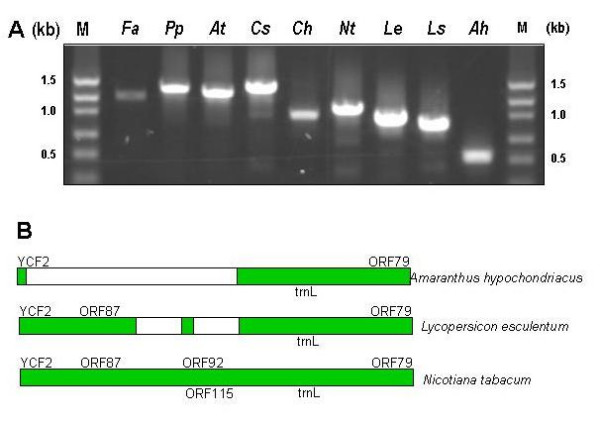
100% coverage of the inverted repeat region was obtained from Arabidopsis, tobacco, orange, strawberry, peach, lettuce, tomato and Amaranthus. Over 80% coverage was obtained from distant species, including Ginkgo, loblolly pine and Equisetum. Sequence from the inverted repeat region of strawberry and peach plastome was obtained, annotated and analyzed. Additionally, a polymorphic region identified from gel electrophoresis was sequenced from tomato and Amaranthus. Sequence analysis revealed large deletions in these species relative to tobacco plastome thus exhibiting the utility of this method for structural and comparative genomics studies.
This simple, inexpensive method now allows immediate access to plastid sequence, increasing experimental throughput and serving generally as a universal platform for plastid genome characterization. The method applies well to whole genome studies and speeds assessment of variability across species, making it a useful tool in plastid structural genomics.
DNA序列信息对于开展质体的结构、功能及比较基因组学研究至关重要。传统上,挖掘叶绿体基因组中有价值信息的第一步需要对叶绿体质粒文库或BAC克隆进行测序。这些操作涉及复杂的准备程序,如叶绿体DNA分离或鉴定合适的待测序BAC克隆。目前滚环扩增(RCA)被用于从纯化的叶绿体DNA中扩增叶绿体基因组,所得产物在测序前进行剪切和克隆。在此,我们展示一种通用的高通量、基于快速PCR的技术,该技术能以合理成本在短时间内从植物总DNA中扩增、测序并组装多种物种的质体基因组序列,以草莓和桃的大反向重复区域作为概念验证。该方法利用质体基因高度保守的编码区或基因间区域。采用信息学方法,将5个可用的真双子叶植物质体基因组的叶绿体DNA序列信息进行比对,以鉴定最保守的区域。然后设计同源引物对,从14个不同属的反向重复区域生成约1 - 1.2 kb的重叠扩增子。
从拟南芥、烟草、橙子、草莓、桃、生菜、番茄和苋属植物中获得了反向重复区域100%的覆盖度。从银杏、火炬松和木贼等远缘物种中获得了超过80%的覆盖度。获得了草莓和桃质体基因组反向重复区域的序列,并进行了注释和分析。此外,从凝胶电泳鉴定出的一个多态性区域对番茄和苋属植物进行了测序。序列分析显示,相对于烟草质体基因组,这些物种存在大片段缺失,从而展示了该方法在结构和比较基因组学研究中的实用性。
这种简单、廉价的方法现在能直接获取质体序列,提高了实验通量,并普遍作为质体基因组特征分析的通用平台。该方法适用于全基因组研究,加快了对物种间变异性的评估,使其成为质体结构基因组学中的有用工具。