Sankyo Co., Ltd., Bio-Science Research Laboratories, 1-2-58 Hiromachi, Shinagawa-ku, Tokyo 140, and Sankyo Co., Ltd., Tanashi Plant, Tanashi, Tokyo 188, Japan.
Appl Environ Microbiol. 1987 Jul;53(7):1504-11. doi: 10.1128/aem.53.7.1504-1511.1987.
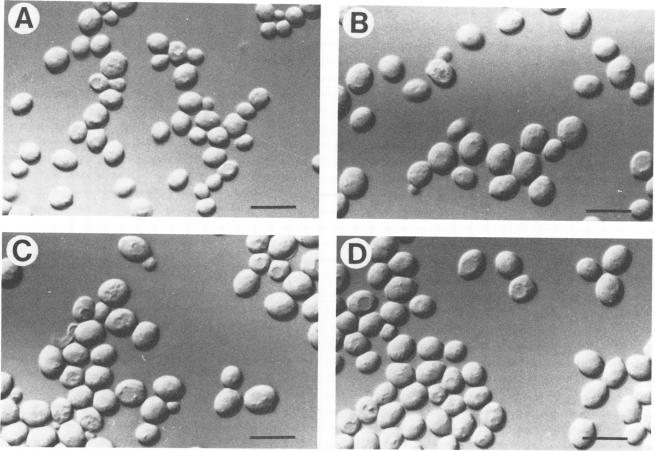
The yeast Torulaspora delbrueckii, which propagates as a haploid, was made into a diploid by treatment with dimethyl sulfoxide (DMSO) on the regeneration of protoplasts. The diploid state was stably inherited; the cell volume was three times that of the parent strain and the cellular DNA content was two times that of the parental strain. No essential difference was found between diploids induced by DMSO and those formed through intraspecific protoplast fusion. The diploid strains sporulated fairly well, with their cells converting directly into asci. Random spore analysis revealed that diploids induced through protoplast fusion gave rise to auxotrophic segregants (haploids) with the parental genetic marker or to segregants formed by recombination, while diploids induced by DMSO from a doubly auxotrophic parent gave rise to no recombinant, indicating that it was chromosomally homoallelic in nature. The magnesium level in the protoplast regeneration medium was found to be an important factor for inducing diploid formation. At 0.2 mM magnesium diploids appeared even in the absence of DMSO, while at 2 mM magnesium diploids never appeared unless DMSO was added to the regeneration medium. Evidence is provided that the diploids induced by DMSO or a low magnesium level are due to direct diploidization but not protoplast fusion. UV light irradiation of intact cells (without protoplasts), 10% of which survived, also produced diploids among this surviving population. From these results we conclude that the perturbation of protoplast regeneration or of cell division by the treatments mentioned above somehow induced direct diploidization of T. delbrueckii.
酵母属的德巴利毕赤酵母以单倍体形式繁殖,用二甲基亚砜(DMSO)处理原生质体后可转化为二倍体。二倍体状态稳定遗传;细胞体积是亲本菌株的三倍,细胞 DNA 含量是亲本菌株的两倍。用 DMSO 诱导的二倍体与通过种内原生质体融合形成的二倍体之间没有发现本质区别。二倍体菌株相当容易形成孢子,其细胞直接转化为子囊。随机孢子分析表明,通过原生质体融合诱导的二倍体产生了具有亲本遗传标记的营养缺陷型分离子(单倍体)或由重组形成的分离子,而从双营养缺陷型亲本通过 DMSO 诱导的二倍体没有产生重组子,表明其本质上是染色体同型等位的。发现原生质体再生培养基中的镁水平是诱导二倍体形成的一个重要因素。在 0.2mM 镁的情况下,即使没有 DMSO,二倍体也会出现,而在 2mM 镁的情况下,除非在再生培养基中添加 DMSO,否则二倍体不会出现。有证据表明,由 DMSO 或低镁水平诱导的二倍体是由于直接二倍体化而不是原生质体融合。对完整细胞(无原生质体)进行紫外线照射,其中 10%的细胞存活下来,在存活的细胞中也产生了二倍体。从这些结果我们得出结论,上述处理对原生质体再生或细胞分裂的干扰以某种方式诱导了德巴利毕赤酵母的直接二倍体化。